Skip to main content

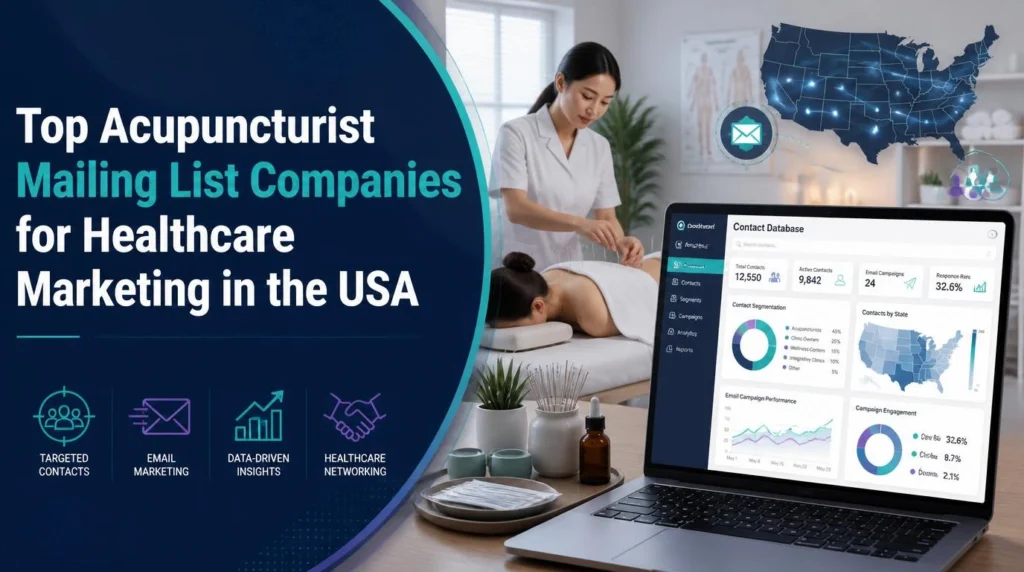
An Acupuncturists Email List can help healthcare businesses, medical suppliers, wellness brands, and healthcare marketers connect with professionals working in acupuncture and complementary care. Choosing a suitable mailing list provider requires evaluating contact accuracy, audience relevance, data transparency, and compliance with applicable marketing regulations.
This guide explores key factors to consider when comparing acupuncturist mailing list companies in the USA and explains how businesses can select a provider that aligns with their marketing goals.
Understanding Acupuncturist Mailing Lists
An acupuncturist mailing list is a database of contact information associated with professionals who provide acupuncture services. Depending on the provider, the database may include licensed acupuncturists, independent practitioners, clinic owners, wellness center managers, and professionals working in integrative healthcare facilities.
Businesses may use these databases to identify relevant professional audiences for product announcements, educational resources, event invitations, and business-to-business communication.
However, not every database offers the same level of detail or accuracy. Some focus on email addresses, while others provide additional information such as professional titles, practice locations, clinic names, and business contact details. Evaluating these differences is essential before choosing a provider.
Why Healthcare Businesses Use Acupuncturist Contact Lists
Acupuncture is used in a variety of complementary and integrative healthcare settings. Businesses offering relevant products or services may want to reach practitioners who could benefit from their solutions.
Common reasons for using a targeted contact database include:
- Healthcare product marketing: Introducing relevant equipment, clinic supplies, and practice-management products.
- Educational outreach: Sharing professional resources, research updates, webinars, and training opportunities.
- Business development: Identifying clinics and practitioners that may be interested in suitable services.
- Event promotion: Inviting professionals to industry conferences, educational sessions, and networking events.
- Market research: Gathering voluntary feedback from practitioners to understand professional needs and purchasing preferences.
- Partnership development: Identifying potential collaborators in complementary and integrative healthcare.
A contact list should support relevant communication rather than indiscriminate mass emailing. Businesses generally achieve better results when they understand their audience and tailor their messages to specific professional interests.
Top Acupuncturist Mailing List Companies for Healthcare Marketing in the USA
The market includes specialist healthcare data providers and broader B2B contact database companies. Their coverage, verification methods, pricing, and delivery formats can vary considerably. The following are companies worth evaluating during the research process, rather than a definitive ranking of verified list quality.
1. MedStream Data
MedStream Data offers healthcare-focused audience data and email list solutions for businesses targeting healthcare professionals. Its specialized healthcare focus makes it a potential starting point for marketers researching professional contact databases.
Businesses considering an acupuncturist database should confirm whether the provider currently offers coverage for licensed acupuncturists and what geographic, professional, and contact fields are available.
What to evaluate:
- Availability of an acupuncturist-specific database
- Coverage across US states and practice types
- Contact verification and update procedures
- Custom segmentation and data delivery options
- Replacement policies for invalid records
2. Data Axle
Data Axle provides business information and marketing data solutions for organizations seeking to identify and reach business audiences. Its broader business data capabilities may be relevant when a campaign targets acupuncture clinics as businesses rather than individual practitioners alone.
Before purchasing, ask whether the available data distinguishes acupuncture practices from general wellness businesses and whether practitioner-level contact details are included.
What to evaluate:
- Business-level coverage of acupuncture clinics
- Availability of professional contact information
- Geographic targeting capabilities
- Data licensing terms and permitted uses
- Options for ongoing data maintenance
3. Dun & Bradstreet
Dun & Bradstreet is known for business information and commercial data solutions. Companies looking to identify healthcare-related businesses may investigate its offerings when researching acupuncture clinics, wellness centers, and related organizations.
However, business records and individual professional email databases are not interchangeable. Buyers should confirm whether the product fits their intended audience and campaign requirements.
What to evaluate:
- Business identification and classification
- Practice-level information
- Available contact fields
- Data access and licensing conditions
- Suitability for small clinics and independent practices
4. ZoomInfo
ZoomInfo provides B2B intelligence and business contact data. It may be worth evaluating for campaigns aimed at organizations and professionals when the relevant records are available within its coverage.
For an acupuncturist-focused campaign, buyers should confirm how well the database represents small, independent practices, since coverage may differ from that of larger healthcare organizations.
What to evaluate:
- Practitioner and clinic coverage
- Professional role and company filters
- Contact verification processes
- Export and integration options
- Contract terms and minimum commitments
5. Apollo.io
Apollo.io offers B2B contact data and prospecting tools that help businesses identify potential customers and organize outreach activities. It may be suitable for marketers who want prospecting features alongside contact discovery.
The availability and accuracy of acupuncturist-specific records should be checked before committing to a subscription or campaign.
What to evaluate:
- Search filters for relevant professional categories
- Availability of US acupuncture practices
- Email verification features
- CRM and outreach integrations
- Usage limits and subscription terms
6. UpLead
UpLead provides B2B prospecting data and tools intended to help businesses find potential customers. It may be considered by organizations looking for a contact discovery workflow with verification features.
As with other general B2B platforms, users should verify that its records cover the precise type of acupuncture professional they want to reach.
What to evaluate:
- Professional and business search filters
- Email verification features
- Geographic coverage
- Data export options
- Credits, subscription limits, and refund conditions
7. Lusha
Lusha provides B2B contact and company information for prospecting. Businesses may investigate it when searching for professional contacts associated with healthcare or wellness organizations.
Its suitability depends on whether relevant acupuncturist records are available and whether the intended use complies with its terms and applicable privacy requirements.
What to evaluate:
- Availability of relevant healthcare contacts
- Professional role and company details
- Data accuracy and refresh practices
- Access limits and pricing
- Permitted outreach activities
8. Lead411
Lead411 offers B2B sales intelligence and contact data solutions. It may be relevant for teams that need prospecting information and tools to organize business outreach.
Businesses targeting acupuncture practices should confirm whether the database contains sufficiently detailed records for independent practitioners, small clinics, and wellness centers.
What to evaluate:
- Relevant industry and business filters
- Availability of contact information
- Verification and data refresh processes
- Integration with sales tools
- Contract and cancellation conditions
9. SalesIntel
SalesIntel provides B2B intelligence and contact data services. Organizations can investigate its solutions when researching professional audiences and potential business customers.
Before choosing it for an acupuncture campaign, buyers should ask for evidence of coverage within this particular professional category instead of assuming broad healthcare coverage guarantees specialist data availability.
What to evaluate:
- Coverage of small healthcare practices
- Contact research and verification methods
- Data freshness and update frequency
- Audience segmentation options
- Pricing and service requirements
10. Cognism
Cognism provides B2B sales intelligence and contact data solutions for organizations conducting prospecting and sales development. It may be worth considering for teams with broader business outreach requirements.
For a niche audience such as acupuncturists in the United States, the key question is whether its available records meet the campaign’s geographic and professional requirements.
What to evaluate:
- Relevant US professional contact coverage
- Data quality and compliance processes
- Available search and segmentation filters
- CRM compatibility
- Pricing and contractual terms
Important: The companies above operate in the business data or prospecting market, but their inclusion does not confirm that each currently sells a dedicated acupuncturist mailing list. Request a sample, product specification, and written confirmation of coverage before purchasing. Compare providers using the same criteria rather than relying on marketing claims alone.
How to Compare Acupuncturist Mailing List Providers
The most suitable provider depends on the campaign objective, target audience, budget, and level of data detail required. A low-cost database may not be useful if it contains outdated contacts or records unrelated to acupuncture.
| Evaluation factor | What to check before purchasing |
| Audience relevance | Whether records specifically cover acupuncturists, acupuncture clinics, or the intended professional category |
| Data accuracy | How email addresses and business details are verified |
| Data freshness | When records were last reviewed or updated |
| Geographic coverage | Whether the database covers the required states, cities, or regions |
| Contact fields | Whether it includes business emails, practice names, professional roles, and other necessary fields |
| Segmentation | Whether records can be filtered by location, practice type, or other relevant criteria |
| Compliance | Whether data collection, licensing, and proposed marketing uses meet applicable requirements |
| Pricing | Total cost, minimum order, subscription terms, and extra charges |
| Customer support | Availability of assistance, documentation, and issue resolution |
| Replacement policy | How invalid or duplicate records are handled under the provider’s written terms |
Key Features to Look for in an Acupuncturist Email Database
1. Relevant Professional Coverage
A database should match the audience a business intends to reach. For example, a company supplying acupuncture needles or treatment tables may need independent practitioners and clinic owners. A software company may be more interested in practice managers or administrators responsible for scheduling and billing.
Ask the provider to clarify how it classifies acupuncturists and whether the database distinguishes them from massage therapists, chiropractors, general wellness practitioners, and other healthcare professionals.
2. Accurate and Current Contact Information
Contact data can become outdated when practitioners change clinics, update business details, or stop using an email address. Outdated information can increase bounce rates and waste campaign resources.
Ask how often records are reviewed, whether email validation is available, and how the provider handles inaccurate data. A sample should be checked carefully, but remember that a small sample cannot guarantee the quality of the entire database.
3. Useful Segmentation Options
Segmentation allows marketers to organize contacts according to relevant characteristics. Depending on the database, possible filters may include:
- State or city
- Practice or clinic name
- Professional role
- Independent practice versus multi-location organization
- Business category
- Available professional contact fields
Only request fields that support a legitimate campaign purpose. More data is not automatically better if it does not improve audience relevance.
4. Transparent Data Sourcing
A reputable provider should explain the general origin of its data, its collection and update practices, the rights granted to the purchaser, and restrictions on use.
Ask whether the records are sourced from public business information, licensed data partners, direct research, or other methods. The provider should also explain what the purchase permits: one-time campaign use, ongoing access, CRM storage, or other activities.
Do not assume that purchasing a database automatically grants permission to send any type of marketing message.
How Healthcare Brands Can Use Acupuncturist Contact Data
When used appropriately, a targeted database can help businesses identify professional audiences for relevant communication.
Promote Relevant Products and Supplies
Manufacturers and distributors of acupuncture equipment, treatment supplies, clinic furniture, and practice accessories may use business contact information to identify potential professional customers.
Messages should explain how a product relates to a practice’s needs, provide accurate specifications, and avoid unsupported claims about health outcomes.
Share Educational Resources
Healthcare brands and professional education providers may want to share webinars, product training, industry updates, or other useful learning materials.
Educational outreach should be relevant to the recipient’s professional interests. A clear subject line and concise message can help recipients understand the purpose of the communication.
Introduce Practice Management Solutions
Software companies offering appointment scheduling, billing support, patient communication, or practice-management systems may research acupuncture clinics as potential business customers.
For these campaigns, clinic-level information and relevant business roles may be more useful than a general list of practitioner email addresses.
Invite Practitioners to Events
Industry events, demonstrations, and professional webinars can provide opportunities to connect with practitioners. Before sending invitations, businesses should ensure that the audience is relevant and that their communication practices comply with applicable rules.
Conduct Professional Market Research
Companies may use contact data to identify practitioners for surveys or interviews about business operations, product needs, and industry trends. Participation should be voluntary, and the purpose of the research should be clearly explained.
Best Practices for Email Outreach
Buying an appropriate database is only one part of a marketing campaign. The quality of the message, audience selection, timing, and follow-up process also influence results.
Personalize the message. Use relevant professional or business information where appropriate. Avoid making intrusive assumptions about an individual or their patients.
Keep communication relevant. A product announcement intended for clinic owners may not be useful to every practitioner. Segment contacts according to the campaign’s purpose.
Use clear sender information. Identify the business sending the message and provide accurate contact details.
Make opting out straightforward. Marketing recipients should have a clear and functional way to stop receiving further messages where required. Maintain suppression lists so opted-out contacts are not inadvertently contacted again.
Monitor campaign performance. Track delivery, bounce rates, replies, unsubscribes, and qualified business inquiries. These metrics help identify problems and improve future campaigns.
Avoid excessive follow-ups. Repeated messages can damage brand perception. Establish a reasonable follow-up schedule and stop when a recipient declines further contact.
Compliance Considerations for US Marketing Campaigns
Businesses purchasing contact databases should assess both the source of the data and the intended communication method. A vendor’s claim that a list is compliant does not remove the buyer’s responsibility to follow applicable laws and platform requirements.
In the United States, the CAN-SPAM Act establishes requirements for commercial email, including accurate header information, non-deceptive subject lines, identification and address requirements, and a functioning opt-out mechanism. Opt-out requests must be honored within the legally required period.
Additional privacy and consumer-protection rules may apply depending on the information involved, the business, the recipient, and the campaign. State laws and contractual obligations should also be reviewed where relevant.
Before launching a campaign:
- Review the provider’s data sourcing and licensing documentation.
- Confirm that the planned use is permitted by the provider’s terms.
- Use accurate sender details and honest subject lines.
- Include a valid business postal address where required.
- Provide an effective unsubscribe option.
- Maintain records of opt-out requests and other compliance actions.
- Review relevant legal requirements with qualified counsel when necessary.
Purchasing a list should not be treated as proof that every recipient has consented to every form of marketing. Where consent or another legal basis is required, verify that the campaign meets the applicable standard.
Common Mistakes to Avoid When Choosing a Provider
Selecting a Provider Based Only on Price
A low initial price can be misleading if the list contains outdated, duplicated, or irrelevant records. Compare the total cost with the quality and scope of the data being supplied.
Assuming All Healthcare Lists Are Specialized
A general healthcare database may include physicians, nurses, dentists, and other professionals without meaningful coverage of acupuncturists. Ask for explicit confirmation of the target category.
Ignoring the Sample Data
Review a sample for duplicate contacts, missing fields, incorrect business classifications, and outdated information. Ask whether the sample reflects the actual product you will receive.
Overlooking Contract Terms
Review minimum purchases, renewal conditions, data usage rights, cancellation policies, and remedies for inaccurate records. Keep written confirmation of important vendor commitments.
Sending the Same Message to Every Contact
Different professionals may have different responsibilities and interests. A campaign that recognizes these differences is more likely to be relevant than a generic message sent to an entire database.
Ignoring Campaign Feedback
High bounce rates, complaints, and opt-outs can indicate poor targeting or data quality. Review campaign results and pause outreach when there are signs of a problem.
How to Select the Right Provider for Your Business
Start by defining the campaign’s purpose. Decide whether you need independent acupuncturists, clinic owners, wellness centers, or another specific audience. Then establish the geographic area, essential contact fields, expected list size, and budget.
Next, shortlist providers that can demonstrate relevant coverage. Request sample records and documentation about sourcing, verification, update frequency, and permitted use. Compare the providers using consistent criteria and assess whether their contractual terms meet your requirements.
Finally, test the data carefully before scaling outreach. Begin with a limited, appropriately selected audience, monitor delivery and recipient feedback, and adjust your approach based on the results. A smaller, relevant database may be more useful than a much larger list with limited targeting or uncertain accuracy.
Conclusion
Choosing the right acupuncturist mailing list company requires more than comparing prices or the number of available records. Healthcare marketers should examine audience relevance, data accuracy, transparency, segmentation options, licensing terms, and compliance requirements before making a decision.
Companies such as MedStream Data, Data Axle, Dun & Bradstreet, ZoomInfo, Apollo.io, and other B2B data providers may be worth researching, but buyers should verify their current acupuncturist coverage rather than assume that every provider offers a dedicated database.
A well-selected Acupuncturists Mailing List can support focused professional outreach when the contacts are relevant, the communication offers genuine value, and the campaign follows applicable marketing rules. Careful vendor evaluation and ongoing performance monitoring help businesses make more informed decisions about their healthcare marketing activities.