Skip to main content

In B2B sales, timing plays an important role in influencing purchasing decisions. While sales teams often focus on contacting decision-makers early, approaching senior executives at the right stage can sometimes produce better results. A B2B Healthcare Email List can help sales and marketing teams identify relevant healthcare professionals and business leaders, but successful outreach also depends on understanding the buying process and the responsibilities of each stakeholder.
C-level executives, such as chief executive officers (CEOs), chief financial officers (CFOs), chief operating officers (COOs), and chief information officers (CIOs), typically oversee business strategy, financial planning, operational performance, and major investments. They may not participate in every early-stage product discussion, but their involvement can become essential when a purchasing decision requires executive approval.
Reaching these leaders later in the B2B sales cycle can be effective because sales teams may already understand the prospect’s needs, have demonstrated the solution’s value, and developed support among relevant stakeholders. However, this approach is not suitable for every sale. The ideal timing depends on the product, purchase value, organizational structure, and complexity of the decision.
This article explains why late-stage executive engagement can be beneficial, when it works best, and how businesses can approach C-level leaders without disrupting the buying process.
Understanding the B2B Sales Cycle
The B2B sales cycle is the series of steps a business follows when evaluating and purchasing products or services from another company. Unlike many consumer purchases, B2B transactions can involve several stakeholders, multiple approval stages, budget reviews, and detailed evaluations.
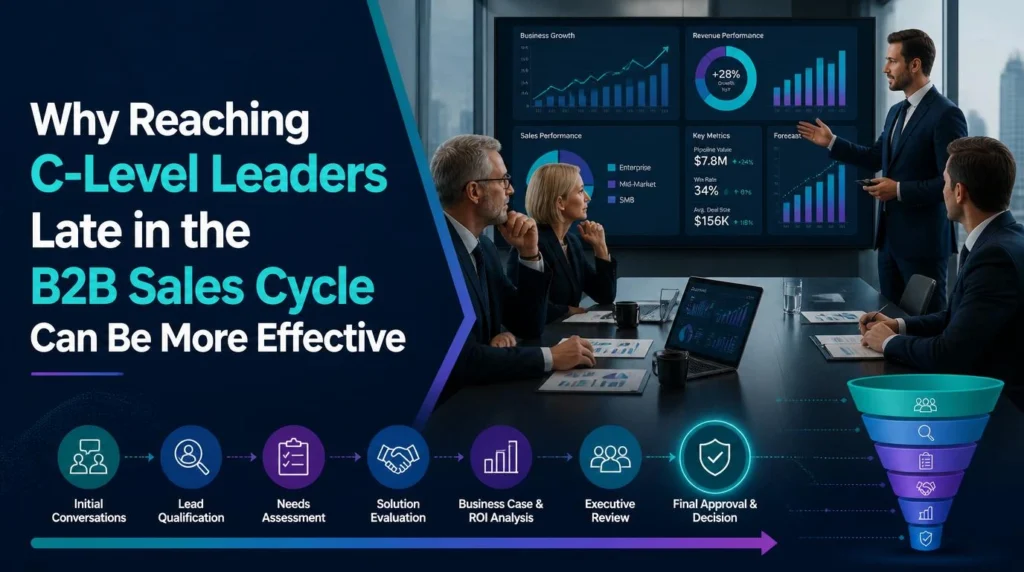
A typical B2B sales cycle includes the following stages:
- Awareness: The prospect recognizes a problem or business opportunity.
- Research: The organization explores possible solutions and vendors.
- Evaluation: Relevant teams compare product features, pricing, performance, and suitability.
- Validation: Stakeholders assess the solution’s practical, technical, financial, and operational value.
- Approval: Authorized decision-makers review the proposal and confirm whether the purchase should proceed.
- Purchase: The organization negotiates final terms and completes the transaction.
C-level executives may be involved at different points throughout this process. In smaller companies, executives might participate from the beginning. In larger organizations, department heads, procurement teams, technical specialists, and operational managers may conduct the initial evaluation before presenting a recommendation to senior leadership.
Understanding this structure helps sales professionals determine when executive involvement is most valuable.
1. Early-Stage Discussions Often Require Detailed Information
At the beginning of the buying process, prospective customers are usually trying to understand their problems and identify suitable solutions. They may want product demonstrations, technical specifications, implementation details, pricing information, and comparisons between vendors.
These discussions often require detailed knowledge of day-to-day operations. Department managers, technical teams, procurement specialists, and end users may therefore be better positioned to evaluate the solution during the initial stages.
For example, a healthcare organization considering a new patient management platform may first ask its IT department to assess integration requirements, data security, usability, and implementation complexity. A hospital administrator may also evaluate how the platform affects daily workflows.
A CEO may not need to attend every technical demonstration. However, the executive may eventually need to understand the business benefits, financial implications, and strategic relevance of the proposed investment.
By allowing operational stakeholders to conduct the initial evaluation, sales teams can build a stronger foundation before requesting executive attention.
2. Executive Time Is Limited
C-level leaders are responsible for high-level decisions that affect the overall organization. Their schedules may include financial reviews, strategic planning, investor discussions, operational meetings, risk management, and leadership responsibilities.
Contacting these executives too early with a broad product pitch can create unnecessary friction. If the sales representative has not yet established the prospect’s needs or demonstrated a clear business benefit, the executive may not have enough information to justify spending time on the discussion.
Late-stage outreach can be more productive because the sales team can present a focused proposal rather than a general introduction.
For example, instead of asking a hospital CEO to attend an introductory product demonstration, a sales representative might request a short meeting after the relevant departments have evaluated the solution. The discussion could focus on expected cost savings, operational improvements, implementation risks, and the investment required.
This approach respects executive time and makes the purpose of the meeting clear.
3. The Business Case Is More Developed
One of the main advantages of late-stage executive engagement is that the business case may be more complete.
Early discussions often establish whether a solution addresses a problem. Later discussions can explain how the solution contributes to measurable business objectives.
A well-developed business case may include:
- Expected financial benefits and total cost of ownership.
- Potential improvements in productivity and operational efficiency.
- Implementation timelines and resource requirements.
- Risks associated with adopting or delaying the solution.
- Alignment with organizational priorities.
- Relevant performance indicators for evaluating results.
Consider a healthcare technology company selling an analytics platform to a hospital network. The operational team may first evaluate the platform’s reporting features and integration capabilities. Once the evaluation is complete, the sales team can present the financial and strategic implications to senior leadership.
This allows the executive discussion to focus on a decision rather than basic product education.
However, sales teams should avoid presenting projected savings or performance improvements as guaranteed outcomes. Estimates should be supported by transparent assumptions, relevant evidence, and realistic implementation conditions.
4. Internal Stakeholder Support May Already Exist
Complex business-to-business transactions typically involve several stakeholders who contribute to the final purchasing decision. A purchasing decision may involve department managers, finance teams, IT professionals, procurement specialists, legal advisors, and executive leadership.
These stakeholders often have different priorities. Technical teams may focus on security and integration, while finance teams evaluate affordability and return on investment. Operational managers may prioritize usability and workflow improvements.
When sales teams engage these groups before approaching senior executives, they can identify concerns and develop a proposal that addresses the organization’s broader requirements.
By the time the opportunity reaches the executive level, relevant stakeholders may already understand the solution and support moving forward.
This internal support can help executives evaluate the proposal more efficiently. It also reduces the risk of introducing a solution that lacks operational acceptance.
Nevertheless, sales representatives should confirm that stakeholder support is genuine. A positive response from one department does not necessarily indicate agreement across the entire organization.
5. Late-Stage Outreach Can Address Strategic Priorities
C-level executives generally evaluate purchases in relation to wider organizational objectives. Their concerns may include revenue growth, cost control, risk reduction, competitive positioning, regulatory responsibilities, and long-term business performance.
A product that appears useful to an individual department may not automatically qualify as a strategic priority. Sales teams must explain how the proposed solution contributes to objectives that matter to senior leadership.
For example, a healthcare data provider might initially discuss contact accuracy, segmentation options, and database coverage with a marketing team. At the executive level, the conversation could focus on how better data management supports campaign efficiency, sales productivity, and customer acquisition.
Communication should be tailored to the recipient’s role, interests, and decision-making responsibilities. Operational stakeholders may need feature-level information, while executives often need a concise explanation of business value, investment requirements, and potential risks.
Engaging senior executives during the later stages helps connect the proposed solution’s evaluated benefits with the company’s long-term goals.
6. Financial Approval Becomes More Relevant
Significant B2B investments, ongoing service agreements, and long-term commitments often require approval from authorized financial decision-makers.
Although finance teams and department managers may assess budgets during earlier stages, final approval may rest with a CFO, CEO, or another authorized executive.
Contacting the appropriate leader when the proposal is sufficiently developed can help resolve outstanding questions about funding, financial priorities, and commercial terms.
For example, a hospital group evaluating a new healthcare software platform may have already confirmed its technical suitability. The remaining questions may concern licensing costs, implementation expenses, payment schedules, and the financial justification for the investment.
In this situation, an executive conversation can focus on the specific issues that affect approval.
Sales professionals should also understand that financial authority varies between organizations. Some companies delegate purchasing decisions to department heads, while others require multiple levels of approval. Identifying the actual approval process is more effective than assuming every C-level executive has the same responsibilities.
7. It Can Reduce Unnecessary Sales Discussions
Without a clear engagement strategy, sales teams may repeatedly explain the same product features to different stakeholders or approach executives before resolving basic concerns.
A structured sales process helps avoid these inefficiencies.
Before meeting with an executive, sales professionals should review the prospect’s needs, summarize evaluation findings, address outstanding concerns, and define the purpose of the discussion.
This preparation creates a more focused discussion and helps both parties use their time effectively.
Late-stage executive engagement can be particularly useful when:
- The prospect has completed an initial evaluation.
- Key stakeholders understand the proposed solution.
- The business case is supported by relevant information.
- Budgetary or strategic approval is the primary remaining obstacle.
- The executive has a defined role in the final decision.
It is less useful when the product is still being explored, the prospect’s needs remain unclear, or the executive is not involved in the approval process.
8. The Approach Can Strengthen Trust and Credibility
Senior executives generally expect business proposals to be relevant, concise, and supported by credible information. A poorly timed sales pitch can suggest that the representative has not researched the organization or understood its purchasing process.
By contrast, an informed approach demonstrates preparation.
Before contacting a C-level leader, sales professionals should understand the organization’s business model, strategic priorities, current challenges, and progress through the buying cycle. They should also know which stakeholders have evaluated the solution and what questions remain unresolved.
A credible executive message should explain why the conversation is relevant, summarize the potential business value, acknowledge important limitations, and propose a clear next step.
Trust also depends on respecting the prospect’s preferences. If an executive requests further information through the procurement team or prefers to remain outside early discussions, the sales representative should follow that process.
Late-stage engagement is not simply about contacting a powerful person at the last moment. It is about presenting the right information to the right stakeholder when it can support a meaningful decision.
9. Different C-Level Executives Have Different Priorities
Not every executive evaluates a purchase in the same way. Effective outreach requires matching the message to the leader’s responsibilities.
| Executive role | Primary areas of interest | Information to emphasize |
| CEO | Organizational growth, strategic planning, and competitive advantage. | Alignment with business objectives, expected organizational benefits, and potential risks. |
| CFO | Financial performance, budgets, investment decisions | Total cost, financial justification, expected return |
| COO | Operational efficiency, productivity, implementation | Workflow impact, resource needs, operational improvements |
| CIO | Technology strategy, systems, digital transformation | Integration, security, scalability, technical requirements |
| CMO | Marketing performance, customer acquisition, brand growth | Campaign effectiveness, audience quality, measurable marketing outcomes |
| CHRO | Workforce planning, employee experience, talent strategy | Workforce impact, adoption, training, organizational needs |
This table provides general guidance rather than a universal decision-making structure. Executive responsibilities vary by industry and organization size.
For example, a healthcare technology purchase may involve a CIO for technical evaluation, a COO for operational impact, and a CFO for financial approval. In some organizations, a chief medical information officer or another clinical leader may also be central to the decision.
Sales teams should identify the relevant decision-makers before beginning executive outreach.
10. Data-Driven Targeting Can Improve Executive Outreach
Reaching the right executive requires accurate information about the organization, the individual’s role, and the relevance of the proposed solution.
B2B sales and marketing teams may use professional databases, company websites, business directories, CRM records, and industry research to identify potential decision-makers. A well-maintained contact database can support segmentation by job title, industry, company size, location, and business function.
However, access to contact information does not guarantee a successful conversation. Sales teams must also determine whether the contact is relevant, whether the organization fits their target market, and whether the timing is appropriate.
Useful targeting practices include:
- Define the ideal customer profile: Identify the industries, company sizes, locations, and organizational characteristics most likely to benefit from the solution.
- Identify the buying committee: Determine which operational, technical, financial, and executive stakeholders participate in the purchase.
- Verify contact information: Review records for accuracy and update outdated job titles or company details.
- Segment by business relevance: Tailor messages to the recipient’s responsibilities and likely priorities.
- Coordinate with the sales team: Use CRM records to avoid duplicate outreach and track previous interactions.
- Respect applicable regulations: Follow relevant privacy, marketing, and data protection requirements when collecting and using business contact information.
Healthcare B2B marketers should be particularly careful when handling professional contact data. They should distinguish ordinary business contact information from sensitive personal or patient information and apply appropriate data protection practices.
11. Common Mistakes to Avoid When Contacting C-Level Leaders
Even well-timed executive outreach can fail when the message is poorly prepared. Sales teams should avoid several common mistakes.
Sending a generic pitch: Executives are more likely to consider a message when it connects to a recognizable business priority. Generic product descriptions rarely explain why the conversation matters.
Ignoring the buying committee: Contacting an executive without understanding the evaluation already completed by other teams can create confusion and undermine internal relationships.
Overstating expected results: Claims about revenue growth, cost savings, or performance improvements should be supported by credible evidence and clearly stated assumptions.
Requesting a meeting without a clear purpose: An executive should understand whether the meeting is intended to review financial justification, discuss strategic fit, resolve an approval concern, or agree on next steps.
Assuming the executive is always the final decision-maker: Some purchases are approved by procurement committees, department leaders, or delegated budget owners. The sales team should confirm the actual decision process.
Waiting too long: Late-stage outreach is not always better. If executive approval is needed to establish priorities or secure funding at the beginning, delaying contact may waste time and resources.
Avoiding these mistakes helps sales teams balance timing, relevance, and respect for the prospect’s internal process.
12. How to Plan an Effective Executive Outreach Strategy
A practical strategy should combine research, stakeholder engagement, business-case development, and a clear communication plan.
Step 1: Map the buying journey. Identify the stages the prospect follows, including research, technical evaluation, financial review, and approval.
Step 2: Identify decision-making authority. Determine who evaluates the solution, who controls the budget, and who has the authority to approve the purchase.
Step 3: Build relationships with relevant stakeholders. Engage operational and technical teams to understand requirements, concerns, and evaluation criteria.
Step 4: Prepare the business case. Summarize the problem, proposed solution, expected benefits, costs, risks, and implementation requirements.
Step 5: Select the right moment. Contact the executive when their input can advance the decision, whether that occurs early, midway through the process, or near final approval.
Step 6: Personalize the message. Explain the relevance of the proposal to the executive’s responsibilities and the organization’s priorities.
Step 7: Agree on next steps. Establish whether the prospect needs a financial review, an additional demonstration, a revised proposal, or a formal approval meeting.
Step 8: Measure results. Track meaningful indicators such as executive meeting acceptance, progression to the next sales stage, approval timelines, and qualified opportunity conversion.
These steps create a repeatable process while allowing sales teams to adapt their approach to each prospect.
Conclusion
Reaching C-level leaders late in the B2B sales cycle can be more effective when the organization has already evaluated the solution, relevant stakeholders understand its value, and the remaining questions concern strategy, financial approval, or business risk. This timing allows sales professionals to present a focused business case rather than an introductory product pitch.
However, late-stage outreach is not a universal rule. Some purchases require executive involvement from the beginning, while others can be approved by department managers or procurement teams. The most effective strategy depends on the buying committee, organizational structure, purchase complexity, and decision-making authority.
Accurate contact data, personalized communication, and a clear understanding of the prospect’s priorities can support this process. For healthcare marketers, a B2B Healthcare Mailing List can help identify relevant business contacts when used alongside appropriate segmentation, contact verification, and compliant outreach practices.
Ultimately, successful executive engagement depends less on contacting leaders at a fixed stage and more on reaching the right decision-maker with relevant information at the moment it can make a meaningful difference.