Skip to main content
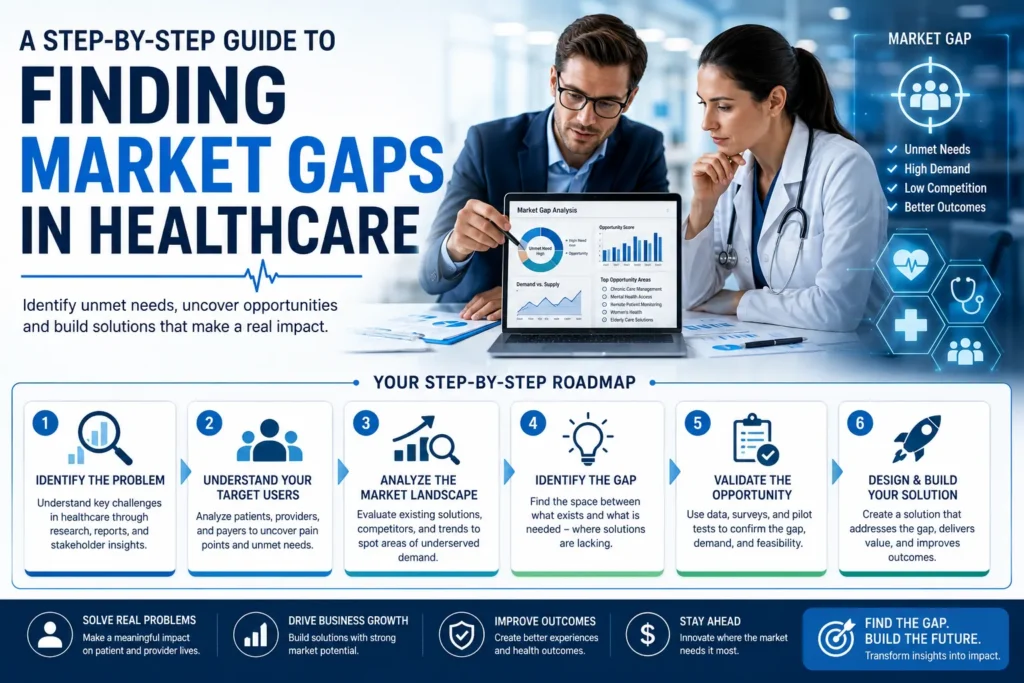
Finding untapped opportunities in healthcare requires more than intuition — it demands a structured, data-driven approach that puts patient and provider needs at the center of every decision.
Healthcare is one of the world’s most rapidly evolving and highly complex industries. Whether you are an entrepreneur, investor, or strategist, identifying market gaps can unlock significant growth opportunities. One of the biggest challenges is understanding where to search and how to properly evaluate the information available. This guide walks you through a practical, step-by-step process for discovering those gaps and building a foundation for meaningful healthcare solutions. To reach decision-makers quickly, many researchers also rely on Physicians Email Lists to gather direct insights from the professionals who experience these gaps firsthand.
Step 1: Understand the Healthcare Landscape
Before you can spot a gap, you need a clear picture of the terrain. Healthcare encompasses a wide range of sectors — pharmaceuticals, medical devices, digital health, diagnostics, insurance, elder care, mental health, and more. Each sub-sector has its own regulatory environment, stakeholder dynamics, and innovation cycle.
Begin by analyzing industry reports from trusted organizations such as the World Health Organization (WHO), the Centers for Disease Control and Prevention (CDC), and leading consulting firms like McKinsey and Deloitte. These documents often highlight emerging trends, funding patterns, and areas of persistent unmet need.
Pay particular attention to:
- Regulatory shifts that open new service windows
- Demographic shifts, including aging populations and the increasing prevalence of chronic illnesses, continue to drive changes across the healthcare industry.
- Technology adoption curves in telehealth, AI diagnostics, and remote monitoring
- Changing reimbursement policies may also create new financial opportunities, making solutions that were once impractical more affordable and sustainable.
Understanding the big picture prevents you from pursuing opportunities that look attractive in isolation but are structurally unfeasible.
Step 2: Define Your Target Segment
A market gap only matters if it affects a specific, reachable group of people. Healthcare markets are highly segmented — what matters to a rural general practitioner differs vastly from what concerns a hospital procurement officer or a health-conscious millennial consumer.
Narrow your focus by asking:
- Who is experiencing the problem? Patients, caregivers, providers, or payers?
- How large is this group? Is it a niche population or a broad demographic?
- What are their behaviors and expectations? Do they prefer in-person services or digital tools?
Segmentation allows you to allocate research resources efficiently and ensures that the gap you identify is commercially viable, not just theoretically interesting.
Step 3: Conduct Primary and Secondary Research
Research is the backbone of any gap analysis. A combination of primary and secondary methods gives you both depth and breadth.
Secondary research involves analyzing existing data — published studies, market reports, government databases, patent filings, and peer-reviewed journals. Look for recurring complaints, high readmission rates, treatment adherence failures, or regions with physician shortages. These are signals of systemic gaps.
Primary research means gathering fresh data directly from stakeholders. This includes:
- Patient surveys to understand unmet needs and frustrations
- Focus groups with caregivers or community health workers
- Interviews with healthcare administrators about operational pain points
- Direct outreach to clinicians through curated contact databases
Primary research tends to surface insights that no report captures. Speaking directly with frontline providers often reveals practical gaps — in workflow tools, communication systems, or patient follow-up — that data alone cannot expose.
Step 4: Analyze Competitor Offerings
Once you have a sense of where needs exist, examine how current players are addressing them. Competitive analysis in healthcare is not about copying rivals — it is about finding the spaces they have left uncovered.
Create a competitive matrix that compares existing products or services across key factors such as affordability, accessibility, usability, clinical effectiveness, and compatibility with existing healthcare systems.
Look for:
- Feature gaps — capabilities the market lacks entirely
- Geographic gaps — regions where quality services are absent
- Demographic gaps — populations that are systematically underserved
- Price gaps — quality solutions that are out of reach for certain payers
Do not overlook small or regional players. Sometimes a local healthcare startup has already identified a gap and validated it — studying their approach can sharpen your own strategy.
Step 5: Identify Underserved Patient and Provider Needs
This step is where research transforms into insight. Cross-reference everything you have gathered to identify patterns of unmet need. Some gaps will be obvious — a rural county with no mental health providers, for instance. Others will be subtle, such as the absence of a reliable tool for medication reconciliation during hospital discharge.
Categorize gaps by type:
- Access gaps — where services exist but populations cannot reach them
- Quality gaps — where services exist but outcomes are poor
- Awareness gaps — where solutions exist but adoption is low due to lack of knowledge
- Affordability gaps — where solutions are clinically effective but economically inaccessible
Each gap type demands a different solution approach, so correct classification matters greatly for downstream strategy.
Step 6: Validate Your Findings
Identifying a gap is not the same as confirming it is real, persistent, and addressable. Validation requires testing your hypothesis with the people who would benefit from a solution.
Methods for validation include:
- Small-scale pilot programs involving a limited group of patients or healthcare providers can help evaluate effectiveness, identify challenges, and refine solutions before wider implementation.
- Landing page tests to gauge interest in a proposed product or service
- Advisory boards composed of clinicians and patient advocates
- Prototype feedback sessions where potential users evaluate early-stage concepts
Validation also involves checking regulatory feasibility. Some healthcare gaps remain unfilled not because of disinterest but because of complex compliance requirements. Consult with legal and regulatory experts before committing significant resources.
Step 7: Map Gaps to Actionable Opportunities
The final step is converting validated gaps into a strategic roadmap. Not every gap is worth pursuing—prioritize based on market size, competitive intensity, regulatory complexity, and alignment with your organization’s capabilities.
Create a simple scoring matrix:
| Opportunity | Market Size | Competitive Gap | Regulatory Risk | Feasibility | Score |
| Rural telehealth | Large | High | Medium | High | 8/10 |
| AI-assisted triage | Large | Medium | High | Medium | 6/10 |
| Caregiver support tools | Medium | High | Low | High | 8/10 |
| Specialty drug access | Medium | Medium | High | Low | 5/10 |
This scoring approach brings objectivity to what is often an intuition-driven process and helps stakeholders align on priorities.
Conclusion
Finding market gaps in healthcare is a disciplined process that blends macro-level research with direct human insight. The steps outlined here—from landscape analysis to validation—provide a repeatable framework that any organization can apply regardless of size or specialty. Many of the most impactful innovations in healthcare come not from creating entirely new concepts, but from addressing everyday problems that millions of people experience without sufficient support.
For marketers and solution providers, maintaining an updated Physician Mailing List can serve as a strategic asset—enabling targeted outreach, primary research, and relationship-building with the clinical community that shapes healthcare demand. When you know where the gaps are and who holds the key to filling them, you are well positioned to make a lasting impact in one of the world’s most essential industries.