Skip to main content
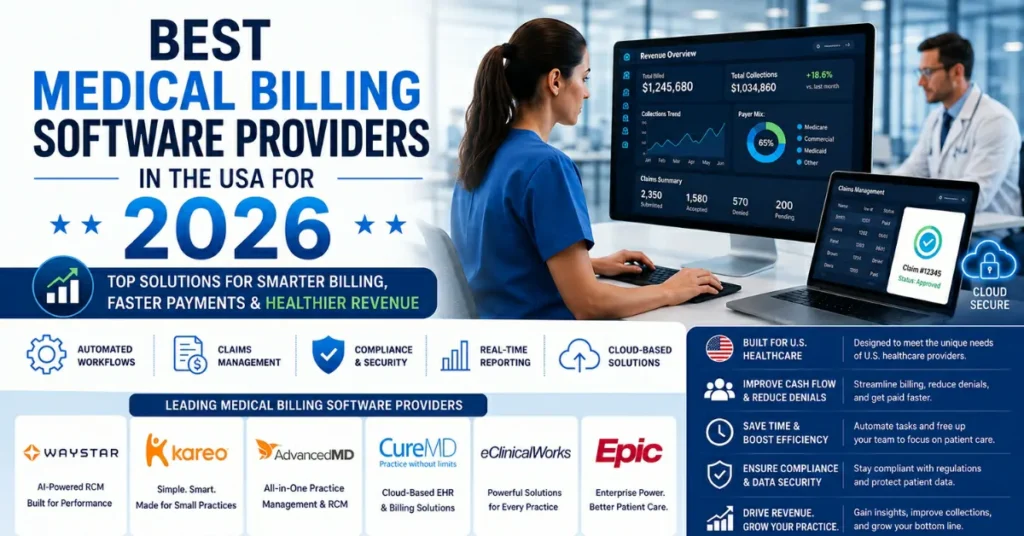
Managing medical billing in today’s healthcare landscape demands more than spreadsheets and manual claims submissions. From independent practices to large hospital networks, healthcare providers across the United States are turning to specialized billing software to reduce claim denials, accelerate reimbursements, and remain compliant with ever-changing payer regulations. Whether you’re a practice administrator, a billing specialist, or part of a Nurses Email Lists campaign targeting healthcare decision-makers, understanding the medical billing software market in 2026 is essential for making informed choices that impact both patient care and operational efficiency.
This comprehensive guide reviews the top medical billing software providers in the USA, breaking down their features, pricing models, ideal use cases, and what makes each platform stand out in a competitive market.
What Is Medical Billing Software?
Medical billing software is a digital platform that automates the process of submitting and following up on claims with health insurance companies to receive payment for services rendered by a healthcare provider. It typically integrates with Electronic Health Records (EHR) systems and practice management tools to create a seamless workflow from patient intake to final payment posting.
Modern solutions go far beyond simple claim generation. They include eligibility verification, denial management, real-time claim tracking, coding assistance (ICD-10, CPT, HCPCS), patient statement generation, and detailed financial reporting — all in one unified dashboard.
Why Upgrading Your Billing Software Matters in 2026
The healthcare revenue cycle is under increasing pressure in 2026. Several key drivers are pushing practices to reassess their billing infrastructure:
Rising claim denial rates: Industry data suggests that claim denial rates have climbed steadily, with some specialties experiencing denial rates above 15%. Outdated billing systems are a leading contributor.
CMS regulatory updates, including yearly changes to Medicare and Medicaid billing codes, fee schedules, and value-based care requirements, require software solutions that can adapt and update automatically.
Patient financial responsibility: With high-deductible health plans becoming the norm, practices need integrated patient billing and payment portal features to collect balances efficiently.
AI and automation adoption: Competitors are using AI-powered billing platforms to accelerate workflows and catch errors before claims are submitted — a significant competitive advantage.
Key Features to Look For
Before evaluating specific vendors, it helps to establish a baseline of must-have capabilities. The top medical billing software solutions in 2026 should provide:
- Automated eligibility verification — real-time insurance checks before appointments
- Claim scrubbing — pre-submission error detection to reduce denials
- ERA/EOB processing — automated posting of electronic remittance advice
- Multi-payer support — compatibility with Medicare, Medicaid, and commercial insurers
- ICD-10 and CPT coding tools — built-in code libraries with search and crosswalk functionality
- Patient payment portals — online bill pay with statement delivery
- Analytics and reporting — revenue cycle KPI dashboards
- EHR/EMR integration — bidirectional data sync with clinical systems
- HIPAA compliance — encryption, audit logs, and role-based access control
- Cloud-based architecture — remote access, automatic updates, and scalable infrastructure
Top Medical Billing Software Providers in the USA
1. Kareo (Tebra)
Best for: Small to mid-size independent practices
Kareo, now operating under the Tebra brand following its merger with PatientPop, remains one of the most widely recognized names in medical billing software for independent providers. The platform offers an end-to-end solution that combines practice management, EHR, billing, and patient engagement tools.
Standout features:
- Intuitive claim submission with built-in scrubbing
- Insurance eligibility verification in under 30 seconds
- Automated patient payment reminders via text and email
- Over 40 specialty-specific billing workflows
- Real-time financial performance dashboards
Pricing: Starts at approximately $110/month per provider; full platform bundles vary by module selection.
Who it suits: Solo practitioners and small group practices looking for an affordable, user-friendly platform with strong support resources.
2. AdvancedMD
Best for: Multi-specialty group practices
AdvancedMD is a comprehensive cloud-based practice management and billing solution built for practices that need enterprise-grade capabilities without enterprise pricing. The platform’s modular design allows organizations to adopt only the features they need, scaling as their workflows evolve.
Standout features:
- AI-assisted charge capture and coding suggestions
- Robust denial management with automated appeal workflows
- Customizable reporting with over 90 built-in reports
- Integrated telehealth billing support
- Native EHR and scheduling modules
Pricing: Custom pricing based on practice size and modules; generally positioned in the mid-to-premium range.
Who it suits: Larger independent practices and multi-location groups needing deep analytics and workflow customization.
3. Athenahealth (athenaOne)
Best for: Practices prioritizing network-driven insights
Athenahealth’s athenaOne platform stands apart due to its cloud-based, continuously updated rules engine. Rather than relying solely on in-house data, the platform uses insights drawn from across its national network of providers to improve claim acceptance rates and identify payer-specific denial patterns.
Standout features:
- Network-informed billing rules updated in real time
- Automated claims submission with payer-specific edits
- Robust patient engagement tools including portal and payment plans
- Population health management integration
- Strong performance guarantees backed by service-level agreements
Pricing: Percentage-based pricing model (typically 4–7% of collections); no large upfront fees.
Who it suits: Mid-size to large practices that prefer outcome-based pricing and value continuous platform updates from network data.
4. DrChrono
Best for: iPad-based and mobile-first practices
DrChrono is a cloud-based EHR and medical billing platform with a distinctive focus on mobile accessibility. Available natively on iPad and iPhone, it enables providers to document, charge, and track billing from anywhere — a major advantage for house-call providers, urgent care clinics, and concierge medicine practices.
Standout features:
- iPad-native EHR and charge capture
- Built-in medical billing service option (outsourced billing)
- Real-time eligibility and benefits verification
- Customizable clinical and billing workflows
- Marketplace integrations with major lab and imaging systems
Pricing: Tiered plans ranging from free (basic EHR) to advanced billing packages starting around $199/month.
Who it suits: Mobile-oriented practices, urgent care centers, and providers who want the option to outsource billing entirely.
5. Epic Systems (EpicCare)
Best for: Large health systems and hospital networks
Epic is the dominant EHR and billing platform for large hospitals and integrated health systems in the United States. Its billing module — part of the broader EpicCare suite — is designed for enterprise-scale revenue cycle management with thousands of concurrent users and complex payer contracting.
Standout features:
- End-to-end revenue cycle from pre-registration to payment posting
- Advanced contract management and underpayment detection
- Integrated clinical documentation reducing charge lag
- Patient financial counseling and financial assistance screening
- Interoperability with external systems via HL7/FHIR standards
Pricing: Enterprise licensing; implementation costs typically range from $1M to $200M+ depending on organization size.
Who it suits: Academic medical centers, large health systems, and multi-hospital networks where deep integration with clinical workflows is a priority.
6. CureMD
Best for: Specialty practices and behavioral health
CureMD is a cloud-based EHR and billing platform that has built a strong reputation among specialty providers including cardiology, dermatology, orthopedics, and behavioral health. Its specialty-specific templates and billing workflows reduce the customization burden that often plagues generic platforms when used in niche clinical settings.
Standout features:
- Specialty-specific charge capture templates
- Behavioral health billing with telehealth support
- Automated prior authorization tracking
- Revenue cycle analytics with benchmark comparisons
- Patient kiosk and digital intake forms
Pricing: Starting around $195/month per provider; additional modules priced separately.
Who it suits: Specialty clinics and behavioral health practices needing tailored documentation and billing tools.
7. Waystar
Best for: Revenue cycle management at scale
Waystar is a healthcare payments platform specifically focused on revenue cycle optimization. Unlike full EHR-integrated suites, Waystar positions itself as a best-of-breed billing and claims solution that integrates with existing EHRs — making it ideal for organizations that already have a clinical documentation system but want superior billing performance.
Standout features:
- AI-powered claim routing and denial prediction
- Unified platform across professional and institutional billing
- Charity care and patient assistance screening
- Integrated prior authorization automation
- Payer intelligence with historical denial trend analysis
Pricing: Enterprise pricing; contact vendor for quotes based on claim volume.
Who it suits: Hospital billing departments, large physician groups, and revenue cycle outsourcing companies.
Comparison Table: Top Providers at a Glance
| Provider | Best For | Pricing Model | EHR Included | AI Features | Cloud-Based |
| Kareo (Tebra) | Small/independent practices | Per provider/month | Yes | Basic | Yes |
| AdvancedMD | Multi-specialty groups | Custom/modular | Yes | Moderate | Yes |
| Athenahealth | Network-driven practices | % of collections | Yes | Strong | Yes |
| DrChrono | Mobile-first practices | Tiered/month | Yes | Moderate | Yes |
| Epic Systems | Large health systems | Enterprise license | Yes | Advanced | Yes |
| CureMD | Specialty/behavioral health | Per provider/month | Yes | Moderate | Yes |
| Waystar | High-volume billing | Enterprise | No (integrates) | Advanced | Yes |
How to Select the Best Software for Your Medical Practice
With so many capable platforms available, the right choice ultimately depends on your organization’s size, specialty, technical resources, and strategic priorities. Below are the key factors you should consider when selecting the right software for your practice:
Practice size and complexity: Solo providers and small groups generally benefit most from all-in-one platforms like Kareo or DrChrono, which minimize IT overhead. Larger organizations should evaluate platforms like AdvancedMD or Athenahealth that offer more sophisticated workflow customization.
Specialty requirements: If you operate in a specialized field — behavioral health, cardiology, oncology — prioritize platforms with proven specialty templates and billing rule sets. CureMD and AdvancedMD are both highly effective solutions for specialty healthcare environments.
Budget and pricing model: Percentage-based pricing (like Athenahealth’s model) can be financially advantageous for newer practices with modest collections, while established high-volume practices may prefer flat-rate or volume-tiered models.
Integration requirements are also an important consideration. If your practice already uses an existing EHR system, a specialized billing platform like Waystar may provide better efficiency and performance than transitioning to an entirely new all-in-one clinical management suite.
Support and training: Evaluate the quality and availability of customer support, especially during the implementation phase. Look for vendors offering onboarding assistance, live support hours, and a robust knowledge base.
Compliance and security: Confirm that any vendor you consider maintains current HIPAA compliance certifications and SOC 2 Type II audits and offers data encryption at rest and in transit.
Conclusion
Medical billing software has evolved from a back-office administrative tool into a strategic asset that directly influences an organization’s financial health, compliance posture, and patient satisfaction levels. As the U.S. healthcare system continues to shift toward value-based care and digital-first patient experiences in 2026, choosing the right billing platform is more consequential than ever.
The software providers highlighted in this guide—from Kareo’s user-friendly solutions for small practices to Epic’s enterprise-level capabilities and Waystar’s AI-powered accuracy—each deliver unique advantages based on different operational needs and practice requirements. Whether you’re part of a growing independent practice, a specialty clinic, or a large health system looking to optimize your revenue cycle, there is a purpose-built solution on this list worth exploring.
For healthcare marketers and outreach professionals, including those building campaigns through a Nurses Mailing List or other HCP-targeted databases, understanding the software landscape your audience operates within helps sharpen messaging, identify decision-makers, and deliver value-driven content that resonates.
The bottom line: take time to audit your current billing workflow, identify your biggest revenue cycle pain points, and request demos from two or three vendors that align with your practice size and specialty. Most providers on this list offer free trials or consultative demos — there’s no reason not to evaluate your options thoroughly before committing.