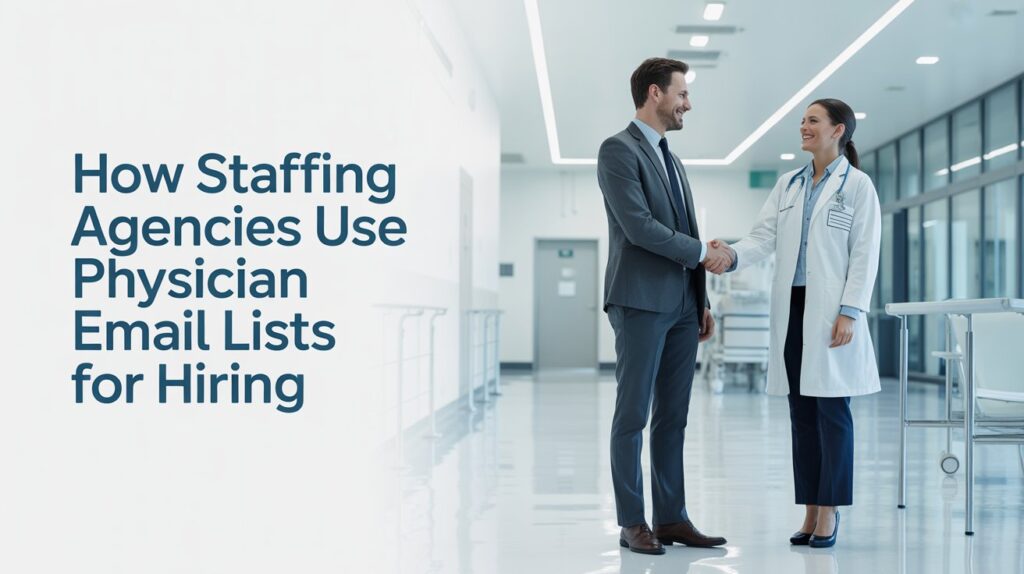
Recruiting qualified physicians has become increasingly competitive in today’s healthcare landscape. Staffing agencies play a critical role in bridging the gap between healthcare providers and medical professionals by using data-driven outreach strategies.
One of the most effective tools in modern recruitment is Physician Email Lists, which allow staffing agencies to connect directly with targeted candidates. By leveraging these lists strategically, agencies can streamline hiring, improve response rates, and build long-term relationships with physicians.
This blog explores how staffing agencies use physician email databases for hiring, the benefits they offer, and best practices to maximize results.
What Are Physician Email Lists?
Physician email lists are curated databases containing contact information of licensed medical professionals. These lists typically include:
- Full name
- Email address
- Specialty (e.g., cardiology, oncology)
- Geographic location
- Years of experience
- Practice type (hospital, clinic, private practice)
Staffing agencies rely on these lists to reach physicians directly with job opportunities, contract roles, and career updates.
Why Staffing Agencies Rely on Email Lists
1. Direct Access to Qualified Candidates
Unlike third-party platforms such as job boards or social media networks, email lists provide unfiltered and direct communication with physicians. This level of access is critical in a market where many top candidates are not actively searching for jobs.
With email lists, recruiters can:
- Engage passive candidates: Many experienced physicians are open to opportunities but do not actively browse job portals. Email allows agencies to bring opportunities directly to their inbox.
- Bypass platform limitations: Job boards often rely on algorithms that limit visibility unless additional fees are paid. Email removes these restrictions entirely.
- Establish one-to-one communication: Recruiters can tailor messages based on a physician’s specialty, career stage, and preferences, creating a more meaningful interaction.
Additionally, direct access enables agencies to build long-term relationships, rather than relying on one-time applications. Over time, this relationship-driven approach leads to higher trust and better placement outcomes.
2. Faster Recruitment Cycles
Speed is a defining factor in healthcare staffing, especially when hospitals need to fill urgent roles such as emergency physicians or specialists in underserved areas.
Email campaigns significantly accelerate the hiring process by:
- Instantly distributing job openings: A single email blast can notify thousands of physicians within seconds.
- Enabling real-time responses: Interested candidates can reply immediately, reducing delays in communication.
- Supporting automated workflows: Follow-up emails, reminders, and application confirmations can be automated, minimizing manual effort.
Faster communication translates into shorter time-to-fill metrics, which is a key performance indicator for staffing agencies. In urgent scenarios, this speed can directly impact patient care by ensuring that positions are filled without delay.
3. Cost-Effective Outreach
Recruitment marketing can be expensive, particularly when relying on paid advertising, job board subscriptions, or in-person events. Email marketing offers a high return on investment (ROI) compared to these traditional methods.
Key cost advantages include:
- Low distribution cost: Sending emails to large databases incurs minimal incremental expense.
- Reduced dependency on paid platforms: Agencies can avoid recurring fees associated with job postings or sponsored ads.
- Higher conversion rates: Targeted email campaigns often yield better engagement, reducing the cost per hire.
Moreover, email campaigns can be continuously optimized using performance data, ensuring that every dollar spent contributes to improved results. This makes email lists especially valuable for agencies operating with tight marketing budgets.
4. Targeted Communication Through Segmentation
One of the most powerful aspects of email lists is the ability to segment audiences and deliver highly relevant content. In healthcare recruitment, relevance is crucial because physicians have specialized skills and preferences.
Segmentation allows agencies to categorize contacts based on:
- Medical specialty: For example, cardiologists, neurologists, or general practitioners
- Geographic location: City, state, or region-specific targeting
- Experience level: Residents, mid-career professionals, or senior consultants
- Availability and job preferences: Full-time, part-time, locum tenens, or telehealth roles
By leveraging segmentation, agencies can:
- Increase engagement rates: Physicians are more likely to open and respond to emails that match their expertise and interests.
- Reduce email fatigue: Sending only relevant opportunities prevents recipients from feeling overwhelmed or disengaged.
- Improve candidate matching: Better alignment between job requirements and candidate profiles leads to higher placement success rates.
Advanced segmentation can also incorporate behavioral data, such as past email interactions or application history, enabling data-driven personalization at scale.
5. Measurable Performance and Continuous Optimization
Another major advantage of email lists is the ability to track and analyze campaign performance in real time. Staffing agencies can monitor key metrics such as:
- Open rates
- Click-through rates
- Response rates
- Conversion rates (applications or placements)
These insights allow recruiters to:
- Identify which job roles generate the most interest
- Optimize subject lines and messaging
- Adjust targeting strategies for better results
This data-driven approach ensures that recruitment campaigns become more effective over time, leading to continuous improvement in hiring outcomes.
6. Relationship Building and Employer Branding
Email is not just a transactional tool—it is also a powerful channel for nurturing relationships with physicians. Staffing agencies can use email lists to:
- Share industry insights and trends
- Provide career advice and resources
- Highlight employer benefits and workplace culture
Consistent communication helps agencies stay top-of-mind, so when physicians are ready to make a career move, they are more likely to engage with a familiar and trusted recruiter.
7. Scalability and Flexibility
As staffing agencies grow, their recruitment needs become more complex. Email lists offer unmatched scalability, allowing agencies to:
- Expand outreach to new regions or specialties
- Launch multiple campaigns simultaneously
- Adapt messaging بسرعة based on market demand
Whether hiring for a single urgent role or conducting large-scale recruitment campaigns, email lists provide the flexibility needed to meet diverse hiring goals.
How Staffing Agencies Use Physician Email Lists
1. Promoting Job Opportunities
The primary use of email lists is to promote open positions. Staffing agencies send:
- Permanent job openings
- Locum tenens opportunities
- Telehealth roles
- Contract-based assignments
These emails often include job descriptions, benefits, and application links.
2. Building Talent Pipelines
Instead of hiring reactively, agencies use email lists to build long-term talent pipelines. By regularly engaging physicians, they:
- Maintain relationships
- Keep candidates informed
- Create a pool of ready-to-hire professionals
3. Personalized Outreach Campaigns
Personalization significantly improves response rates. Agencies customize emails by:
- Addressing physicians by name
- Referencing their specialty
- Suggesting relevant opportunities
4. Geographic Targeting
Location-based hiring is crucial in healthcare. Email lists allow agencies to:
- Target physicians in specific regions
- Promote relocation opportunities
- Fill rural or underserved area roles
5. Promoting Employer Branding
Staffing agencies also use email campaigns to showcase:
- Hospital culture
- Work-life balance
- Compensation packages
- Career growth opportunities
This helps attract top-tier talent.
6. Re-engaging Passive Candidates
Not all physicians are actively job hunting. Email lists help agencies re-engage passive candidates by:
- Sharing industry insights
- Sending career tips
- Highlighting exclusive roles
Key Benefits of Using Physician Email Lists
Improved Hiring Efficiency
Email campaigns reduce the time spent sourcing candidates manually.
Higher Response Rates
Targeted messaging leads to better engagement and conversions.
Scalable Recruitment
Agencies can reach thousands of physicians simultaneously.
Better Candidate Matching
Segmentation ensures the right candidates receive the right opportunities.
Traditional Recruitment vs Email List-Based Recruitment
| Factor | Traditional Recruitment | Email List-Based Recruitment |
| Reach | Limited | Large-scale outreach |
| Speed | Slow | Fast and instant |
| Cost | High | Cost-effective |
| Personalization | Minimal | Highly customizable |
| Candidate Engagement | Low | High |
| Scalability | Limited | Easily scalable |
Best Practices for Using Physician Email Lists
1. Segment Your Audience
Divide your email list based on:
- Specialty
- Location
- Experience level
This ensures more relevant and effective communication.
2. Craft Compelling Subject Lines
Subject lines determine whether an email is opened. Use:
- Clear job titles
- Urgency (e.g., “Immediate Opening”)
- Personalization
3. Focus on Value
Instead of generic messages, highlight:
- Competitive salaries
- Flexible schedules
- Career growth
4. Optimize for Mobile
Many physicians check emails on mobile devices. Ensure:
- Responsive design
- Short paragraphs
- Clear call-to-action buttons
5. Maintain Compliance
Ensure compliance with email regulations such as:
- CAN-SPAM Act
- GDPR (if applicable)
Always include:
- Opt-out options
- Accurate sender information
6. Track and Analyze Performance
Use analytics to measure:
- Open rates
- Click-through rates
- Conversion rates
This helps refine future campaigns.
Challenges and How to Overcome Them
Data Accuracy
Outdated email lists can reduce effectiveness.
Solution:
Regularly update and verify your database.
Low Engagement Rates
Generic emails often go unnoticed.
Solution:
Use personalization and targeted messaging.
Compliance Risks
Improper email practices can lead to legal issues.
Solution:
Follow all email marketing regulations.
Future Trends in Physician Recruitment
AI-Driven Personalization
Artificial intelligence will enable hyper-personalized email campaigns.
Automation
Automated workflows will streamline communication and follow-ups.
Data Integration
Combining email lists with CRM systems will improve candidate tracking.
Conclusion
Staffing agencies are transforming healthcare recruitment by leveraging data-driven strategies. Email marketing, supported by a well-segmented database, allows agencies to connect directly with qualified physicians, reduce hiring timelines, and improve overall efficiency.
By implementing best practices such as personalization, segmentation, and compliance, staffing agencies can maximize the potential of their outreach efforts. As competition for healthcare talent continues to grow, adopting advanced email strategies will be essential for success.
Ultimately, a well-maintained Physician Mailing List serves as a powerful asset for staffing agencies, enabling them to build strong candidate relationships and achieve long-term hiring goals.