Skip to main content

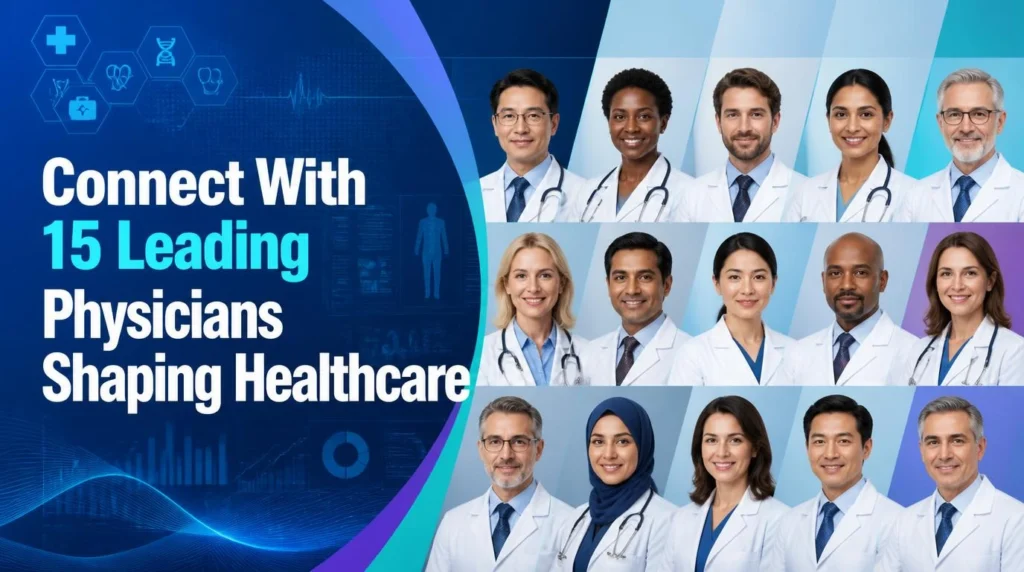
Healthcare continues to evolve through advances in medical research, digital health, artificial intelligence, public health, and patient-centered care. A Physicians Email List can help healthcare organizations, researchers, marketers, and industry professionals understand and reach physician audiences across specialties.
At the same time, some physicians have become influential beyond their individual clinical practices. Their work in medicine, research, healthcare leadership, technology, education, and public communication is helping shape how healthcare develops.
This article highlights 15 physicians whose work provides useful perspectives on the changing healthcare landscape. The list is not intended as a ranking. Instead, it brings together physicians recognized for contributions across different areas of healthcare.
What Is Shaping Healthcare Today?
The healthcare industry is experiencing several major changes simultaneously. Artificial intelligence is increasingly being evaluated for clinical applications, healthcare organizations are exploring new models of care, and researchers continue to develop treatments for complex diseases.
Physician leaders are often positioned at the intersection of these changes because they understand both the clinical environment and the operational challenges faced by healthcare organizations.
According to the American Medical Association, physician leaders are increasingly involved in areas such as technology adoption, workforce development, new care models, access, quality, and patient outcomes.
The following physicians represent different approaches to influencing healthcare.
1. Atul Gawande, MD
Atul Gawande is a surgeon, writer, researcher, and public-health leader known for connecting clinical medicine with healthcare-system improvement.
His work has frequently examined how healthcare organizations can improve quality and reduce preventable problems through better systems and processes. His books and research have also made complex healthcare topics more accessible to broader audiences.
Gawande’s influence extends beyond surgery because his work addresses how healthcare is organized and delivered. His perspective is particularly relevant to organizations interested in patient safety, healthcare quality, global health, and system-level improvement.
His combination of clinical experience, research, writing, and public-health work illustrates how physicians can influence healthcare beyond traditional patient care.
2. Eric Topol, MD
Eric Topol is a cardiologist and researcher whose work focuses heavily on digital medicine, artificial intelligence, medical technology, and the future of clinical practice.
He has become one of the prominent physician voices examining how AI could change diagnosis, medical research, and healthcare delivery. His approach generally emphasizes evaluating technology through scientific evidence rather than assuming that every new technology will automatically improve healthcare.
For healthcare professionals and organizations following digital transformation, Topol provides an important perspective on the relationship between physicians and emerging technologies.
His work also raises an important question for the industry: how can technology support physicians while maintaining clinical judgment and patient trust?
3. Vivek Murthy, MD, MBA
Vivek Murthy is a physician and former U.S. Surgeon General whose work has focused on public health, prevention, mental health, social connection, and health communication.
His public-health career demonstrated the importance of communicating medical information to audiences outside traditional healthcare settings. Rather than focusing only on clinical treatment, his work has addressed broader factors that influence population health.
Physicians working in public-health leadership have an opportunity to translate scientific evidence into information that communities can understand and use.
Murthy’s career is an example of how medical expertise can contribute to national conversations around prevention, mental health, health policy, and community well-being.
4. Ashish Jha, MD, MPH
Ashish Jha is a physician, public-health researcher, and healthcare leader whose work spans epidemiology, health policy, healthcare delivery, and public communication.
He became widely recognized for his role in communicating evidence during the COVID-19 pandemic and has continued to participate in discussions surrounding public health and healthcare policy.
Jha’s career demonstrates the increasingly connected roles of clinical medicine, epidemiology, research, and policy.
For healthcare organizations, his work highlights the importance of physicians who can interpret research and communicate its implications to policymakers, healthcare professionals, and the public.
5. Sanjay Gupta, MD
Sanjay Gupta is a neurosurgeon and medical communicator who has played a prominent role in bringing medical information to general audiences.
His work demonstrates how physicians can contribute to public understanding of health through journalism, television, writing, and education.
Medical communication has become particularly important as consumers encounter large amounts of health information online. Physicians who can explain complex topics in accessible language can help audiences distinguish between evidence-based information and unsupported claims.
Gupta’s career therefore represents another dimension of healthcare influence: communication.
6. Vin Gupta, MD
Vin Gupta is a physician with experience spanning pulmonary medicine, public health, healthcare technology, and medical communication.
His career illustrates how physicians can operate across multiple healthcare environments. Clinical experience can provide a valuable foundation for understanding the challenges faced by healthcare systems, technology companies, policymakers, and patients.
Physicians with experience in both clinical and organizational environments can help connect healthcare innovation with practical medical needs.
This is increasingly relevant as healthcare organizations explore AI, data-driven decision-making, remote care, and other technology-enabled models.
7. Abraham Verghese, MD
Abraham Verghese is a physician, educator, and author recognized for his work emphasizing the human side of medicine.
His perspective is particularly relevant at a time when healthcare is becoming increasingly technology-driven. While digital tools can improve efficiency and provide clinicians with new information, the relationship between physicians and patients remains central to healthcare.
Verghese’s work emphasizes the value of listening, physical examination, clinical reasoning, and human connection.
His contribution provides an important counterbalance to technology-focused discussions. Healthcare innovation is not only about new tools; it is also about preserving meaningful patient relationships.
8. Siddhartha Mukherjee, MD
Siddhartha Mukherjee is a physician, researcher, and author whose work has helped bring complex medical science to a broad audience.
His writing has explored cancer, genetics, medicine, and scientific discovery. By translating complicated research into understandable narratives, he has helped readers appreciate both the possibilities and limitations of modern medicine.
His career demonstrates the role physicians can play in science communication.
For healthcare organizations, researchers, and consumers, effective communication can make complex medical developments easier to understand while maintaining appropriate scientific context.
9. Peter J. Hotez, MD, PhD
Peter Hotez is a physician-scientist known for his work in vaccines, neglected tropical diseases, global health, and science communication.
His career demonstrates the connection between medical research and population health. Vaccine development and infectious-disease research can have implications that extend far beyond individual clinical encounters.
Hotez has also been an active public communicator on vaccines and infectious diseases.
His work illustrates why physician researchers can have influence across clinical medicine, scientific research, public health, and health education.
10. Leana Wen, MD, MSc
Leana Wen is an emergency physician, public-health expert, author, and health communicator.
Her professional work has included emergency medicine, public health leadership, healthcare policy, and communication with general audiences.
Emergency physicians often encounter patients at critical points in the healthcare system, giving them a unique perspective on access, prevention, treatment, and system capacity.
Wen’s career illustrates how clinical experience can inform broader discussions about healthcare policy and public health.
11. Robert M. Wachter, MD
Robert Wachter is a physician, professor, and healthcare leader recognized for his work in hospital medicine and digital health.
He has also contributed significantly to discussions about electronic health records, healthcare technology, patient safety, and the changing role of physicians.
As hospitals continue to adopt digital systems, physicians like Wachter provide an important perspective on how technology affects clinical workflows.
Technology can improve information access and coordination, but implementation must also consider usability, physician workload, patient experience, and clinical safety.
12. Ezekiel J. Emanuel, MD, PhD
Ezekiel Emanuel is an oncologist, health-policy researcher, and academic whose work covers healthcare policy, medical ethics, economics, and healthcare delivery.
His work demonstrates how physicians can contribute to questions that extend beyond individual treatment decisions.
Healthcare systems must constantly make decisions involving cost, access, quality, resource allocation, and innovation. Physicians with expertise in policy and ethics can contribute clinical perspectives to these discussions.
Emanuel’s career illustrates the intersection between medicine and healthcare policy.
13. Danielle Ofri, MD, PhD
Danielle Ofri is an internist, writer, and educator known for exploring the human experience of medicine.
Her work examines communication, medical uncertainty, physician-patient relationships, and the emotional dimensions of clinical practice.
These topics are increasingly relevant as healthcare organizations attempt to improve patient experience while physicians face growing administrative and technological demands.
Ofri’s perspective reinforces an important principle: healthcare quality cannot be evaluated solely through technology, efficiency, or clinical measurements. Communication and trust also influence the patient experience.
14. Kiran Musunuru, MD, PhD
Kiran Musunuru is a physician-scientist whose work focuses on genetics, cardiovascular disease, and gene editing.
Genetic medicine is one of the areas with potential to significantly change how certain diseases are diagnosed and treated. The development of individualized genetic therapies has demonstrated how advances in molecular biology can move toward clinical applications.
TIME’s 2026 TIME100 Health coverage highlighted the administration of a customized CRISPR gene therapy for a baby with a genetic disease, illustrating the broader movement toward highly personalized medicine.
Musunuru’s work represents the growing connection between genetics, research, and clinical medicine.
15. Maria Ansari, MD, FACC
Maria Ansari is a cardiologist and healthcare executive who has held senior leadership roles within the Permanente healthcare system.
Her work has included areas such as value-based care, clinical quality, operational performance, physician workforce development, and healthcare innovation.
In 2026, Ansari was recognized by Modern Healthcare among its 50 Most Influential Clinical Executives. Her recognition reflected work involving patient care, value-based care, operational efficiency, clinician wellness, and workforce development.
Her career represents another important form of physician leadership: combining clinical knowledge with large-scale healthcare-system management.
15 Physicians at a Glance
The physicians discussed above represent different specialties, career paths, and areas of influence. Some focus primarily on clinical medicine, while others work in research, healthcare leadership, public health, communication, or technology.
| Physician | Primary Area of Influence | Healthcare Focus |
| Atul Gawande, MD | Surgery & health systems | Quality, safety, global health |
| Eric Topol, MD | Cardiology & research | AI, digital health, technology |
| Vivek Murthy, MD | Public health | Prevention, mental health, communication |
| Ashish Jha, MD | Public health | Epidemiology, policy, health communication |
| Sanjay Gupta, MD | Neurosurgery | Medical communication |
| Vin Gupta, MD | Pulmonary medicine | Public health, technology |
| Abraham Verghese, MD | Internal medicine | Patient-centered care, medical education |
| Siddhartha Mukherjee, MD | Oncology & research | Cancer, genetics, science communication |
| Peter Hotez, MD, PhD | Infectious disease | Vaccines, global health |
| Leana Wen, MD | Emergency medicine | Public health, healthcare policy |
| Robert Wachter, MD | Internal medicine | Digital health, patient safety |
| Ezekiel Emanuel, MD, PhD | Oncology & policy | Healthcare policy, ethics |
| Danielle Ofri, MD, PhD | Internal medicine | Communication, patient experience |
| Kiran Musunuru, MD, PhD | Genetics & cardiology | Gene editing, precision medicine |
| Maria Ansari, MD, FACC | Cardiology & leadership | Value-based care, innovation |
What Can We Learn From These Physician Leaders?
Although their specialties and careers differ, several common themes emerge from their work.
1. Technology Needs Clinical Context
Artificial intelligence, digital health platforms, electronic records, and data analytics are becoming increasingly important in healthcare.
However, technology alone does not determine whether a healthcare solution is useful. Physicians understand clinical workflows, patient needs, and practical barriers that may not be obvious from a technology-focused perspective.
The American Medical Association has similarly highlighted that AI and other technologies are only part of the broader changes affecting healthcare. Successful transformation also depends on access, quality, value, and trust.
2. Research Continues to Drive Change
Many healthcare advances begin with research before eventually reaching clinical practice.
Cancer research, genetics, vaccines, cardiovascular medicine, and precision medicine demonstrate how scientific discoveries can gradually become practical healthcare solutions.
Physician-scientists play an important role in connecting laboratory research with real-world medical applications.
3. Communication Is a Healthcare Skill
Several physicians on this list have influenced healthcare through writing, journalism, public speaking, education, or digital communication.
Healthcare information can be difficult for consumers to interpret. Physicians who communicate clearly can help explain medical developments while maintaining appropriate context.
This is particularly important in an environment where consumers have access to enormous amounts of health-related information online.
4. Patient Experience Remains Important
Healthcare innovation is sometimes discussed primarily in terms of technology and efficiency.
However, patient experience remains a fundamental part of healthcare. Communication, trust, accessibility, continuity, and compassion can influence how patients experience medical care.
Physician leaders who focus on these factors demonstrate that innovation does not necessarily mean replacing traditional elements of medicine. In many cases, it means finding better ways to support them.
5. Healthcare Leadership Is Becoming Multidisciplinary
Modern physician leadership can involve much more than managing a medical department.
Physicians may participate in research, technology development, healthcare policy, business strategy, public health, education, or organizational transformation.
This broader role can help healthcare organizations make decisions that balance clinical requirements with operational and patient needs.
Why Physician Networks Matter to Healthcare Organizations
Understanding influential physicians is useful not only for following healthcare trends. Organizations working in healthcare may also need to communicate with physicians for legitimate professional purposes.
Healthcare technology companies may seek physician feedback on products. Medical education organizations may communicate information about educational opportunities. Researchers may need appropriate professional outreach. Healthcare recruiters may communicate career opportunities.
Similarly, pharmaceutical, medical-device, and healthcare service organizations may need to identify relevant professional audiences for business-to-business communication.
In these situations, organizations should focus on relevance, transparency, data accuracy, and responsible communication rather than simply pursuing the largest possible contact database.
A well-structured physician database can potentially allow organizations to segment audiences according to specialty, geography, professional role, organization type, and other appropriate business criteria.
How Physician Data Can Support Targeted Outreach
A professional physician database may contain information such as specialty, job title, organization, location, professional contact information, and other business-relevant attributes.
Segmentation can make outreach more relevant.
For example, a medical-device company developing cardiology equipment may have different communication requirements from a healthcare software company targeting hospital administrators.
Instead of sending the same message to every physician, organizations can develop campaigns around specific professional audiences.
Some common segmentation approaches include:
- Medical specialty
- Geographic location
- Practice or organization type
- Professional role
- Healthcare facility
- Clinical area
- Seniority or decision-making role
- Business application
- Research or educational interests
The quality of the data is important because outdated or inaccurate information can reduce campaign efficiency and create poor experiences for recipients.
Responsible Physician Outreach
Healthcare organizations should approach physician communication responsibly.
Professional outreach should be relevant to the recipient’s role and should provide clear information about the organization sending the communication.
Organizations should also consider applicable privacy, email marketing, data protection, and professional communication requirements before launching campaigns.
A physician contact database should not be viewed simply as a collection of email addresses. Its value depends on the relevance, accuracy, context, and responsible use of the underlying information.
The Future of Physician Leadership
The healthcare environment is likely to continue changing rapidly.
Artificial intelligence may influence clinical decision support and medical administration. Precision medicine may enable more individualized treatments. Remote and digital care models may expand access in certain settings. At the same time, healthcare organizations will continue dealing with workforce pressures, rising costs, access challenges, and patient expectations.
Physicians will remain important participants in these developments because they understand the realities of clinical care.
The strongest healthcare innovations are unlikely to come from technology or medicine operating independently. Instead, progress will often require collaboration between physicians, researchers, technology companies, healthcare organizations, policymakers, and patients.
Recent healthcare leadership coverage reflects this broader trend, with physician leaders increasingly involved in technology adoption, new care models, workforce strategy, patient access, and quality improvement.
Frequently Asked Questions
Who are some physicians shaping modern healthcare?
Physicians such as Atul Gawande, Eric Topol, Vivek Murthy, Ashish Jha, Sanjay Gupta, Vin Gupta, Abraham Verghese, Siddhartha Mukherjee, Peter Hotez, Leana Wen, Robert Wachter, Ezekiel Emanuel, Danielle Ofri, Kiran Musunuru, and Maria Ansari have contributed to different areas of medicine, research, public health, communication, technology, or healthcare leadership.
Why are physician leaders important to healthcare innovation?
Physicians understand clinical workflows, patient needs, treatment decisions, and challenges that occur in real healthcare environments. Their involvement can help ensure that innovations are practical and aligned with clinical requirements.
How is artificial intelligence changing healthcare?
AI is being explored across areas such as clinical decision support, medical imaging, administrative processes, research, and personalized medicine. However, healthcare leaders emphasize that technology should support measurable improvements in outcomes, access, value, and trust.
Why is physician communication important?
Medical information can be complex and difficult for consumers to interpret. Physician communication can help translate research and healthcare developments into information that is easier for patients and professionals to understand.
What should organizations consider when contacting physicians?
Organizations should prioritize relevance, accurate professional information, transparent communication, and compliance with applicable privacy and marketing requirements. Segmentation can also help ensure that physicians receive information appropriate to their professional roles.
Can physician databases support B2B healthcare marketing?
Yes. Professionally maintained databases can support B2B activities such as healthcare technology outreach, medical recruitment, professional education, research communication, and business development when used responsibly and in accordance with applicable requirements.
Conclusion
The 15 physicians highlighted in this article demonstrate the many ways medical professionals can influence the future of healthcare. Their contributions span clinical practice, research, public health, technology, education, communication, genetics, healthcare policy, and organizational leadership.
Their work also shows that healthcare transformation is not driven by one discipline alone. Meaningful progress often comes from collaboration between physicians, researchers, healthcare organizations, technology companies, policymakers, and patients.
For organizations communicating with healthcare professionals, understanding physician specialties and professional roles is equally important. A relevant and accurately segmented Physicians mailing List can support more focused B2B communication when used responsibly.
Ultimately, the future of healthcare will depend not only on new technologies and treatments but also on the physicians and healthcare professionals who evaluate, implement, communicate, and improve them.