Skip to main content
Chief Medical Officers (CMOs) play a critical role in shaping the future of healthcare by leading clinical strategy, improving patient outcomes, and driving innovation across healthcare organizations. As the industry evolves with new technologies, value-based care models, and changing patient expectations, CMOs are at the forefront of ensuring high-quality, efficient, and accessible care.
For healthcare marketers, providers, and industry stakeholders, staying connected with these influential leaders is essential, and Physicians Email Lists can help facilitate meaningful engagement with key decision-makers. Understanding the impact and leadership of today’s top CMOs offers valuable insight into the trends, challenges, and opportunities transforming modern healthcare delivery.
What Is a Chief Medical Officer (CMO)?
A chief medical officer—often abbreviated as CMO—is one of the most senior clinical executives within a healthcare organization. The role sits at the intersection of medicine and management, requiring individuals who are equally at home in an operating room or boardroom. CMOs are responsible for overseeing clinical operations, ensuring regulatory compliance, maintaining patient safety standards, and guiding evidence-based practices across their organizations.
While the title may vary — some organizations use “Chief Clinical Officer” or “Chief of Medical Affairs” — the core function remains consistent: bridging the gap between frontline medical teams and executive leadership. CMOs develop clinical policies, manage physician relationships, champion quality improvement programs, and often serve as the public face of a healthcare organization’s medical credibility.
In large hospital systems, CMOs can manage thousands of physicians, nurses, and allied health professionals. In pharmaceutical or technology companies, they may oversee drug development programs, regulatory submissions, or digital health integration. Regardless of sector, the CMO is ultimately accountable for the clinical integrity of the organization.
Why CMOs Matter in Today’s Healthcare Landscape
Healthcare is experiencing unprecedented pressure from multiple directions simultaneously. An aging global population is increasing demand for services. Chronic diseases such as diabetes, heart disease, and cancer continue to place enormous strain on healthcare systems. Meanwhile, digital health technologies, artificial intelligence, and telehealth are rapidly changing what care delivery looks like.
Against this backdrop, the Chief Medical Officer has never been more important. CMOs are now expected to lead clinical transformation efforts, integrate new technologies responsibly, address workforce burnout and physician retention, and respond to complex public health challenges — all while keeping patient outcomes at the center of decision-making.
The COVID-19 pandemic further underscored the critical importance of strong medical leadership. Organizations with experienced, forward-thinking CMOs were better positioned to pivot operations, implement safety protocols, and maintain quality of care during extraordinary circumstances.
Beyond crisis management, CMOs play a central role in value-based care — a model that rewards health systems for patient outcomes rather than the volume of services rendered. Designing programs that improve health outcomes while reducing costs requires exactly the combination of clinical knowledge and organizational leadership that a skilled CMO brings to the table.
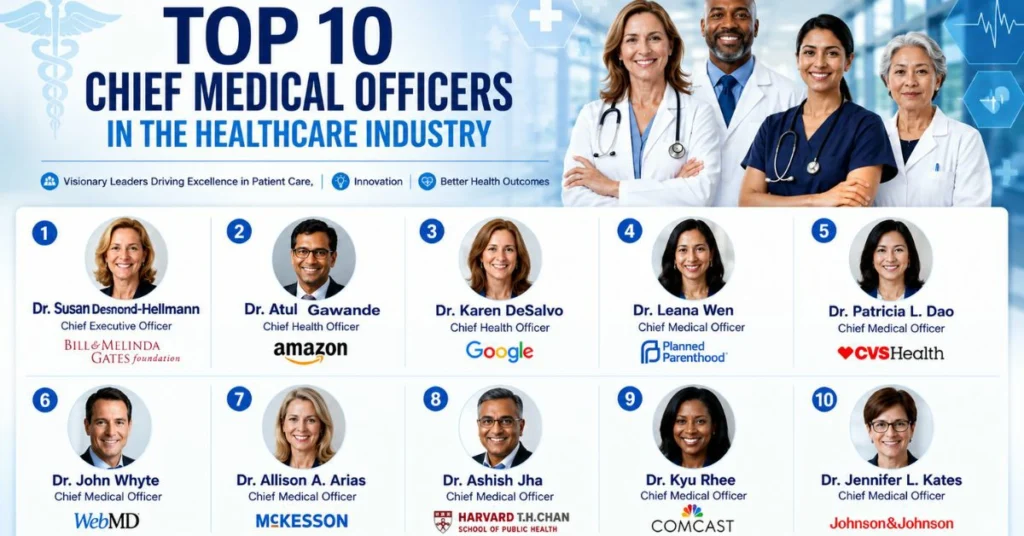
Top 10 Chief Medical Officers in the Healthcare Industry
The following list highlights ten Chief Medical Officers who have made significant contributions to the healthcare industry through their leadership, innovation, and unwavering commitment to patient care. These individuals represent diverse sectors — from hospital systems and insurance companies to technology firms and pharmaceutical giants.
1. Dr. Susan Bailey — American Medical Association (AMA)
Dr. Susan Bailey served as a prominent medical leader at the American Medical Association, one of the most influential physician advocacy organizations in the United States. She was trained as an allergist and immunologist, graduated from Texas A&M University College of Medicine, and went on to have a distinguished career in both clinical practice and medical policy.
Dr. Bailey has been a powerful voice in advocating for medical ethics, physician wellbeing, and patient rights. Her leadership at the AMA helped shape national health policy at a time of significant change in the American healthcare system, including debates around insurance reform, physician burnout, and the role of technology in medicine. She has been widely recognized for her ability to bring clarity to complex policy discussions and for representing the interests of both physicians and patients.
Her work highlights a critical truth about modern CMO leadership: technical expertise in medicine must be matched by the ability to communicate, advocate, and navigate political and institutional complexity.
2. Dr. Richard Isaacs — Kaiser Permanente
Dr. Richard Isaacs has served as Chief Medical Officer and CEO of The Permanente Medical Group, one of the largest medical groups in the United States operating within the Kaiser Permanente system. An otolaryngologist by specialty, Dr. Isaacs earned his MD from Wayne State University School of Medicine and furthered his surgical training in head and neck surgery at Cornell University.
Kaiser Permanente is widely recognized for its integrated care model, and Dr. Isaacs has been instrumental in advancing that model at scale. Under his leadership, the organization has made significant strides in preventive care, chronic disease management, and digital health — including one of the nation’s most sophisticated electronic health record systems.
Dr. Isaacs is particularly noted for championing patient-centered approaches that emphasize continuity of care, physician accountability, and measurable health outcomes. His work demonstrates how a CMO can shape not just clinical protocols but the entire culture of a large health system.
3. Dr. Tony Farah — Highmark Health
Dr. Tony Farah brings a rare combination of clinical expertise and technology-forward thinking to his role as Chief Medical Officer at Highmark Health, one of the nation’s largest integrated health systems. A trained cardiologist, Dr. Farah studied at the American University of Beirut before building a career that spans both clinical cardiology and health system leadership.
At Highmark, Dr. Farah has been a driving force behind the adoption of digital technologies to improve care delivery and patient engagement. He has championed telehealth expansion, data analytics, and digital therapeutics as tools to improve outcomes while making healthcare more accessible. His work reflects an understanding that the future of medicine lies in the responsible integration of technology — not as a replacement for clinical judgment, but as an amplifier of it.
Dr. Farah also prioritizes population health strategies that address chronic disease prevention, particularly in cardiovascular health — an area where proactive management can dramatically reduce hospitalizations and long-term costs.
4. Dr. David Feinberg — Google Health
Due to his position at Google Health, Dr. David Feinberg was at the forefront of the digital revolution in healthcare. A psychiatrist by training, Dr. Feinberg earned his MD from the Chicago Medical School and had a distinguished career in academic medicine before moving into executive roles at major health systems and ultimately technology.
At Google Health, Dr. Feinberg oversaw the company’s ambitious effort to use artificial intelligence, data science, and consumer technology to fundamentally improve how healthcare is accessed and experienced. Google Health’s initiatives have included AI-powered diagnostic tools, partnerships with major hospital systems, and efforts to make health information more accessible and actionable for everyday consumers.
Dr. Feinberg’s career trajectory — from clinical practice to academic medicine to one of the world’s largest technology companies — illustrates how the CMO role is evolving. Increasingly, the most impactful medical leaders are those who can translate clinical insight into scalable, technology-driven solutions.
5. Dr. Albert Bourla — Pfizer
Few CMOs have commanded global attention in the way Dr. Albert Bourla did during the COVID-19 pandemic. Dr. Bourla, a veterinarian by training who graduated from the Aristotle University of Thessaloniki, worked for Pfizer for many years before rising to the position of CEO. His earlier roles placed him at the intersection of drug development, regulatory affairs, and commercial strategy — the classic training ground for pharmaceutical CMOs.
Under Dr. Bourla’s leadership, Pfizer developed and brought to market one of the first and most widely distributed COVID-19 vaccines in history. The BNT162b2 vaccine, developed in partnership with BioNTech, reached populations across the globe within roughly a year of the pandemic’s outbreak — an achievement widely described as unprecedented in vaccine development history.
His leadership continues to be one of the most important CMO tales of the contemporary era and highlights the life-saving potential of strategically led, well-resourced pharmaceutical companies.
6. Dr. Amy Compton-Phillips — Press Ganey
Dr. Amy Compton-Phillips serves as Chief Clinical Officer at Press Ganey, a leading healthcare performance improvement company. An internist by specialty, Dr. Compton-Phillips earned her medical degree from Johns Hopkins School of Medicine and built an extensive career in clinical quality, patient safety, and population health.
Before joining Press Ganey, she held leadership roles at major health systems including Providence Health, where she played a key role in building integrated clinical programs focused on chronic disease management and health equity. At Press Ganey, her work focuses on helping healthcare organizations improve patient experience, workforce engagement, and clinical quality simultaneously — recognizing that these goals are interconnected rather than competing.
Dr. Compton-Phillips is recognized as a thought leader on how healthcare systems can use data and measurement to drive meaningful, sustainable improvements. Her work bridges the gap between operational performance and clinical excellence.
7. Fulton County Department of Health’s Dr. Patrice Harris
Dr. Patrice Harris is a psychiatrist and former President of the American Medical Association who has served in key public health leadership roles, including as Director of the Fulton County Department of Health in Georgia. She earned her MD from West Virginia University and has devoted her career to addressing mental health, substance use disorders, and the social determinants of health.
Dr. Harris is widely known for her leadership during critical public health moments, including the opioid epidemic, where she was a vocal advocate for evidence-based treatment approaches and destigmatization of addiction. As AMA President, she championed physician wellness, health equity, and the importance of mental health integration into primary care.
Her contributions are a reminder that CMOs in public health settings face distinctive challenges — limited resources, broad populations, and complex social factors — and that leadership in these roles requires deep empathy as much as clinical expertise.
8. Dr. Rodney Hochman — Providence Health & Services
Dr. Rodney Hochman serves as President and CEO of Providence Health & Services, one of the largest not-for-profit health systems in the United States. A rheumatologist by specialty, Dr. Hochman earned his MD from Boston University and completed a fellowship at Harvard Medical School.
Throughout his career, he has been a strong advocate for making high-quality healthcare more accessible and affordable, particularly for underserved communities. Providence operates across multiple states and serves millions of patients annually, requiring exactly the kind of broad clinical vision and organizational leadership that Dr. Hochman provides.
He has been particularly influential in discussions around value-based care, community health investment, and the role of not-for-profit health systems as community anchors — organizations whose mission extends beyond financial performance to the health of the communities they serve.
9. Dr. Penny Wheeler — Allina Health
Dr. Penny Wheeler served as Chief Executive Officer and Chief Clinical Officer at Allina Health, a not-for-profit health system based in Minnesota. An obstetrician-gynecologist by training, she earned her MD from the University of Minnesota Medical School and spent years in clinical practice before transitioning into health system leadership.
Dr. Wheeler is recognized for her work advancing women’s health, patient-centered care models, and community health programs. Under her leadership, Allina Health made significant investments in addressing social determinants of health — factors such as housing, food security, and transportation that profoundly affect health outcomes but fall outside traditional clinical care settings.
Her career illustrates how CMOs who rise to the CEO level can reshape not just clinical strategy but the entire purpose and community footprint of a health organization.
10. Sree Chaguturu, MD — CVS Health
Dr. Sree Chaguturu serves as Executive Vice President and Chief Medical Officer of CVS Health, one of the nation’s largest healthcare companies with an expansive presence across pharmacy, insurance, and primary care. An internal medicine physician, Dr. Chaguturu continues to practice at Massachusetts General Hospital while leading clinical strategy at the corporate level.
Dr. Chaguturu is in charge of raising clinical quality standards at CVS Health, enhancing health outcomes for the company’s sizable patient base, and lowering the cost and increasing access to care. He is also associated with the American Telemedicine Association, reflecting his commitment to expanding virtual care access.
His role at CVS Health — a company that operates pharmacies, MinuteClinics, and insurance plans — highlights how CMOs in large integrated health enterprises must think about care in a fundamentally different way: not just within a single hospital or clinic, but across the full continuum of how people access and experience healthcare.
Key Traits That Define a Successful CMO
Looking across the careers of these ten leaders, several common traits emerge that define effective Chief Medical Officers in the modern era:
Clinical Credibility: All ten leaders have deep roots in clinical practice. This expertise is not merely biographical — it provides the credibility to lead clinicians, understand patient needs, and make evidence-based decisions.
Organizational and Business Acumen: Modern CMOs must understand finance, operations, regulatory compliance, and strategic planning. Clinical knowledge alone is insufficient; it must be paired with the ability to lead large, complex organizations.
Communication and Advocacy: The most impactful CMOs are skilled communicators who can translate complex clinical information for diverse audiences — from patients and families to boards of directors and policymakers.
Technology Fluency: As healthcare rapidly adopts AI, telehealth, electronic health records, and data analytics, CMOs who understand and embrace technology are increasingly better positioned to drive meaningful change.
Commitment to Equity: Healthcare disparities remain one of the most pressing challenges in medicine. The best CMOs are not only clinically excellent — they are committed to building systems that work equally well for all patients, regardless of background.
How CMOs Are Shaping the Future of Healthcare
Chief Medical Officers are at the vanguard of several major shifts reshaping healthcare delivery. From the integration of artificial intelligence in diagnostics and treatment planning to the expansion of value-based care contracts that reward outcomes over volume, CMOs are the clinical leaders who translate strategy into practice.
Public health challenges — whether pandemic preparedness, chronic disease burdens, or mental health crises — require medical executives who can think at both the systems level and the individual patient level simultaneously. The leaders profiled above demonstrate that this balance is achievable and that it produces meaningful results for patients and communities.
Workforce wellbeing is another frontier where CMOs are playing an increasingly prominent role. Physician burnout, nursing shortages, and post-pandemic staffing challenges require thoughtful, empathetic leadership — the kind that the most effective CMOs have consistently provided.
As healthcare continues to evolve, the role of the Chief Medical Officer will only grow in importance. These leaders will be central to navigating the opportunities and challenges ahead — from personalized medicine and genomics to climate health and global disease surveillance.
Conclusion
The Chief Medical Officers profiled in this article represent the best of healthcare leadership — individuals who combine deep clinical expertise with strategic vision, technological fluency, and an unwavering commitment to patients and communities. From the innovation hubs of Silicon Valley to the community health clinics of rural America, these leaders are shaping what healthcare looks like today and what it will become tomorrow.
For healthcare marketers, researchers, vendors, and industry professionals looking to connect with the right medical decision-makers, a well-curated Physician Mailing List can be an invaluable resource — enabling targeted outreach to the clinicians and executives who are driving change across the industry.
Understanding who these leaders are, what they stand for, and what challenges they are working to solve is not just informative — it is essential context for anyone with a stake in the future of healthcare.