Skip to main content
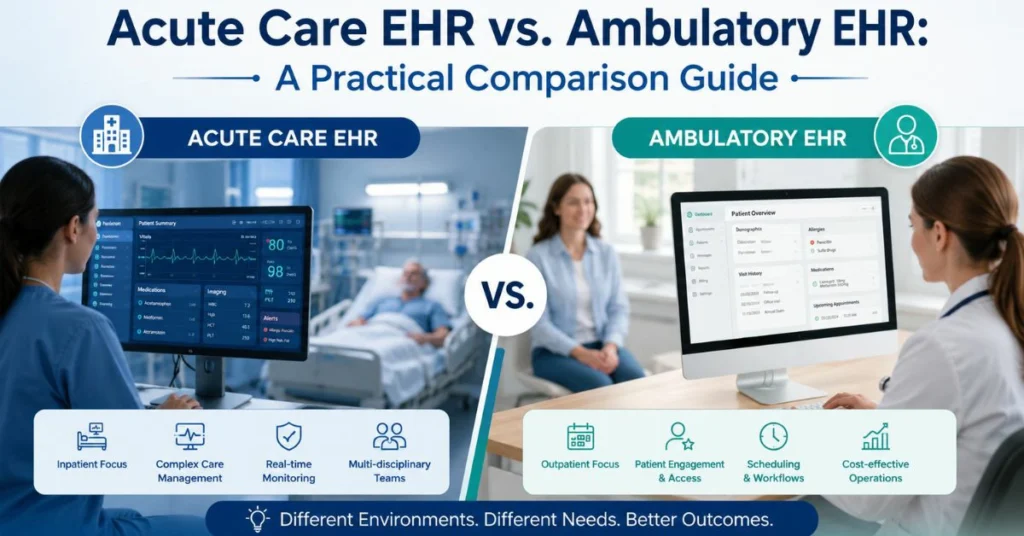
Choosing between an ambulatory EHR and an acute care EHR is one of the most consequential decisions a healthcare organization will make when investing in digital infrastructure. Although both categories of software manage clinical records, they are engineered around fundamentally different care models, patient flows, and operational demands.
For hospital administrators, clinic managers, and health IT decision-makers, understanding these distinctions is the first step toward selecting a system that truly fits daily operations. Vendors that offer a Physicians Email List can also help healthcare marketers reach the physicians and administrators who influence EHR purchasing decisions. This guide breaks down what separates ambulatory and acute care platforms, the features that define each, and how to decide which one — or which combination — makes sense for your organization.
What Is an Ambulatory EHR?
Ambulatory EHR platforms are purpose-built for outpatient settings, where a patient comes in for a scheduled visit and leaves the same day. This category covers primary care practices, specialty clinics, urgent care centers, behavioral health offices, and rehabilitation or physical therapy facilities.
The term “ambulatory” traces back to the Latin word ambulare — to walk — and in a medical context simply describes patients who remain mobile rather than being confined to a hospital bed. Because outpatient care runs on a different rhythm than hospital care, ambulatory EHRs are optimized for high appointment volume, short visit windows, recurring patient relationships, and an emphasis on prevention and long-term chronic disease management.
Defining traits of ambulatory EHR environments:
- Patients are seen and discharged within a single visit
- Daily volume can range from a handful of appointments to several hundred
- Core workflows revolve around scheduling, charting, billing, and follow-up communication
- A single physician or small care team typically manages the patient relationship over years
What Is an Acute Care EHR?
Acute care EHRs are engineered for inpatient hospital environments, where patients are formally admitted and monitored continuously over a period ranging from several hours to several weeks. These platforms support intensive care units, surgical suites, emergency departments, maternity units, and general inpatient floors.
The operational complexity of a hospital dwarfs that of an outpatient clinic. A single inpatient record might be touched by attending physicians, nurses, pharmacists, radiologists, and lab staff — often within the same shift. The EHR has to synchronize all of these inputs continuously, not just during business hours.
Defining traits of acute care EHR environments:
- Patients remain admitted for extended, sometimes unpredictable, stays
- Numerous departments and specialists contribute to one shared chart
- Workflows are frequently urgent and directly tied to patient safety
- The system must function reliably around the clock, every day of the year
Feature-by-Feature Comparison
| Feature Area | Ambulatory EHR | Acute Care EHR |
| Primary Setting | Outpatient clinics, private practices | Hospitals, inpatient units |
| Patient Encounter Type | Brief, recurring visits | Extended, multi-day stays |
| Scheduling Tools | Appointment booking and automated reminders | Bed tracking, admission/discharge/transfer (ADT) |
| Clinical Documentation | SOAP notes, visit summaries | Physician orders, nursing flowsheets, progress notes |
| Medication Management | E-prescribing, med reconciliation | CPOE, integrated pharmacy workflows |
| Billing & Coding | Outpatient CPT coding, claims submission | DRG coding, inpatient billing, case management |
| Care Coordination | Referral tracking, care plans | Multi-disciplinary rounds, structured handoffs |
| Analytics & Reporting | Population health dashboards, quality scores | Length-of-stay trends, readmission tracking |
| Patient Portal | Booking, secure messaging, lab access | Discharge instructions, follow-up scheduling |
| Interoperability | HL7 FHIR, referral networks, lab connections | HIE integration, ancillary department links |
| Regulatory Compliance | MACRA/MIPS, PCMH standards | Joint Commission, CMS Conditions of Participation |
| Implementation Complexity | Moderate | High |
What Sets Ambulatory EHR Systems Apart
1. Scheduling and Patient Flow
Scheduling sits at the heart of any ambulatory platform. These systems let staff manage bookings, cancellations, and rescheduling across multiple providers and office locations simultaneously. Common capabilities include automated text or email reminders, waitlist tools, calendar views spanning several providers, and built-in telehealth for virtual appointments.
2. Visit-Specific Documentation Templates
Because outpatient visits tend to follow recognizable patterns, ambulatory systems ship with condition-specific templates — for example, diabetes check-ins, annual physicals, or allergy follow-ups — that speed up charting while preserving clinical detail. Most platforms blend structured fields with free-text notes so providers aren’t boxed in.
3. Electronic Prescribing
E-prescribing is a foundational capability in outpatient care. Clinicians can route prescriptions straight to a pharmacy, get real-time interaction warnings, check formulary coverage, and pull up a patient’s medication history without leaving the chart. Many systems also support the electronic workflows required for controlled substances in states that mandate them.
4. Chronic Condition and Population Health Tools
Ambulatory EHRs shine when it comes to tracking patients with ongoing conditions across years of visits. Look for care-gap notifications (like a patient overdue for bloodwork), risk-stratification views, and quality reporting that ties directly into value-based reimbursement programs such as MIPS or ACO models.
5. Revenue Cycle Support
Outpatient billing depends on precise CPT coding, modifier use, and prompt claims filing, so ambulatory platforms usually bundle in — or connect tightly with — revenue cycle tools. These features monitor claim status, catch denials early, and automate patient billing statements to keep cash flow steady.
6. Patient-Facing Engagement Features
Most ambulatory systems come with a full-featured patient portal that lets patients schedule visits, review lab results, message their care team securely, fill out intake paperwork digitally, and browse their own health record. These tools cut down front-desk workload and tend to boost patient satisfaction.
What Sets Acute Care EHR Systems Apart
1. Admission, Discharge, and Transfer (ADT)
ADT functionality is the operational spine of an acute care EHR. The moment a patient is admitted, the system opens a live record that follows them through every unit transfer, manages bed availability, supports discharge planning, and notifies downstream care teams when follow-up is needed.
2. Computerized Physician Order Entry (CPOE)
Inside a hospital, orders for medication, labs, imaging, or dietary needs have to be logged precisely and acted on immediately. CPOE tools remove handwritten orders from the process, cut down on transcription mistakes, and layer in decision-support warnings for dangerous interactions or contraindications.
3. Nursing Flowsheets and Continuous Monitoring
Hospital nursing teams record vitals, pain levels, fluid intake, wound status, and more — sometimes every hour. Acute care platforms include detailed flowsheet tools that can pull data automatically from bedside equipment such as cardiac monitors and infusion pumps.
4. Pharmacy Integration and Medication Administration Records (MAR)
Pharmacists and nurses depend on the MAR to confirm and log every dose given to a patient. Barcode medication administration (BCMA) is a common safety feature here, requiring staff to scan both the patient’s wristband and the medication packaging before administering anything.
5. Surgical and Procedural Charting
Operating room care has its own documentation demands: pre-op checklists, anesthesia logs, intraoperative notes, implant records, and post-op recovery plans. Acute care EHRs provide dedicated tools for tracking each phase of a surgical case.
6. Real-Time Clinical Decision Support
Hospitals rely on live alerting across departments — sepsis screening, fall-risk flags, pressure-injury prevention prompts, and early warning scores. These alerts respond to shifts in patient data and can be routed to staff through mobile devices or unit dashboards.
7. Multi-Disciplinary Collaboration Tools
Because inpatient care involves so many specialties, acute care EHRs need to support structured shift handoffs, cross-department notes, consult requests, and shared task lists. This keeps everyone — from the admitting physician to the physical therapist — aligned on the patient’s current status and plan.
Advantages of Ambulatory EHR Adoption
Outpatient practices that implement the right ambulatory system tend to see:
- Faster charting thanks to smart templates and dictation tools
- Fewer denied claims through built-in coding checks and eligibility screening
- Stronger patient retention via automated recall reminders and engagement tools
- Better outcomes for chronic conditions through proactive dashboards and care-gap alerts
- Easier compliance with MIPS, HEDIS, and similar reporting requirements
- Smoother hybrid care delivery that blends in-person and telehealth visits
Advantages of Acute Care EHR Adoption
Hospitals and health systems that invest in a strong acute care platform typically gain:
- Fewer medication errors thanks to CPOE, BCMA, and pharmacist oversight
- Shorter average length of stay through better-coordinated discharge planning
- Lower readmission rates via structured post-discharge order sets
- Stronger compliance standing with Joint Commission and CMS requirements
- Live visibility into bed capacity, staffing needs, and clinical outcomes
- Better support for quality initiatives like Leapfrog and ORYX measures
Choosing the Right System for Your Organization
There’s rarely a one-size-fits-all answer here. A few things worth weighing:
Start with your care setting. A hospital-grade acute care system will be needlessly complex and costly for a purely outpatient practice. On the flip side, a basic ambulatory tool won’t meet the clinical demands of an inpatient facility.
Look at unified platforms. Vendors like Epic, Oracle Health, and Meditech offer both ambulatory and acute care modules under one roof. For health systems that run both hospitals and affiliated clinics, a single connected platform can keep patient data consistent across every setting.
Think about specialty requirements. Fields like oncology, cardiology, behavioral health, and ophthalmology often need documentation and workflow features that generic EHRs don’t fully support — so check for certified specialty modules.
Budget for the full cost, not just licensing. Acute care rollouts are considerably more involved and expensive than ambulatory ones once you factor in hardware, staff training, go-live support, and custom interfaces.
Don’t overlook interoperability. Regardless of setting, your EHR should support HL7 FHIR, connect to regional health information exchanges, and integrate with patient-facing apps and wearables.
Conclusion
Ambulatory and acute care EHRs both play essential roles in modern healthcare delivery, but they’re built to solve very different problems. Ambulatory platforms are tuned for the pace of outpatient medicine — scheduling, charting, e-prescribing, and patient engagement — while acute care systems are designed to handle hospital-level complexity, where split-second coordination and medication safety can’t be compromised.
For healthcare vendors and marketers trying to reach physicians who are evaluating or rolling out new EHR technology, effective outreach starts with accurate contact data. A verified Physician Mailing List can connect you directly with the clinical and administrative leaders who make these purchasing decisions — putting your message in front of the right people at the right moment.
Whether you’re a health IT vendor, a revenue cycle consultancy, or a training provider, tailoring your outreach to match the specific EHR environment your prospects work in will sharpen your targeting and drive stronger engagement across every channel.