Skip to main content
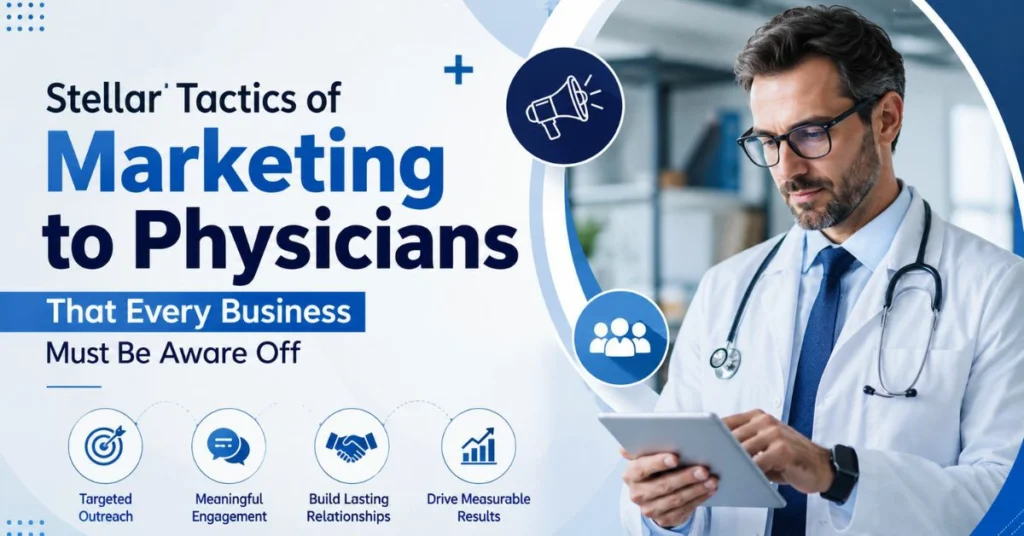
Stellar tactics of marketing to physicians begin with understanding that doctors are unlike the average consumer. They have limited time, rely on evidence-based decisions, and are protected by gatekeepers, strict compliance requirements, and crowded inboxes, making generic promotional campaigns largely ineffective. A well-targeted Physicians Email List enables healthcare vendors, pharmaceutical companies, medical device manufacturers, health-tech startups, and healthcare service providers to connect directly with verified physicians using personalized, relevant communication.
However, successful outreach goes far beyond having accurate contact data. Businesses must deliver educational content, build trust through consistent value, personalize every interaction, and use compliant, multi-channel marketing strategies. This guide explores the proven tactics that help businesses capture physicians’ attention, increase engagement, and build lasting professional relationships that drive measurable marketing success.
Why Marketing to Physicians Is Fundamentally Different
Most consumer marketing playbooks fall apart the moment they’re pointed at a physician audience. Doctors are pressed for time between patient visits, administrative work, and continuing education requirements, so anything that looks like generic sales content gets filtered out almost instinctively. A 2023 survey by Medscape found that a large share of physicians spend under 15 hours a week reading professional communications of any kind, which means every marketing touchpoint has to earn its place.
Unlike a typical B2C buyer, a physician’s purchasing decisions are often influenced by clinical evidence, peer recommendations, hospital procurement committees, and regulatory constraints. A campaign that works for retail or SaaS products, built around urgency and emotional triggers, tends to backfire with a clinical audience trained to be skeptical of exaggerated claims. Physicians respond far better to data, peer-reviewed sources, and messaging that respects their expertise rather than trying to persuade them with hype.
This is also an audience that is expensive to reach through paid advertising. Google and social platforms allow only limited targeting by profession, and physicians rarely click on generic display ads. That scarcity is part of why direct channels, especially curated physician email lists, remain a cornerstone of healthcare marketing budgets even as digital advertising has matured elsewhere.
Understanding the Physician Audience
Before building any campaign, it helps to understand who is actually opening (or ignoring) the message. Physicians are not a monolithic group. A primary care doctor running a small independent practice has different pain points than a hospital-employed cardiologist or a surgeon splitting time between an academic medical center and private patients.
Key audience variables that shape physician marketing include:
- Specialty: A message about a new diabetes management device needs to reach endocrinologists and primary care physicians, not dermatologists.
- Practice setting: Independent practices, hospital systems, academic medical centers, and multi-specialty groups all have different decision-making structures.
- Career stage: Early-career physicians tend to be more receptive to new technology and workflow tools, while established physicians may prioritize proven track records.
- Geography: Rural physicians often face different resource constraints than urban specialists, which affects what solutions are relevant to them.
- Digital behavior: Some physicians are highly active on platforms like Doximity or Sermo, while others rely almost entirely on medical journals and conferences for information.
Companies that skip this segmentation step and blast a single generic message to every physician in a purchased database tend to see abysmal open and response rates, and worse, they risk damaging their sender reputation for future campaigns.
Building and Segmenting Physician Email Lists
The foundation of any physician outreach program is the quality of the list behind it. A list of a million physician emails scraped from public directories is worth far less than a smaller, verified, specialty-segmented list where recipients have some reasonable expectation of receiving relevant communications.
There are generally three ways businesses assemble physician email lists:
- Licensed third-party databases from vendors such as Definitive Healthcare, IQVIA OneKey, ZoomInfo Healthcare, or M3 Global Research, which maintain verified physician records segmented by specialty, NPI number, practice affiliation, and prescribing behavior.
- First-party list building through gated content, webinar registrations, conference booth sign-ups, and CME (Continuing Medical Education) partnerships, where physicians opt in directly.
- Publisher and association partnerships, where a medical journal, specialty society, or platform like Medscape or Doximity sends sponsored content to its own opted-in physician subscriber base on a business’s behalf.
The table below compares these approaches across the factors that matter most when choosing a list strategy.
| List-Building Method | Typical Data Accuracy | Compliance Risk | Cost per Contact | Best Use Case |
| Licensed third-party database (e.g., IQVIA, Definitive Healthcare) | High, NPI-verified | Low if properly licensed | Moderate to high | Broad specialty targeting at scale |
| First-party opt-in (CME, webinars, gated content) | Very high, self-reported | Very low | Low per contact, high effort to build | Long-term relationship building |
| Publisher/association sponsored sends (Medscape, Doximity) | High, platform-verified | Low | High per campaign | Reaching niche or hard-to-find specialists |
| Public directory scraping | Low, often outdated | High | Very low upfront, high hidden cost | Not recommended |
Regardless of the source, every physician email list should be refreshed regularly. Doctors change practices, retire or switch specialties more often than most marketers realize. The National Provider Identifier (NPI) registry is a helpful free resource to confirm a physician’s license and practice information is up to date before launching a campaign.
Content Marketing Strategies That Resonate With Doctors
Once a business has a properly built list, the next challenge is content. Physicians respond to substance, not sizzle. The most effective content formats tend to include:
Clinical case studies and outcomes data. Physicians want to see how a product or service performed in a real clinical setting, ideally with numbers attached. A device manufacturer citing a peer-reviewed study showing a measurable reduction in complication rates will outperform a generic product brochure every time.
CME-accredited content. Partnering with an accredited CME provider to create educational content lets a business associate its brand with genuine clinical education rather than a sales pitch. This is one of the most trusted content formats in the industry because physicians are required to complete CME credits regardless of any marketing angle.
Peer-to-peer testimonials. Hearing from another physician who has used a product carries far more weight than hearing from a sales representative. Platforms like Sermo and Doximity have built entire advertising products around this dynamic, allowing verified physicians to discuss products in a peer forum setting.
Short, scannable clinical updates. Given how limited physician reading time is, digestible formats such as one-page clinical summaries, short video abstracts, or podcast-style audio briefs tend to get more engagement than long-form articles sent cold.
Webinars with live Q&A. A well-promoted webinar featuring a recognized specialist discussing a clinical topic, with product mentions kept secondary to the educational content, remains one of the highest-converting formats for physician audiences.
The common thread across all of these formats is that they lead with clinical value first and commercial intent second. Physicians can tell the difference, and content that respects that order tends to build long-term trust rather than one-off clicks.
Compliance and Regulatory Guardrails
Marketing to physicians carries legal obligations that don’t apply to typical consumer campaigns, and businesses that ignore them expose themselves to real financial and reputational risk.
HIPAA governs how any patient-related information is handled, and while physician contact data itself is not patient health information, campaigns that reference patient case examples must be scrubbed of any identifiable details.
The CAN-SPAM Act applies to any commercial email sent to a physician’s business address in the United States. This means every email needs a clear sender identity, an accurate subject line, a working physical mailing address, and a functioning unsubscribe mechanism honored within ten business days.
The Physician Payments Sunshine Act, part of the Affordable Care Act, requires pharmaceutical and medical device companies to publicly report payments and other transfers of value made to physicians, including some forms of sponsored content and speaking fees. Any business operating in this space needs a clear process for tracking and disclosing these payments through the Open Payments database.
State-specific pharmaceutical marketing laws, such as those in Massachusetts, Vermont, and California, impose additional restrictions on gifts, meals, and promotional spending directed at physicians, and these rules vary enough that a national campaign needs legal review before launch.
Businesses that license third-party physician email lists should also confirm the vendor’s data was collected and is maintained in a way that satisfies CAN-SPAM and any relevant state privacy laws, since liability for a non-compliant list can extend to the company using it, not just the vendor that sold it.
Personalization Tactics That Actually Work
Generic mass email to a physician list rarely converts, but personalization in healthcare marketing means something different than in consumer retail. It’s less about using a first name in a subject line and more about demonstrating relevance to a physician’s actual clinical world.
Effective personalization tactics include:
- Specialty-specific messaging, where the same product is framed differently for a cardiologist versus a family medicine physician based on how each would actually use it.
- Practice-size targeting, tailoring messages about staffing tools or administrative software differently for a solo practitioner versus a 200-physician hospital system.
- Behavioral triggers, such as sending a follow-up resource to a physician who attended a webinar or downloaded a clinical guideline, rather than treating all recipients the same regardless of their previous engagement.
- For pharmaceutical marketing, Regional and formulary relevance is especially critical. Any messaging about a drug’s insurance coverage needs to be reflective of the payer landscape that exists in a physician’s region.
- Timing around clinical workflow, since physicians are more likely to engage with email early in the morning before clinic hours or later in the evening after patient visits wrap up, rather than during the middle of a packed clinical day.
The businesses that get the most consistent engagement from their physician email lists tend to treat personalization as an ongoing data practice, not a one-time setup, continuously refining segments based on how different physician groups actually respond over time.
Multi-Channel Outreach Beyond the Inbox
While email remains a workhorse channel, the most effective physician marketing programs don’t rely on it exclusively. Email outreach is always complemented by a few channels:
Medical conferences and trade shows. Events like the American Medical Association’s annual meeting or specialty-specific conferences remain some of the highest-trust environments for introducing a new product, since physicians can ask questions directly and see demonstrations in person.
Peer physician networks. Platforms such as Doximity and Sermo allow for sponsored posts, native advertising, and physician-to-physician discussion threads that carry more credibility than a direct vendor message.
Direct mail. Despite being an older channel, direct mail to a verified practice address still performs well for physician audiences precisely because inboxes are so crowded; a well-designed printed clinical brief can stand out in a way email no longer does.
Field sales and medical science liaisons. For higher-value products, particularly in pharma and medical devices, in-person representatives remain central to the relationship, with email and digital content serving as reinforcement between visits rather than a replacement for direct contact.
Retargeting on medical publisher sites. Running display ads on trusted platforms like Medscape, UpToDate, or specialty journal websites lets a business reach physicians in an environment where they already expect clinical and industry content.
The strongest programs treat these channels as reinforcing each other. A physician who sees a booth demo at a conference, later receives a relevant email, and then encounters a peer testimonial on Doximity is far more likely to engage than one who receives a single cold email in isolation.
Measuring Success: KPIs That Matter
Standard consumer email metrics don’t always translate cleanly to physician marketing, and businesses need to track a slightly different set of indicators.
Open rates and click-through rates still matter, but industry benchmarks for physician email campaigns tend to run lower than typical B2B email, often in the 15–25% open rate range depending on specialty and list quality, so comparing results against general marketing benchmarks can be misleading. More meaningful indicators include:
- CME completion rates for educational content, which signal genuine engagement rather than a passive click.
- Webinar attendance and Q&A participation, which reflect real interest rather than curiosity clicks.
- Sample requests or trial sign-ups, which indicate a physician is seriously evaluating a product.
- Repeat engagement across channels, tracking whether the same physician interacts with email, conference content, and peer-network posts over time.
- List churn and opt-out rates, which serve as an early warning sign that messaging frequency or relevance has drifted off target.
Attribution in physician marketing is also slower than in consumer marketing. A physician might see a product mentioned three or four times across different channels over several months before ever requesting a sample or scheduling a meeting with a sales representative, so short attribution windows tend to undercount the real impact of a campaign.
Common Mistakes Businesses Make
Even well-resourced marketing teams stumble in a few predictable ways when targeting physicians:
Buying cheap, unverified lists. A low-cost physician email list scraped from outdated directories leads to high bounce rates, spam complaints, and damaged sender reputation that can affect future deliverability across every campaign.
Ignoring specialty relevance. Sending a surgical device announcement to an entire general practitioner list, rather than segmenting by specialty, wastes budget and trains physicians to ignore future messages from that sender.
Overloading frequency. Physicians who receive daily or even weekly unsegmented emails from the same sender tend to unsubscribe quickly, so pacing and relevance matter more than volume.
Leading with price or promotions. Consumer-style discount language rarely works on a clinical audience that is more persuaded by outcomes data and peer validation than by a limited-time offer.
Skipping compliance review. If you launch a campaign without confirming that it complies with CAN-SPAM, Sunshine Act and state-specific requirements, you could be fined, forced to retract content and suffer lasting reputational damage with the very audience you’re trying to build trust with.
Treating physicians like generic B2B leads. Applying a standard SaaS or retail lead-scoring model to physician engagement misses the nuances of clinical decision-making, where influence often comes from peers, professional societies, and evidence rather than typical sales funnel behavior.
Conclusion
Stellar Tactics of marketing to physicians focus on building trust through precision, relevance, and long-term relationship building rather than aggressive promotion. Businesses achieve better results by using accurate data, audience segmentation, evidence-based messaging, and personalized communication that aligns with physicians’ professional needs while remaining fully compliant with healthcare regulations. A well-maintained Physicians Mailing List helps organizations connect with verified healthcare professionals, improve campaign performance, and deliver valuable educational content across multiple marketing channels. When combined with webinars, email marketing, thought leadership, conferences, and consistent follow-up, these strategies strengthen credibility, increase engagement, generate qualified healthcare leads, and create lasting partnerships that support sustainable business growth and long-term marketing success.