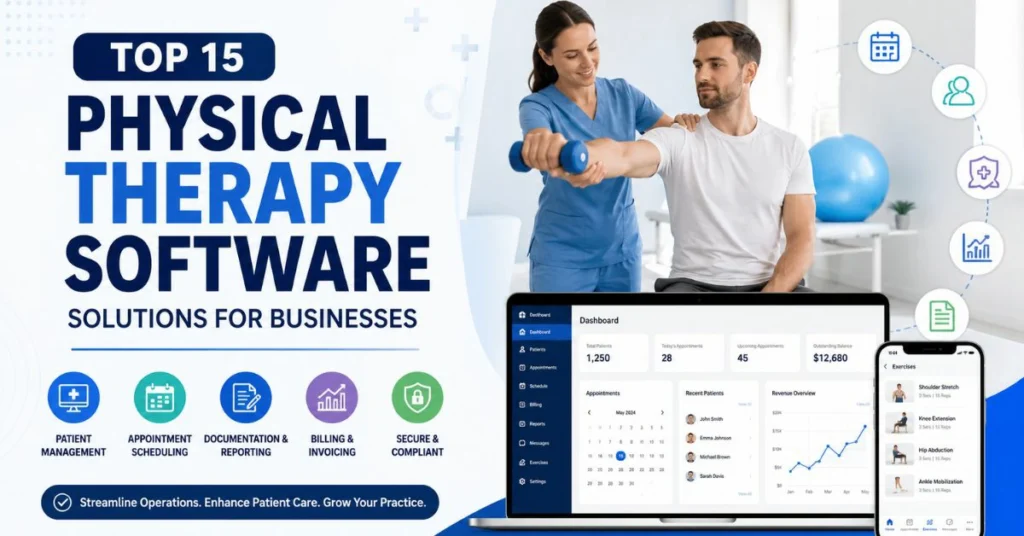
Digital health investors continue to fuel innovation across healthcare, including the rapid evolution of physical therapy software that helps clinics streamline scheduling, documentation, billing, patient communication, and overall practice management. As physical therapy providers adopt digital solutions to improve operational efficiency and patient outcomes, selecting the right platform has become a critical business decision.
For organizations focused on expanding referral networks, a Physicians Email List enables effective outreach to physicians and healthcare professionals who regularly refer patients for rehabilitation services. This guide explores 15 leading physical therapy software solutions, highlighting their key features, benefits, and ideal use cases to help clinics choose a platform that enhances productivity, supports better patient experiences, and drives long-term practice growth.
This guide is written for clinic owners, practice managers, and multi-location rehab businesses who are evaluating software options for the first time or considering a switch from an existing system. Rather than ranking platforms by a single “best overall” score, it walks through what each tool does well so you can match features to your specific practice model.
Why Physical Therapy Software Matters
Physical therapy practices operate differently from a typical medical office. Patients come in for multiple visits per week over weeks or months, treatment plans evolve based on functional progress rather than a single diagnosis, and billing depends on time-based and unit-based codes that are easy to get wrong. Generic scheduling or EHR tools built for general medicine often don’t reflect any of this.
Purpose-built physical therapy software solves these problems by combining electronic medical records (EMR), scheduling, billing, and patient engagement features into one system designed around therapy-specific workflows. Clinics that adopt the right platform typically see fewer claim denials, less time spent on documentation, and better patient follow-through between visits — all of which affect the bottom line as directly as any marketing effort does.
Key Features to Look For
Before comparing specific products, it helps to know which features actually move the needle for a physical therapy business:
- Specialty-specific documentation templates built around SOAP notes, functional outcome measures, and plan-of-care tracking
- Scheduling and automated reminders to reduce no-shows, which can cost clinics tens of thousands of dollars a year
- Home exercise program (HEP) tools that let patients follow guided routines between appointments
- Telehealth capability for remote check-ins and hybrid care models
- Billing and claims management with clean-claim rates that reduce denials and speed up reimbursement
- Reporting and analytics to track outcomes, productivity, and financial performance
- Integration options with existing billing, imaging, or referral systems
- Patient portals for intake forms, secure messaging, and payment processing
With those criteria in mind, here’s a closer look at 15 platforms commonly used across physical therapy clinics today.
The Top 15 Physical Therapy Software Solutions
1. WebPT
One of the most well-known brands of physical therapy software is WebPT, which provides PT-specific scheduling, billing, and documentation templates based on outpatient rehab processes. Both single-location clinics and larger multi-site practices use it extensively, and because of its long history in the industry, it has a sizable support network and an extensive ecosystem of integrations. Clinics that want a proven, feature-rich system with strong compliance tools often start their search here.
Key strengths typically cited by long-time users include detailed, therapy-specific note templates, dependable customer support, and a large library of third-party integrations covering everything from patient payments to outcomes tracking. Because WebPT has been in the market for well over a decade, it also tends to have deep institutional knowledge of payer requirements and compliance changes, which can matter a great deal for practices that bill a high volume of insurance claims.
2. SPRY
SPRY has gained traction as a fast-growing, AI-powered EMR and billing platform built specifically for physical therapy, occupational therapy, and speech-language pathology clinics. It’s known for streamlining documentation with AI-assisted note generation, offering a high clean-claim rate, and combining EMR and practice management into a single system. Clinics looking to modernize an aging tech stack often shortlist SPRY for its mobile-friendly design and all-in-one approach.
Beyond documentation speed, SPRY is frequently highlighted for automating parts of the prior-authorization process and for dashboards that give owners visibility into productivity and reimbursement trends without needing a separate reporting tool. Some reviewers note occasional software glitches, which is worth factoring into any trial period.
3. Prompt (Prompt Therapy Solutions)
Prompt positions itself as an AI-powered EMR and practice management platform built for rehab therapy businesses, including PT, OT, and chiropractic clinics. It’s designed to be adaptable across multiple therapy types while maintaining strong customer support. Practices that value responsive onboarding and a system that grows with a multi-discipline clinic tend to favor Prompt.
Prompt’s positioning as an “AI-native” platform means many of its documentation and scheduling tools are built to reduce repetitive data entry from the ground up, rather than as an add-on feature layered onto an older system. This can be especially useful for newer clinics that don’t have years of legacy workflows to migrate.
4. Raintree Systems
Raintree offers a comprehensive suite of EMR, billing, and practice management tools aimed at mid-size to larger rehab therapy organizations. It includes robust training resources, which makes it a reasonable option for clinics with more complex operational needs or multiple locations that require standardized workflows across sites.
Because Raintree is built with larger organizations in mind, it often includes more configurable permission structures, multi-location reporting, and revenue cycle management tools that smaller, single-location practices may not need but that become valuable once a business scales past a handful of providers.
5. TheraOffice
TheraOffice markets itself as one of the most adaptable EMR and practice management platforms for rehab and therapy businesses of all kinds, including physical, occupational, and speech therapy. Its all-in-one approach covers documentation, scheduling, and billing, making it a solid choice for practices that want flexibility without stitching together multiple separate tools.
Its adaptability comes largely from configurable templates and workflows that can be adjusted to match a clinic’s specific documentation style, rather than forcing every practice into the same rigid note structure.
6. Clinicient
Clinicient is built to simplify care delivery for PT, OT, and speech-language pathology organizations through a single, easy-to-use platform. It focuses heavily on optimizing business performance alongside clinical workflows, which makes it a good fit for practice owners who want financial and operational reporting built directly into their day-to-day system.
For owners who think in terms of visit volume, productivity per provider, and reimbursement rate, Clinicient’s reporting tools are generally designed to surface those numbers without requiring a separate business intelligence platform.
7. Net Health Therapy (TherapySource)
Net Health’s therapy management software is designed to support outpatient rehabilitation and physical therapy settings, including hospital-based and skilled nursing environments. It’s often chosen by organizations that need software capable of scaling across different care settings while maintaining consistent documentation standards.
This flexibility across care settings makes Net Health Therapy a common choice for hospital-affiliated rehab departments or larger health systems that operate physical therapy services alongside other lines of business.
8. SimplePractice
SimplePractice is widely used by smaller and solo practices that want a clean, easy-to-navigate system without heavy configuration. It covers scheduling, documentation, billing, and telehealth in one place, and its straightforward interface makes it a popular entry point for therapists transitioning away from paper charts or spreadsheets.
Its pricing structure, which typically starts at a lower monthly cost than many enterprise-focused platforms, also makes it an accessible starting point for a solo practitioner or a very small team that isn’t ready to invest in a heavier system.
9. Jane App
Jane App is frequently praised for being noticeably easier to use than many larger clinic systems — a factor that matters more than a long feature list might suggest. A platform the whole team actually adopts well can outperform a more powerful tool that frustrates staff. For private practices looking for software that covers scheduling, charting, and billing but feels light rather than bloated, Jane is a great choice.
Jane is also commonly used by multidisciplinary clinics that combine physical therapy with massage therapy, chiropractic, or other allied health services, since its scheduling tools are built to handle multiple practitioner types under one roof.
10. ClinicSource
ClinicSource offers therapy practice management built around scheduling, documentation, and billing, with a focus on usability for smaller to mid-size clinics. It’s commonly evaluated alongside WebPT and TheraOffice by practices comparing established, therapy-specific systems.
Its documentation tools are generally geared toward pediatric and outpatient therapy settings as well, which can be a useful consideration for practices that treat a mixed caseload of adult and pediatric patients.
11. TheraPlatform
TheraPlatform is designed with a strong emphasis on telehealth alongside scheduling, billing, and documentation. Clinics that deliver a meaningful share of care remotely, or that want a system built with virtual visits in mind from the ground up, often find TheraPlatform’s telehealth-first design appealing.
Because its telehealth tools aren’t an afterthought, features like screen sharing for home exercise demonstrations and built-in video scheduling tend to feel more integrated than in platforms where telehealth was added later as a supplemental feature.
12. Medbridge
Medbridge stands apart from traditional EMR platforms by focusing on home exercise programs, patient education, and adherence support after the visit ends. Since recovery outcomes depend heavily on what patients do between appointments, clinics that already have EMR and billing covered sometimes add Medbridge specifically to strengthen patient engagement and follow-through.
Many practices use Medbridge alongside — rather than instead of — a full EMR system, treating it as a specialized add-on that improves outcomes tracking and patient compliance without replacing existing scheduling or billing infrastructure.
13. DrChrono
DrChrono is a cloud-based platform offering fully customizable charts, medical billing, and mobile apps for iPhone and iPad. While it serves a broader healthcare audience beyond physical therapy, its customization options and mobile-first design make it usable for PT practices that want flexibility to tailor documentation templates to their own workflow.
Its general-medicine roots mean it may require more upfront configuration to feel truly PT-specific compared to purpose-built rehab platforms, but that same flexibility can be an advantage for multi-specialty practices.
14. Fusion Web Clinic
Fusion Web Clinic is built to support therapy practices — including PT, OT, and speech-language pathology — with electronic health records, scheduling, documentation, and billing. It places particular emphasis on consolidating clinical and administrative workflows into one secure system, which can reduce manual effort for practices juggling multiple disciplines under one roof.
It’s particularly well regarded among pediatric and multi-discipline therapy practices that need consistent documentation standards across different types of providers working from the same patient charts.
15. Noterro
Physical therapy clinics and other hands-on fields use Noterro, a cloud-based practice management platform. Clinics seeking modern functionality without superfluous complexity will find it appealing as it integrates scheduling, documentation, billing, and AI-assisted charting into a single integrated system.
For practices that want AI-assisted charting and connected billing without committing to the longer implementation timelines associated with some enterprise-level systems, it is a reasonable option due to its relatively simple setup process.
Quick Comparison Table
| Software | Best For | Notable Strength |
| WebPT | Established multi-site clinics | Long track record, wide integration ecosystem |
| SPRY | Clinics modernizing their tech stack | AI-assisted documentation, high clean-claim rate |
| Prompt | Multi-discipline rehab practices | Adaptability across therapy types |
| Raintree Systems | Larger, multi-location organizations | Comprehensive training resources |
| TheraOffice | Flexible all-in-one needs | Broad rehab therapy adaptability |
| Clinicient | Business-performance-focused owners | Built-in financial and operational reporting |
| Net Health Therapy | Multi-setting rehab organizations | Scales across outpatient and facility-based care |
| SimplePractice | Solo and small practices | Simple, low-configuration setup |
| Jane App | Private practices valuing usability | Clean, team-friendly interface |
| ClinicSource | Small to mid-size clinics | Straightforward scheduling and billing |
| TheraPlatform | Telehealth-focused practices | Built around virtual visit delivery |
| Medbridge | Patient engagement add-on | Home exercise programs and adherence tools |
| DrChrono | Practices wanting customization | Fully customizable charts and mobile apps |
| Fusion Web Clinic | Multi-discipline therapy clinics | Consolidated clinical and admin workflows |
| Noterro | Clinics wanting modern simplicity | AI-assisted charting without added complexity |
How to Choose the Right Fit
There’s no single “best” physical therapy software — the right choice depends on practice size, specialty mix, and operational priorities. A few practical questions can help narrow the list:
- How many locations and providers do you have? Larger, multi-site practices generally benefit from platforms like Raintree Systems, WebPT, or Net Health Therapy that are built to standardize workflows across sites.
- How much of your care happens virtually? If telehealth is a meaningful part of your delivery model, TheraPlatform’s virtual-first design may fit better than a system where telehealth feels bolted on.
- Do you need simplicity or depth? Solo and small practices often do well with SimplePractice or Jane App, while clinics with complex billing needs may lean toward SPRY, Prompt, or Clinicient.
- How important is patient engagement between visits? If adherence to home exercise programs is a persistent challenge, pairing your core EMR with a tool like Medbridge can close that gap.
- What’s your budget, and how is pricing structured? Most platforms price on a per-user, per-month basis, and costs can range from around $25 a month for basic solo plans to several hundred dollars a month for enterprise-level systems with advanced billing and analytics.
It’s also worth requesting a demo and, where possible, a trial period. A platform’s feature list only tells part of the story — how a system actually feels to your front-desk staff and clinicians during a busy Monday morning is often the better test.
Tips for a Smooth Software Implementation
Choosing the right platform is only half the equation — how you roll it out determines whether your team actually benefits from it. A few practical steps can make the transition smoother:
- Migrate data in phases. Rather than moving every historical record at once, many clinics start new patients on the new system while gradually transitioning active caseloads, which reduces the risk of data entry errors during a busy week.
- Train front-desk and clinical staff separately. Scheduling staff and clinicians use different parts of the system, and separate, role-specific training sessions tend to be more effective than a single all-staff walkthrough.
- Run both systems in parallel briefly, if possible. A short overlap period where staff can reference the old system while learning the new one helps catch gaps before your practice is fully dependent on the new platform.
- Assign an internal champion. Having one staff member who becomes the go-to expert on the new software — and who works closely with the vendor’s support team during onboarding — tends to speed up adoption across the rest of the practice.
- Revisit your workflow after 90 days. Most clinics don’t get every setting right on day one. A short review a few months in, once staff have had time to work with the system day-to-day, often reveals configuration changes that make ongoing use noticeably smoother.
Frequently Asked Questions
How much does physical therapy software typically cost?
Pricing varies widely by platform and feature set. Basic, solo-practitioner plans can start around $24–$30 per month, while comprehensive systems with AI-assisted documentation, advanced billing, and multi-location support can run several hundred dollars per month per provider. Most vendors price on a per-user, per-month basis, so total cost scales with the size of your team.
What’s the difference between an EMR and full practice management software?
An EMR (electronic medical record) handles clinical documentation — notes, treatment plans, and progress tracking. Practice management software covers the full business operation: scheduling, billing, patient intake, and reporting. Many of the platforms on this list combine both functions into a single system, which reduces the need to maintain separate, disconnected tools.
How long does it take to switch from an existing system?
Implementation timelines depend on practice size and how much historical patient data needs to be migrated. Smaller, single-location practices switching to a simpler platform like SimplePractice or Jane App may be operational within a few weeks. Larger, multi-location organizations moving to an enterprise system like Raintree Systems or Net Health Therapy should budget more time for data migration, staff training, and payer setup.
Do I need telehealth features if I don’t currently offer virtual visits?
It’s worth considering even if telehealth isn’t part of your current model. Patient expectations continue to shift toward hybrid care options, and having the capability built in — even if used only occasionally for check-ins or home exercise program reviews — can be more cost-effective than adding a separate telehealth tool later.
Can physical therapy software help with referral and outreach efforts?
Yes, in an indirect but meaningful way. Many platforms include reporting on referral sources, which helps practices understand which referring physicians send the most patients. Pairing that internal data with external outreach tools, such as a physician mailing list or physician email lists, allows a clinic’s marketing team to follow up with referring providers more efficiently and keep the referral pipeline active.
Conclusion
The physical therapy software market has matured considerably, offering purpose-built solutions for nearly every practice size, specialty mix, and operational priority. Whether your clinic needs deep customization, AI-assisted billing, strong telehealth support, or simple, fast-to-implement scheduling tools, there’s a platform suited to the job among the 15 covered here. Just as accurate outreach data — such as a well-maintained Physician Mailing List — helps healthcare marketers connect with the right professionals, choosing the right practice management software helps your clinic connect more efficiently with the patients it serves. Evaluating platforms against your practice size, billing needs, and patient engagement priorities is the clearest path to finding the right long-term fit.