Skip to main content

Medical Device Companies play a central role in modern healthcare by developing products and technologies used for diagnosis, treatment, monitoring, and patient care. Their portfolios range from implantable cardiac devices and surgical technologies to advanced imaging equipment and home-based medical solutions. The United States is home to numerous prominent organizations in this sector, with their products influencing healthcare delivery across hospitals, clinics, physician practices, and other care settings. For businesses researching this industry, resources such as a Medical and Healthcare Facilities Email List may also support outreach to healthcare leaders and decision-makers involved in purchasing and adopting medical technologies.
A Medical and Healthcare Facilities Email List can be useful for organizations seeking to understand healthcare facilities and the professionals involved in medical technology decisions. This guide examines ten leading U.S.-based medical device companies, highlighting their primary areas of specialization, industry presence, and contributions to medical technology. Whether you are a healthcare consumer interested in the organizations behind familiar medical products, an investor exploring the medical technology sector, or a reader interested in healthcare innovation, this overview provides a straightforward look at the companies shaping the industry. As technologies such as artificial intelligence, advanced diagnostics, and robotic-assisted procedures continue to develop, medical device manufacturers remain important contributors to the evolution of patient care.
Why Medical Device Companies Matter
Medical devices span an enormous range of categories, from simple disposable tools to highly sophisticated implantable technologies and robotic surgical systems. Unlike pharmaceuticals, which treat conditions through chemical or biological mechanisms, medical devices often work through mechanical, electrical, or structural means, ranging from a basic bandage to a complex cardiac monitoring implant.
The companies that design, manufacture, and distribute these devices play a foundational role in modern healthcare delivery. Their innovations directly influence surgical outcomes, chronic disease management, diagnostic accuracy, and overall quality of life for millions of patients. Because medical devices are subject to rigorous regulatory oversight from the Food and Drug Administration, the companies operating in this space must also navigate a complex approval and compliance landscape before their products reach hospitals and patients.
The scale of this industry is substantial. The global medical device market has been valued at several hundred billion dollars, with continued growth projected as aging populations, rising chronic disease rates, and technological advancement drive increased demand for innovative medical technology. American companies consistently account for a significant share of this global market, with the largest U.S. firms generating tens of billions of dollars in annual revenue.
What Sets Leading Medical Device Companies Apart
Not every medical device company operates at the same scale or with the same strategic focus. Several factors tend to distinguish the industry’s leading players from smaller or more niche competitors.
Breadth of product portfolio. The largest medical device companies typically operate across multiple therapeutic areas, from cardiovascular devices to surgical instruments, diagnostics, and patient monitoring systems, rather than focusing narrowly on a single product category.
Investment in research and development. Because medical technology evolves rapidly, leading companies consistently invest substantial resources into R&D, translating that investment into new product approvals and clinical adoption at scale.
Global manufacturing and distribution capacity. Large-scale medical device companies typically maintain extensive manufacturing operations and distribution networks capable of supplying hospitals and healthcare systems worldwide, not just within the United States.
Regulatory track record. Consistent success in navigating FDA approval processes and maintaining compliance with evolving medical device regulations is a critical factor separating established industry leaders from newer entrants.
Adaptability to emerging technology. Companies that have successfully integrated artificial intelligence, robotics, and digital health capabilities into their product lines are increasingly positioned as industry leaders, reflecting the broader technological transformation occurring across the sector.
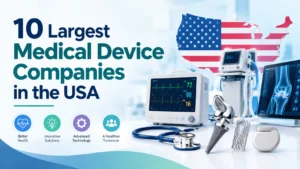
With these factors in mind, let’s examine ten companies that currently stand among the leading medical device manufacturers headquartered in the United States.
1. Medtronic
Medtronic is widely recognized as the largest medical device company in the world, with tens of billions of dollars in annual revenue generated across its medical device segments. The company’s operational headquarters is based in Minneapolis, Minnesota, and its product portfolio spans cardiovascular devices, diabetes management technology, surgical robotics, and neuromodulation therapies, among many other categories.
Medtronic’s cardiovascular portfolio has consistently served as one of its strongest growth engines, reflecting the company’s deep expertise in developing devices for heart rhythm management, structural heart repair, and related conditions. The company has also made significant investments in robotic-assisted surgery and diabetes technology, including insulin delivery systems designed to help patients manage chronic conditions more effectively.
With a global manufacturing and distribution footprint, Medtronic supplies hospitals and healthcare systems across dozens of countries, reinforcing its position as one of the most influential and widely recognized names in the medical device industry.
2. Johnson & Johnson MedTech
Johnson & Johnson MedTech is the medical technology segment of Johnson & Johnson, a major global healthcare organization. Its operations span areas such as surgical technologies, orthopedics, vision care, and cardiovascular care, making it a significant contributor to the company’s overall business.
The company’s surgical technology segment includes a wide range of instruments and devices used across general surgery, while its orthopedics business covers joint replacement systems and related surgical tools. Johnson & Johnson MedTech has also continued to expand its presence in robotic-assisted surgery, an area of significant growth across the broader medical device industry.
Backed by the extensive resources and global infrastructure of its parent company, Johnson & Johnson MedTech maintains a substantial research and development budget, allowing it to continuously bring new surgical and diagnostic technologies to market across a wide range of clinical specialties.
3. Abbott Laboratories
Abbott Laboratories has built a diverse medical device portfolio spanning diagnostics, cardiovascular devices, diabetes care, and neuromodulation technology. With annual medical device revenue reaching into the tens of billions of dollars, Abbott ranks among the largest medical technology companies headquartered in the United States.
One of Abbott’s most notable product lines involves continuous glucose monitoring technology, which has transformed diabetes management for millions of patients by providing real-time blood sugar tracking without the need for frequent finger-stick testing. The company has also built a strong presence in cardiovascular devices, including structural heart products and vascular technologies used in a wide range of cardiac procedures.
Abbott’s diagnostics business further strengthens its position within the broader medical device landscape, offering testing technologies used across hospitals, laboratories, and point-of-care settings nationwide.
4. Stryker
Stryker has established itself as a major force in orthopedics, surgical equipment, and neurotechnology, generating tens of billions of dollars in annual revenue. The company’s product portfolio includes joint replacement systems, surgical navigation technology, and a range of medical and surgical equipment used across hospitals and outpatient surgical centers.
Stryker has consistently ranked among the fastest-growing companies within the medical device sector, reflecting strong demand for its orthopedic implants and surgical technology solutions. The company has also invested heavily in robotic-assisted surgical systems, particularly within orthopedic procedures such as joint replacement, where precision and consistency can significantly influence patient outcomes.
With a broad presence across hospitals, ambulatory surgery centers, and specialty clinics, Stryker remains one of the most recognized names among healthcare providers performing orthopedic and neurosurgical procedures.
5. Becton Dickinson (BD)
Becton Dickinson, commonly known as BD, focuses heavily on medical technology used in everyday clinical settings, including injection systems, diagnostic testing equipment, and infection prevention products. With annual revenue reaching into the tens of billions of dollars, BD plays a foundational role in the day-to-day operations of hospitals and healthcare facilities across the country.
The company’s product lines include widely used items such as syringes, catheters, and specimen collection devices, alongside more advanced diagnostic and monitoring technologies. BD’s broad presence across nearly every type of healthcare setting, from large hospital systems to small outpatient clinics, reflects the essential, everyday nature of many of its core products.
BD has also continued to expand into more advanced diagnostic technology, including molecular testing and infection detection systems, reinforcing its role as both a foundational supplier of everyday medical devices and an innovator in more specialized diagnostic categories.
6. Boston Scientific
Boston Scientific has built a strong reputation in cardiovascular devices, endoscopy technology, and urology solutions, and the company has consistently ranked among the fastest-growing medical device companies in recent years. Its product portfolio spans a wide range of minimally invasive medical technologies designed to treat conditions ranging from cardiac arrhythmias to gastrointestinal disorders.
The company’s cardiovascular division includes devices used in structural heart repair, electrophysiology, and interventional cardiology, areas that have seen significant technological advancement in recent years. Boston Scientific has also continued to expand its endoscopy and urology product lines, reflecting a broader strategy of diversifying across multiple high-growth medical specialties.
Boston Scientific’s consistent revenue growth and expanding product portfolio have reinforced its position as one of the more dynamic and rapidly evolving companies within the U.S. medical device industry.
7. GE HealthCare
GE HealthCare, the medical technology subsidiary of General Electric, focuses primarily on medical imaging, diagnostics, and patient monitoring technology. With a history dating back over a century, GE HealthCare has built an extensive product portfolio that includes MRI systems, CT scanners, ultrasound equipment, and a wide range of patient monitoring devices used throughout hospitals and diagnostic imaging centers.
The company’s imaging technology plays a central role in modern diagnostic medicine, supporting everything from routine screenings to complex diagnostic evaluations across nearly every medical specialty. GE HealthCare has also continued to invest in digital health and AI-powered diagnostic tools, reflecting the broader industry shift toward integrating artificial intelligence into imaging and diagnostic workflows.
With a substantial global installed base of imaging and diagnostic equipment, GE HealthCare remains one of the most influential companies shaping how hospitals and imaging centers approach diagnostic care.
8. Intuitive Surgical
Intuitive Surgical has become synonymous with robotic-assisted surgery through its widely known da Vinci surgical system. The company has experienced substantial revenue growth in recent years, with millions of procedures performed using its robotic platforms and thousands of systems installed in hospitals worldwide.
The company’s flagship da Vinci system has continued to evolve through successive generations of technology, incorporating advancements in precision, visualization, and surgical control. Intuitive Surgical has also expanded the range of procedures its systems are cleared to perform, broadening its addressable market across surgical specialties including urology, gynecology, and increasingly, certain cardiac procedures.
As robotic-assisted surgery continues to gain adoption across hospitals and surgical centers, Intuitive Surgical’s early leadership position in this space has helped establish it as one of the most closely watched companies within the broader medical device industry.
9. Baxter International
Baxter International operates across several key business segments, including medical products and therapies, healthcare systems and technologies, and advanced surgery solutions. The company’s product portfolio includes infusion systems, patient monitoring technologies, surgical products, and renal care solutions used across hospitals and dialysis centers nationwide.
Baxter has continued to grow its advanced surgery product line, which includes hemostatic and sealant products used to help control bleeding during surgical procedures, alongside infusion pumps and other technologies supporting patient care in acute care settings. The company has also introduced new products aimed at improving hospital workflow and patient transport efficiency.
With a diverse portfolio spanning both essential hospital equipment and more specialized surgical and renal care technologies, Baxter International continues to serve as an important supplier across a wide range of healthcare settings.
10. Edwards Lifesciences
Edwards Lifesciences has built its reputation primarily around structural heart disease treatment and critical care monitoring technology. The company has experienced strong revenue growth in recent years, driven largely by increased demand for its heart valve replacement and repair technologies used in both the United States and international markets.
Edwards Lifesciences’ structural heart portfolio includes transcatheter heart valve technologies that allow certain heart valve procedures to be performed using minimally invasive techniques, reducing recovery time compared to traditional open-heart surgery. This focus on less invasive treatment options has positioned the company as a leader within the rapidly growing structural heart disease treatment market.
The company’s critical care division further complements its cardiovascular focus, providing monitoring technologies used to track patient hemodynamics during surgery and in intensive care settings.
How These Companies Shape the Broader Healthcare System
While each of these ten companies has developed its own areas of specialization, together they represent a substantial share of the medical technology that hospitals, surgical centers, and diagnostic facilities rely on every day. From the syringes and monitoring equipment used in routine care to the robotic surgical systems and structural heart devices used in complex procedures, these companies’ products touch nearly every stage of the modern patient care journey.
Their continued investment in research and development also drives much of the innovation shaping the future of medicine, from AI-powered diagnostic imaging to increasingly sophisticated robotic surgical platforms. As these technologies continue to evolve, hospitals and healthcare systems must stay informed about new device approvals, updated clinical guidelines, and evolving best practices for integrating new technology into patient care.
For organizations working to reach healthcare decision-makers about new device technologies, clinical training resources, or procurement opportunities, tools such as a Medical and Healthcare Facilities Email List can support outreach to administrators and clinical leaders across hospitals and health systems evaluating these evolving medical technologies.
Trends Shaping the Medical Device Industry
Several broader trends are likely to influence how these companies, and the industry as a whole, continue to evolve. Artificial intelligence is increasingly being integrated into diagnostic imaging, surgical robotics, and patient monitoring systems, allowing for more precise and efficient clinical decision-making. Companies that successfully translate AI research into FDA-cleared, clinically adopted technology are likely to maintain a competitive advantage in the years ahead.
Robotic-assisted surgery continues to expand into new procedure types and surgical specialties, reflecting growing confidence in the precision and outcomes associated with these platforms. Meanwhile, minimally invasive treatment options, particularly within cardiovascular care, continue to gain adoption as patients and physicians increasingly favor approaches that reduce recovery time and procedural risk.
Global market expansion also remains a significant factor, with many of these companies increasingly focused on growth opportunities outside the United States, particularly in fast-growing regions where healthcare infrastructure investment continues to accelerate.
Frequently Asked Questions
Which company is currently the largest medical device manufacturer in the United States?
Medtronic has consistently ranked as the largest medical device company by revenue, though competition among the top companies, including Johnson & Johnson MedTech and Abbott, remains close.
What is the difference between a medical device company and a pharmaceutical company?
Medical device companies design and manufacture physical technologies, such as implants, surgical tools, and diagnostic equipment, while pharmaceutical companies develop drugs and biological treatments. Some large healthcare companies, like Johnson & Johnson, operate both types of divisions.
Why has robotic-assisted surgery become such a significant growth area?
Robotic surgical systems, such as those developed by Intuitive Surgical, offer increased precision and control during complex procedures, which has driven growing adoption across multiple surgical specialties in recent years.
How does FDA regulation affect medical device companies?
Medical devices must go through FDA review and clearance processes before reaching the market, and companies must maintain ongoing compliance with safety and quality regulations, which significantly influences product development timelines and company operations.
Are all of the largest medical device companies based in the United States?
No, though the United States is home to a majority of the world’s largest medical device companies. Several major competitors, including Siemens Healthineers and Philips, are headquartered outside the U.S. but still hold significant market share globally.
Conclusion
Medical Device Companies headquartered in the United States continue to shape modern healthcare through continuous innovation in surgical technology, diagnostics, and patient monitoring systems. The ten companies highlighted here, Medtronic, Johnson & Johnson MedTech, Abbott Laboratories, Stryker, Becton Dickinson, Boston Scientific, GE HealthCare, Intuitive Surgical, Baxter International, and Edwards Lifesciences, each bring distinct strengths that collectively influence patient care across hospitals and healthcare systems nationwide.
As these companies continue investing in AI-powered diagnostics, robotic surgery, and minimally invasive treatment options, many organizations connect with healthcare decision-makers through tools like a Medical and Healthcare Facilities Mailing List to share relevant updates and opportunities. Together, these companies represent the backbone of American medical technology innovation shaping healthcare’s future.