Skip to main content
A B2B Healthcare Email List may seem like a quick way to discover professional contacts in the healthcare market. However, obtaining a large database does not necessarily mean that every contact will be useful for marketing.
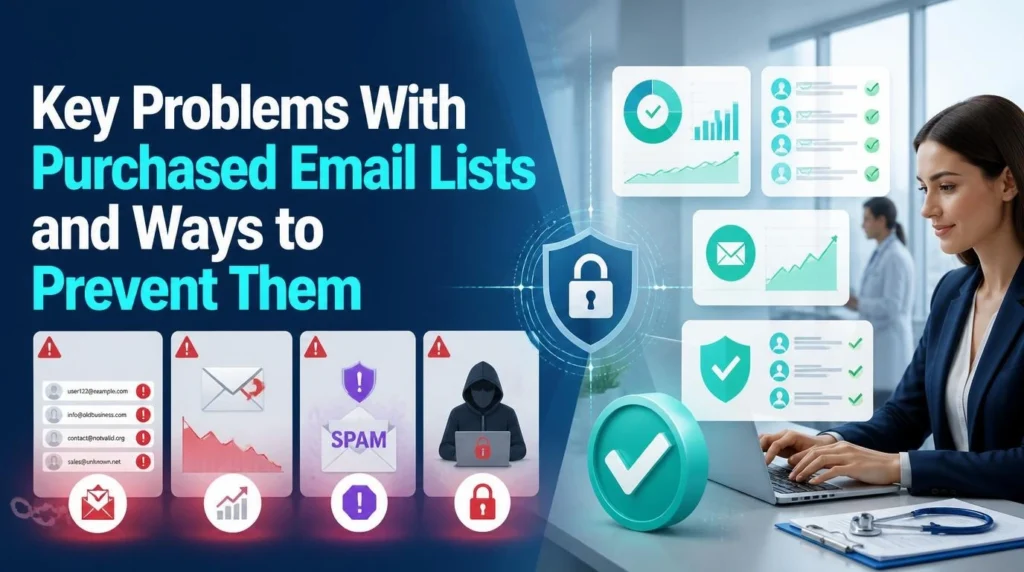
The Problems With Purchased Email Lists can affect campaign performance, deliverability, data quality, and customer trust. Businesses that use third-party contact data should therefore evaluate where the information came from, how recently it was verified, and whether the intended communication is appropriate.
A successful B2B email strategy is not based simply on having more addresses. It depends on reaching relevant people with useful information while managing data responsibly.
Understanding Purchased Email Lists
A purchased email list is a collection of contact records obtained from an external provider for a fee. Depending on the provider, these records may contain professional email addresses along with information such as names, job titles, company names, industries, locations, and other business details.
The quality of these databases can differ considerably.
One provider may maintain frequently updated professional records, while another may offer information that has not been reviewed for a long period. Some databases may also contain duplicate, incomplete, or irrelevant records.
This makes evaluation important before a business decides whether an external database is appropriate for its marketing activities.
Why Do Companies Consider Buying Email Lists?
Businesses may look at purchased databases when they want to expand their prospecting activities or enter a new market.
For example, a company launching a service for healthcare organizations may want to identify professionals working in hospitals, clinics, pharmaceutical companies, medical technology firms, or other healthcare-related organizations.
Creating a targeted audience organically can require considerable time and effort. An external database may appear to provide a faster starting point.
However, speed should not replace proper research. A list that contains thousands of unsuitable or inactive contacts can consume marketing resources without producing meaningful results.
The important question is not simply how many contacts are available, but whether those contacts are relevant, accurate, and appropriate for the intended campaign.
Problem 1: The Information May No Longer Be Current
Professional contact information can change frequently.
Employees move between companies, departments are reorganized, organizations change domains, and email accounts can become inactive. As a result, a database that was accurate when originally collected may gradually lose its value.
Sending campaigns to old addresses can increase failed deliveries and reduce the overall efficiency of an email program.
Prevention
Before obtaining a database, ask the provider about its update schedule.
Important questions include:
- When was the information collected?
- How often is the database refreshed?
- Are inactive contacts removed?
- How are changes in employment detected?
- Are email addresses checked before delivery?
Businesses should also continue maintaining their own records rather than assuming that a purchased database will remain accurate indefinitely.
Problem 2: The Audience May Not Match Your Market
A contact can be genuine and still be completely unsuitable for a particular campaign.
Imagine a company that sells specialized software to hospital management teams. A database containing general business contacts from unrelated industries would have limited value, even if every email address were valid.
Poor targeting can increase costs while producing little engagement.
Prevention
Establish an audience profile before selecting any external data.
Consider factors such as:
- Industry
- Professional role
- Seniority
- Organization type
- Company size
- Location
- Business function
- Relevant interests
A clearly defined audience makes it easier to determine whether a database actually supports the campaign objective.
Problem 3: Contact Details Can Be Inaccurate
Not every record in an external database is guaranteed to be correct.
A contact’s name may be misspelled, their job title may have changed, or the company information may no longer correspond with their current role.
Incorrect information can make a campaign look careless and may reduce recipient confidence.
Prevention
Look for providers that explain how their information is collected and reviewed.
Businesses can also use data-validation processes before importing records into their marketing systems.
Where possible, compare important details against reliable business sources and remove records that cannot be reasonably verified.
Problem 4: Too Many Messages May Fail to Reach Their Destination
A database containing inactive or incorrect addresses can lead to a high number of failed deliveries.
This situation is generally described as a high email bounce rate. A significant number of failed messages can indicate that the underlying data needs attention.
It also means marketing teams are spending effort on contacts who cannot receive the communication.
Prevention
Validate addresses before launching a campaign.
After sending, monitor delivery results and remove addresses that repeatedly fail. Maintaining a smaller database of usable contacts is generally more practical than keeping a large collection of questionable records.
Problem 5: Recipients May Have Little Interest in the Offer
A person may meet the demographic or professional criteria for a campaign without having any interest in the product being promoted.
For instance, a healthcare professional may work within the industry but have no role in purchasing or using the promoted service.
This can lead to weak engagement even when the database appears relevant on paper.
Prevention
Go beyond basic contact information.
Where appropriate, consider business needs, professional responsibilities, previous interactions, and other legitimate indicators of relevance.
Marketing messages should also explain why the information may be useful to the recipient instead of immediately focusing on a sales pitch.
Problem 6: Recipients May Regard the Email as Unwanted
People are generally more receptive to communication when they understand why they are receiving it.
A message from an unfamiliar company can be viewed negatively if the recipient does not expect the communication or cannot see its relevance.
This may result in complaints or unsubscribes.
Prevention
Businesses should carefully review the rules that apply to their intended audience and communication method.
Campaigns should clearly identify the sender and provide an appropriate way for recipients to stop receiving future marketing messages where required.
Content should be relevant and transparent rather than misleading.
Problem 7: Email Deliverability Can Suffer
Email deliverability refers to the ability of messages to successfully reach recipients’ inboxes.
Poor-quality databases can contribute to negative sending signals when they generate excessive bounces, complaints, or other unwanted engagement patterns.
Repeatedly, this may affect a company’s ability to reliably deliver emails to genuine subscribers and potential customers.
Prevention
Good database hygiene is essential.
Businesses should:
- Remove invalid addresses
- Monitor bounce rates
- Track complaint rates
- Avoid sending irrelevant campaigns
- Respect unsubscribe requests
- Maintain accurate records
- Send content appropriate to the audience
These practices can help support healthier email operations.
Problem 8: Professional Reputation May Be Affected
B2B communication contributes to how an organization is perceived.
Repeatedly sending irrelevant or poorly targeted emails can make a company appear careless. This may affect how potential customers view its brand.
Trust can be especially important in industries where purchases involve substantial budgets, sensitive information, or multiple decision-makers.
Prevention
Treat every campaign as part of the overall customer experience.
Use accurate information, professional messaging, clear sender identification, and useful content. A smaller group of relevant prospects can often provide a better foundation for communication than a large collection of poorly matched contacts.
Problem 9: Duplicate Records Can Distort Your Database
External databases may contain multiple records representing the same person.
Duplicates can occur because of differences in spelling, company names, job titles, or email addresses.
If duplicates are not removed, the same individual might receive the same campaign multiple times.
Prevention
Clean the database before using it.
Email address is usually one useful field for identifying duplicates, but companies may also compare names, organizations, domains, and other available business information.
A clean CRM makes campaign management and reporting easier.
Problem 10: Data Collection Methods May Be Unclear
One of the most important questions to ask about an external database is how the information was obtained.
If a provider cannot clearly explain its data sources, update process, or collection practices, businesses may have difficulty assessing whether the information is suitable for their intended use.
Prevention
Ask providers direct questions about:
- Collection methods
- Data sources
- Verification procedures
- Update frequency
- Geographic coverage
- Industry coverage
- Privacy practices
- Data removal procedures
Clear answers provide a stronger basis for evaluating a potential data supplier.
Problem 11: Privacy Requirements Can Vary
Email and data-protection requirements are not identical everywhere.
Rules may differ depending on the recipient’s location, the type of organization, the nature of the communication, and how the information was collected.
Buying an email address does not automatically mean that a business has unrestricted permission to send every type of marketing communication to that individual.
Prevention
Before using external contact data, businesses should identify the requirements relevant to their campaign.
They should consider:
- Whether consent is necessary
- Whether the communication is permitted
- How personal information was obtained
- What disclosures are required
- How opt-out requests will be handled
- How contact data will be stored
For campaigns involving multiple countries, organizations may need appropriate professional compliance advice.
Problem 12: Generic Messaging Can Reduce Results
Even an accurate database may perform poorly when every recipient receives exactly the same message.
A healthcare executive, medical researcher, procurement professional, and technology manager can have very different priorities.
A generic message may fail to address any of them effectively.
Prevention
Use audience segmentation to create more relevant communication.
For instance, a campaign for healthcare procurement professionals might discuss purchasing considerations, while content for healthcare technology leaders could address implementation or integration.
The more closely the message matches the recipient’s legitimate business interests, the more useful the communication can become.
Problem 13: Buying Data Does Not Create Buying Intent
One of the biggest misconceptions about purchased databases is that having someone’s contact information means that person is a sales prospect.
A database may identify who a person is and where they work, but it does not necessarily indicate whether they are currently researching a solution.
This distinction is important.
Prevention
Combine contact information with genuine engagement signals.
Examples may include:
- Visiting relevant website pages
- Downloading educational resources
- Registering for webinars
- Requesting information
- Responding to previous communication
- Engaging with relevant business content
These actions can provide additional context when evaluating potential opportunities.
Problem 14: Businesses May Become Too Dependent on External Data
Purchased lists can be one potential source of prospects, but depending entirely on them can create an unbalanced acquisition strategy.
A sustainable marketing program can also attract people through channels where they voluntarily interact with the business.
Prevention
Consider developing several lead-generation channels, such as:
- Search engine optimization
- Educational content
- Website forms
- Webinars
- Industry events
- Referrals
- Professional networking
- Social media
- Direct inquiries
These methods can complement other prospecting activities and help create a broader marketing ecosystem.
Problem 15: There May Be No Clear Follow-Up Process
Even a relevant prospect may not become a customer after one communication.
B2B purchases can involve research, internal discussions, budget approval, product comparisons, and several stakeholders.
Without an effective follow-up plan, valuable prospects and sales opportunities could be overlooked.
Prevention
Develop a structured nurturing process.
Depending on the audience, businesses can provide educational resources, industry insights, case studies, product information, demonstrations, or other relevant material.
The purpose should be to support the buyer’s decision-making process rather than repeatedly sending promotional messages.
How to Evaluate a Purchased Email Database
Before using an external database, businesses can review several factors.
| Evaluation Area | What to Check |
| Data freshness | When was the information last reviewed? |
| Accuracy | How are email addresses and business details verified? |
| Relevance | Does the audience match the ideal customer profile? |
| Segmentation | Can contacts be filtered by industry, role, or location? |
| Source | Is the provider transparent about where the contact information was collected? |
| Duplicates | Are repeated records removed? |
| Compliance | Can the provider explain relevant data practices? |
| Maintenance | How frequently is the database updated? |
| Support | What happens when inaccurate records are identified? |
This evaluation can help businesses identify weaknesses before committing resources to a campaign.
Purchased Data and Permission-Based Audiences
There is an important difference between third-party contact information and audiences that have previously engaged with a company.
When someone subscribes to a newsletter, downloads a resource, registers for an event, or requests information, the organization may have a clearer understanding of that person’s relationship with the brand.
People whose information was obtained through an external source may have different expectations about receiving communications.
Therefore, businesses should take the method of audience acquisition into account when planning their communication approach.
Better Ways to Manage External Contact Data
If a business decides that external data is appropriate for its strategy, responsible management should remain a priority.
A practical process can include:
Evaluate → Verify → Segment → Communicate → Monitor → Clean
First, evaluate the source and relevance of the database. Next, verify important contact information and remove unsuitable records.
Next, divide the contacts into relevant groups and create communication suited to each segment. Monitor campaign results and regularly clean the database based on delivery, engagement, and recipient preferences.
This process can help prevent a one-time purchase from becoming a long-term data-quality problem.
Signs That an Email List May Be Low Quality
Businesses should be cautious when a provider makes claims that cannot be supported with clear information.
Potential warning signs include:
- No explanation of data sources
- Extremely vague update information
- No details about verification
- Large numbers of incomplete records
- Unusually broad targeting
- Excessive duplicate entries
- No clear process for correcting inaccurate data
- Lack of transparency around data practices
A provider’s ability to answer basic questions can be an important part of evaluating the reliability of its database.
How to Reduce Risk Before Launching a Campaign
Businesses can take several preliminary steps before sending messages to an external audience.
First, review the intended recipients and remove contacts that clearly fall outside the target market.
Second, validate the available contact information.
Third, check the communication requirements that apply to the recipients.
Fourth, prepare content that is genuinely relevant to the audience.
Finally, monitor campaign performance closely rather than assuming that a large list will automatically generate positive results.
This approach can make the process more controlled and measurable.
Building a Sustainable B2B Email Strategy
Long-term email marketing should focus on relationship building rather than simply increasing database size.
Businesses can strengthen their strategy by consistently producing useful content, learning from audience interactions, maintaining accurate records, and respecting communication preferences.
External databases may help with prospect research in some situations, but they should not replace the fundamentals of effective marketing.
The strongest strategies combine accurate audience understanding with relevant communication and continuous measurement.
Key Practices to Remember
Businesses considering purchased email data can keep several principles in mind:
- Know your audience before selecting a database.
- Investigate how the information was collected.
- Check how recently the data was updated.
- Validate important contact information.
- Remove duplicates and unsuitable records.
- Segment prospects according to meaningful criteria.
- Create useful, audience-specific content.
- Monitor delivery and engagement results.
- Respect applicable privacy and communication requirements.
- Continue building direct relationships with interested audiences.
These practices can help businesses make more informed decisions about external contact data.
Conclusion
Purchased email databases can provide access to potential business contacts, but they also introduce challenges that should not be overlooked. Outdated records, irrelevant contacts, inaccurate information, delivery problems, weak engagement, complaints, unclear data sources, and privacy considerations can all affect the success of an email campaign.
The key is to evaluate the quality and suitability of the data before using it. Businesses should verify information, define their target audience, segment contacts, create relevant messages, monitor results, and maintain their databases over time.
A B2B Healthcare Mailing List can be useful for targeted healthcare prospecting when the information is relevant, properly evaluated, and handled in accordance with applicable privacy and email marketing requirements. Ultimately, effective B2B marketing is less about acquiring the largest possible database and more about creating meaningful communication with the right professional audience.