Skip to main content

Businesses that market healthcare products, services, software, and professional solutions often need to communicate with audiences across different parts of the United States. A campaign that performs well in one state may not produce the same results in another because industries, business sizes, healthcare systems, regulations, and professional needs can vary significantly.
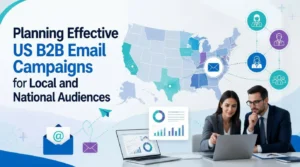
A well-planned US B2B Email Campaigns strategy can help marketers organize audiences based on location while maintaining consistent messaging and campaign objectives. Instead of treating the entire country as one audience, businesses can combine local targeting with national outreach to make their email marketing more relevant.
For healthcare-focused businesses, a B2B Healthcare Email List can support targeted communication with relevant professional audiences when it is properly segmented and maintained.
What Are Local and National B2B Email Campaigns?
Local B2B email campaigns focus on businesses or professionals within a specific geographic area. This could mean targeting recipients in one state, several neighboring states, a metropolitan area, or a particular healthcare market.
National campaigns, on the other hand, are designed to reach audiences across multiple states or throughout the United States. They generally use broader messaging that applies to a wider range of organizations.
Both approaches can be useful. The right choice depends on the company’s goals, audience, products, sales territory, and campaign resources.
For example, a healthcare software company launching a product in California may initially use state-specific messaging. Once the campaign is established, the company could expand the same offer nationally while adapting messaging based on regional performance.
Why Geographic Segmentation Matters in B2B Email Marketing
Geographic segmentation allows marketers to organize audiences according to location. While location alone does not determine a buyer’s needs, it can provide useful context for campaign planning.
Different states can have different:
- Healthcare market structures
- Business concentrations
- Population sizes
- Professional demographics
- Healthcare facilities
- Industry clusters
- Economic conditions
- Regional business priorities
A healthcare technology company may therefore find that its strongest opportunities are concentrated in particular states or metropolitan markets.
Instead of sending identical emails to every contact, marketers can use geographic information as one layer of segmentation alongside job title, specialty, organization type, company size, and business interests.
Local vs. National: Which Strategy Should Businesses Choose?
There is no universal answer. Local and national campaigns serve different purposes.
A local strategy is generally more appropriate when the business has a concentrated sales territory, regional service availability, local events, or state-specific messaging.
A national approach can be useful when the company sells products or services throughout the country and has the operational capacity to serve customers across multiple markets.
Many businesses can also use a hybrid strategy.
For example, a company could maintain a national campaign for general product education while creating localized campaigns for states where it has sales teams, events, partnerships, or stronger market opportunities.
Key Differences Between Local and National Campaigns
| Factor | Local B2B Email Campaign | National B2B Email Campaign |
| Audience | Businesses in selected locations | Businesses across the US |
| Messaging | More location-specific | Broader and widely applicable |
| Geographic segmentation | High | Moderate |
| Personalization | Can reference regional factors | Usually based on broader business needs |
| Campaign size | Smaller audience | Larger audience |
| Testing | State or regional testing | Nationwide testing |
| Sales alignment | Regional sales teams | National sales teams |
| Best use | Local expansion and regional outreach | Broad awareness and nationwide growth |
The choice should ultimately depend on campaign objectives rather than simply audience size.
Step 1: Define the Campaign Objective
Before dividing an audience by state, establish what the campaign is supposed to accomplish.
Possible objectives include:
- Generating qualified leads
- Promoting healthcare software
- Introducing a new product
- Increasing webinar registrations
- Promoting an industry event
- Sharing educational content
- Supporting sales outreach
- Building brand awareness
- Encouraging product demonstrations
- Re-engaging existing prospects
A clearly defined objective makes it easier to decide whether geographic segmentation is necessary.
For example, an invitation to a healthcare conference in Texas should probably use a localized campaign. A nationwide report about healthcare technology trends may be more appropriate for a national campaign.
Step 2: Identify Priority US States
Not every state needs to receive equal attention.
Businesses can prioritize states according to their existing customers, sales opportunities, healthcare market size, business presence, or historical campaign performance.
A practical approach is to divide states into groups such as:
Tier 1: High-priority states with strong sales opportunities.
Tier 2: Emerging states where the business wants to increase awareness.
Tier 3: Lower-priority markets that can remain part of broader national campaigns.
This approach allows marketers to allocate resources more efficiently.
Step 3: Segment the Audience Beyond Location
State-level targeting should not be the only form of segmentation.
For B2B healthcare marketing, marketers may also consider:
- Job role
- Medical specialty
- Organization type
- Healthcare facility type
- Company size
- Business function
- Seniority level
- Professional interests
- Previous engagement
- Customer or prospect status
For example, sending the same email to a hospital executive, independent physician, healthcare technology manager, and medical supplier may not produce the same results.
Combining geographic segmentation with professional information can create more meaningful audience groups.
Step 4: Build a Reliable B2B Healthcare Audience
Campaign performance depends heavily on audience quality.
A large database is not necessarily a valuable database if contacts are outdated, duplicated, incorrectly categorized, or irrelevant to the campaign.
Healthcare marketers should pay attention to factors such as:
- Contact accuracy
- Business relevance
- Current professional information
- Geographic accuracy
- Role and organization details
- Duplicate records
- Invalid email addresses
- Suppression lists
- Consent and applicable communication requirements
A well-maintained B2B Healthcare Email List can make segmentation easier because marketers can organize contacts according to relevant business and professional characteristics.
Businesses should also review their data regularly rather than assuming that contact information remains accurate indefinitely.
Step 5: Create Localized Messaging
Localized email marketing does not necessarily mean completely rewriting every campaign.
Small adjustments can make an email more relevant to a particular audience.
For example, marketers can customize:
- Opening statements
- Examples
- Case studies
- Event references
- Regional business challenges
- Calls to action
- Sales contact information
- Landing pages
Suppose a healthcare technology company is promoting an appointment-management platform.
A national email could focus on improving administrative efficiency across healthcare organizations.
A state-specific campaign could highlight a local healthcare event, regional customer example, or market-specific business consideration when those details are genuinely relevant.
The goal should be useful personalization rather than simply inserting the name of a state into an email.
Step 6: Keep National Campaigns Broad but Relevant
National campaigns have the advantage of scale, but broad messaging can become generic if marketers are not careful.
A nationwide email should focus on challenges that are relevant to the majority of the intended audience.
For example, a healthcare software company might discuss:
- Operational efficiency
- Patient engagement
- Data management
- Digital transformation
- Healthcare cybersecurity
- Workforce challenges
- Technology adoption
The message can remain broad while the audience is still segmented by job function or organization type.
National campaigns should not assume that every healthcare organization operates in exactly the same way.
Step 7: Use Regional Data to Improve Campaign Decisions
Campaign analytics can reveal which states or regions are responding most effectively.
Marketers can monitor metrics such as:
- Delivery rate
- Open rate
- Click-through rate
- Landing-page visits
- Form submissions
- Demo requests
- Conversion rate
- Unsubscribe rate
- Bounce rate
- Qualified leads
Suppose a national campaign generates significantly more qualified leads from three states than from the rest of the country.
Rather than immediately increasing the entire campaign volume, marketers can investigate those markets more closely.
They may create dedicated campaigns for the stronger states and test different messaging, offers, or content.
Step 8: Test Local and National Campaigns
Testing can help businesses determine whether geographic personalization actually improves performance.
A company might compare:
Campaign A: One national message sent to the entire target audience.
Campaign B: Separate messages customized for selected states.
The comparison should use meaningful business metrics rather than relying only on opens.
For B2B campaigns, qualified leads, engagement, meetings, and conversions may provide more useful information than surface-level engagement metrics.
Testing can also include different subject lines, content formats, offers, calls to action, and landing pages.
Step 9: Coordinate Email With Landing Pages
Email and landing-page messaging should be consistent.
If an email promotes a healthcare webinar for professionals in a specific region, the landing page should clearly communicate the same event information.
For national campaigns, a general landing page may be appropriate.
For local campaigns, businesses can consider dedicated landing pages when there is enough traffic and a meaningful difference in the audience’s needs.
This can create a smoother experience from email interaction to conversion.
Step 10: Consider Timing Differences
Timing can influence campaign performance, particularly when audiences are distributed across multiple time zones.
The United States includes several time zones, so a single send time may not be ideal for every recipient.
Marketers can test sending campaigns according to recipient time zones or schedule different regional campaigns separately.
However, timing should be tested rather than assumed. Audience behavior can differ based on profession, organization type, and working patterns.
A healthcare professional may also have a very different email engagement pattern from a healthcare technology executive or procurement manager.
Local Campaigns Can Support Market Expansion
Local campaigns can be particularly useful when a company wants to expand into a new market.
Instead of immediately launching a large national campaign, the business can select several priority states and test its positioning.
The campaign can then provide insights into:
- Audience interest
- Product-market fit
- Messaging performance
- Lead quality
- Sales response
- Content preferences
If results are positive, the company can gradually expand its outreach.
This approach can reduce unnecessary spending and give marketers more opportunities to learn before scaling.
National Campaigns Can Support Brand Awareness
National campaigns remain valuable for companies that serve customers across the United States.
They can help businesses distribute:
- Industry reports
- Research findings
- Educational guides
- Product announcements
- Webinars
- Newsletters
- Thought-leadership content
A national campaign can establish broad awareness while regional campaigns provide deeper engagement in priority markets.
Using both approaches can create a balanced email marketing strategy.
Avoid Over-Segmentation
Geographic personalization can be useful, but creating too many small segments can make campaigns difficult to manage.
For example, a business does not necessarily need a completely different campaign for every state.
If the message, offer, audience, and sales process are essentially the same, a national campaign may be more efficient.
A practical segmentation strategy should balance:
Relevance + Scale + Resources + Campaign Goals
The goal is to create meaningful audience segments rather than simply increasing the number of segments. It is to create useful segments that lead to better communication and measurable business outcomes.
Email Compliance Should Remain a Priority
B2B email marketing still requires responsible data practices.
Businesses should consider applicable email marketing, privacy, and data-protection requirements when collecting, storing, segmenting, and contacting professional audiences.
Marketers should maintain appropriate suppression processes, honor opt-out requests, keep data reasonably accurate, and avoid misleading subject lines or sender information.
Requirements can vary depending on the type of communication, audience, data source, and jurisdiction. Businesses should therefore review their compliance responsibilities before launching large-scale campaigns.
How to Create a Hybrid Local-National Strategy
A hybrid model can combine the advantages of both approaches.
For example:
National layer:
Use broad campaigns to promote educational content, industry research, product information, and brand messaging.
Regional layer:
Create targeted campaigns for priority states where sales opportunities, events, partnerships, or customer concentration justify additional personalization.
Professional layer:
Within each geographic segment, organize recipients by job function, specialty, organization type, or business need.
This three-level approach can make campaigns more structured without creating unnecessary complexity.
Common Mistakes to Avoid
Treating Every State the Same
A national campaign may overlook regional differences. Review campaign data regularly to determine whether certain markets require additional attention.
Relying Only on Geographic Data
Location is useful, but professional role and business relevance can be equally important.
Creating Too Many Campaigns
Excessive segmentation can consume resources without improving results. Create separate campaigns only when there is a meaningful difference in audience needs or objectives.
Using Generic Personalization
Adding a state name to an email does not automatically make the content relevant. Personalization should provide actual value.
Ignoring Data Quality
Outdated or inaccurate contact records can increase bounce rates and reduce campaign efficiency.
Measuring Only Email Opens
Open rates can provide directional information, but B2B marketers should also evaluate clicks, leads, meetings, conversions, and overall business outcomes.
A Practical Workflow for US B2B Email Campaigns
Businesses can use the following process when planning geographic email campaigns:
- Define the goal
Determine whether the campaign is intended for awareness, engagement, lead generation, or conversion. - Identify the audience
Define the relevant professional roles, industries, organizations, and geographic markets. - Prioritize states
Use business opportunities and historical performance to determine priority markets. - Clean the data
Remove duplicates, invalid records, and contacts that should no longer receive communication. - Create segments
Combine location with relevant professional or business characteristics. - Develop messaging
Create national content and localized variations where useful. - Test campaigns
Compare different approaches using meaningful performance indicators. - Measure results
Review engagement, lead quality, conversion, and revenue-related metrics. - Optimize
Invest more resources in segments that demonstrate meaningful business potential. - Scale carefully
Expand successful regional strategies into additional markets while continuing to monitor performance.
Final Thoughts
Planning effective B2B email marketing across the United States does not have to mean choosing between local and national campaigns. Both strategies can serve important purposes.
National campaigns can provide scale and consistent brand communication, while local campaigns can help businesses address specific markets with greater relevance. The strongest approach often combines both.
Geographic segmentation should also be considered alongside professional roles, organization types, industry interests, and engagement behavior. A data-driven approach allows marketers to identify which markets deserve additional attention without creating unnecessary campaign complexity.
For healthcare marketers, maintaining accurate audience information is particularly important because professional roles and organizational structures can change over time. A properly managed B2B Healthcare Mailing List can support organized segmentation and targeted outreach when used responsibly and in accordance with applicable communication requirements.
Ultimately, successful US B2B Email Campaigns depend less on sending the largest possible number of emails and more on reaching the right professional audience with useful, relevant, and timely information.