Skip to main content
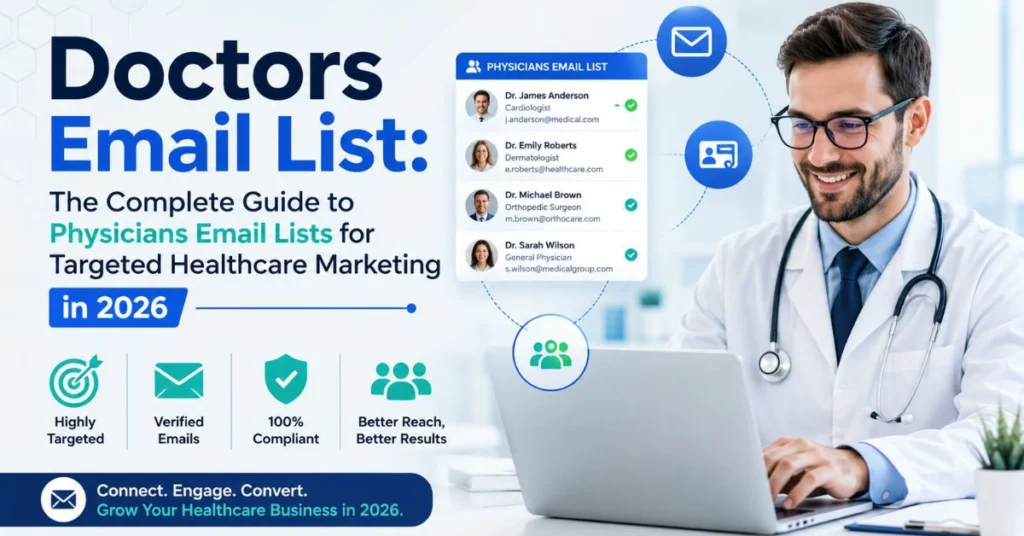
Reaching licensed physicians at scale has never been more strategically critical — or more technically demanding — than it is today. Physicians Email Lists have become the backbone of high-performance B2B healthcare campaigns, enabling marketers, recruiters, pharmaceutical reps, and medical device companies to connect directly with the right clinical decision-makers. Whether you are launching a new drug, pitching a SaaS platform, or filling a locum tenens role, a verified Doctors Email List gives you the precise targeting infrastructure your outreach demands.
This comprehensive guide covers everything you need to know: what a physicians email list is, how it’s built, how to evaluate vendors, how to stay compliant, and how to squeeze maximum ROI from every campaign you send.
What Is a Doctors Email List?
A Doctors Email List — also widely referred to as a Physicians Email List, Physician Contact Database, or Medical Professionals Email List — is a curated, structured dataset containing the verified contact details of licensed physicians practicing across the United States or globally.
These lists are compiled from a variety of authoritative sources, including:
- State medical licensing boards
- National Provider Identifier (NPI) registries
- Hospital and clinic affiliations directories
- Medical association memberships (AMA, specialty boards)
- Peer-reviewed journal subscriptions
- Opt-in digital touchpoints and healthcare professional portals
The purpose of a Doctor Contact Database is to give B2B healthcare marketers, pharmaceutical companies, medical device manufacturers, telemedicine providers, and healthcare SaaS platforms a direct, reliable channel to reach physicians without relying on cold calling or expensive paid advertising. Unlike general B2B lists, a properly built physician email directory is specialty-coded, licensure-verified, and geographically segmented — meaning every record corresponds to an actual, practicing medical professional.
In the United States alone, there are over 1 million actively licensed physicians across more than 120 recognized specialties. A well-maintained US Physicians Email List makes that entire universe of potential contacts accessible and filterable for precise campaign targeting.
Key Statistics: The State of Physician Email Marketing in 2025
Understanding the market landscape puts the value of a verified healthcare email list in sharp context. Here are the most relevant figures shaping physician outreach in 2025:
- Over 1.1 million licensed physicians are actively practicing in the United States as of 2024 (AAMC Physician Workforce Report).
- 72% of physicians report checking their professional email at least once daily, making email the single highest-reach channel for clinical outreach (Doceree Healthcare HCP Survey, 2024).
- Email marketing ROI in B2B healthcare averages $42 for every $1 spent when campaigns are precisely segmented — one of the highest returns of any outreach channel (DMA, 2024).
- Pharmaceutical companies that deploy targeted physicians email lists for marketing see response rates 3–5× higher than those using untargeted broadcast lists.
- Open rates for personalized physician email campaigns average between 22% and 31%, compared to a 14% industry average for general B2B emails (Mailchimp Healthcare Benchmarks, 2024).
- The global healthcare email marketing market is projected to reach $3.2 billion by 2027, growing at a CAGR of 14.8%.
- 63% of medical device companies cite email as their primary channel for reaching physicians, outpacing digital ads, conferences, and direct mail.
- A Verified Physicians Email List with quarterly data refresh reduces bounce rates by up to 68% compared to static, unverified lists (industry benchmark, 2024).
These numbers confirm what experienced healthcare marketers already know: a high-quality, segmented Physician Email Database is not a commodity — it is a strategic competitive asset.
What Is Included in a Physicians Email List?
A comprehensive Doctor Contact Database from a reputable provider typically includes the following data fields per record:
Primary Contact Details
- Professional email address (verified)
- Direct phone number or office number
- Fax number (still widely used in clinical settings)
- Mailing address (street, city, state, ZIP)
Professional Identifiers
- Full name (first, middle initial, last)
- Medical specialty (primary and secondary)
- Board certifications held
- NPI number (National Provider Identifier)
- Medical license number and issuing state
- Years in practice
Institutional Affiliations
- Hospital name(s)
- Practice/clinic name
- Health system or group affiliation
- Academic/teaching hospital status
Demographics and Segmentation Data
- State and metropolitan area
- Gender (where available and compliant)
- Medical school and graduation year
- DEA registration status (for pharmaceutical targeting)
Campaign-Ready Append Data
- Social media profile links (LinkedIn, Doximity)
- Technology adoption scores (EHR platform used)
- Publication and research activity flags
The richness of these fields is what separates a premium Physician Email List by Specialty from a basic contact compilation. Bulk email lists for medical professionals that lack specialty coding, NPI verification, and geographic tagging are functionally limited for precision campaigns.
Types of Physicians Email Lists: Specialty and State Segmentation
One of the most powerful features of a modern Targeted Physicians Email List for Marketing is its ability to be filtered by clinical specialty and geographic region. This transforms a raw contact database into a laser-focused outreach instrument.
Physician Email List by Specialty
Different healthcare marketing campaigns require different clinical audiences. Here are the most commonly requested specialty segments:
- General Practice, Internal Medicine, Family Medicine
- Surgical Specialties: Orthopedic Surgeons, Neurosurgeons, Cardiothoracic Surgeons, General Surgeons
- Cardiology: Interventional Cardiologists, Electrophysiologists, Cardiac Surgeons
- Oncology: Medical Oncologists, Radiation Oncologists, Surgical Oncologists
- Dermatology: General Dermatologists, Mohs Surgeons, Cosmetic Dermatologists
- Psychiatry and Behavioral Health: Psychiatrists, Child Psychiatrists, Addiction Medicine Specialists
- Radiology: Diagnostic Radiologists, Interventional Radiologists, Nuclear Medicine Physicians
- Pediatrics: General Pediatricians, Pediatric Subspecialists
- OB/GYN: Obstetricians, Gynecologic Oncologists, Maternal-Fetal Medicine Specialists
- Emergency Medicine: Emergency Physicians, Intensivists, Hospitalists
Physician Email List by State
Geographic segmentation is equally important for compliance, territory management, and regional campaign relevance:
- High-volume states: California, Texas, Florida, New York, Pennsylvania collectively account for nearly 40% of all US practicing physicians.
- Growth markets: Arizona, Colorado, North Carolina, and Georgia are experiencing rapid physician population growth due to migration and expanding health systems.
- Targeted MSAs: Campaigns can be filtered to specific metropolitan statistical areas (e.g., Chicago Metro, Dallas-Fort Worth, Miami-Dade) for hyper-local outreach.
A Physician Email List by State is especially valuable for telemedicine providers expanding into new markets, healthcare recruiters filling regional positions, and medical device companies managing sales territories.
Doctors Email List vs. Healthcare Provider Email List: Key Differences
The terms “doctors email list” and “healthcare provider email list” are frequently used interchangeably by marketers. Although they are similar products, they differ significantly.
| Feature | Doctors Email List | Healthcare Provider Email List |
| Primary Audience | Licensed MDs and DOs only | MDs, DOs, NPs, PAs, RNs, Dentists, Pharmacists, Therapists |
| Scope | Narrower; physician-exclusive | Broader; entire clinical workforce |
| Average List Size (US) | 800K–1.1M records | 3M–5M+ records |
| Specialty Granularity | High (120+ specialties) | Moderate (varies by provider type) |
| NPI Verification | Standard | Varies by record type |
| Best For | Pharma, medical devices, physician-specific SaaS | Hospitals, staffing agencies, broad health system outreach |
| Cost Per Record | Higher (precision premium) | Lower per record; higher minimum purchase |
| Compliance Complexity | Moderate | Higher (more regulated roles: RNs, pharmacists) |
| Engagement Rate | Higher (targeted messaging) | Lower on average (less personalization) |
| Update Frequency Needed | Quarterly minimum | Bi-annual acceptable |
Summary: If your product, service, or message is specifically for physicians — prescribing authority, clinical decision-making, surgical adoption — choose a dedicated Doctors Email List. If your campaign spans the broader clinical team, a Healthcare Provider Email List or Medical Email List provides wider reach at a lower cost per contact.
Buyer’s Guide: How to Choose the Best Physician Email Database
Not all Physician Contact Lists are created equal. This buyer’s guide gives you the evaluation criteria to separate premium providers from data brokers selling stale, unverified compilations.
1. Data Sourcing Transparency
Ask every vendor: Where does your data come from? Reputable providers source from NPI registries, state licensing boards, medical associations, and opt-in physician portals. Avoid vendors who cannot or will not disclose their sources.
2. Verification Methodology
A Verified Physicians Email List should have undergone multi-step validation:
- Email deliverability verification (SMTP ping, bounce testing)
- NPI cross-reference to confirm active licensure
- Phone verification for high-value records
- Human review for senior or specialist segments
Ask for documentation of the verification process, not just a claim of accuracy.
3. Data Freshness and Update Frequency
Physician contact data decays at approximately 25–30% annually due to practice changes, relocations, retirements, and hospital transitions. A list that was “accurate” 18 months ago may now have a 40%+ error rate. Require quarterly refresh cycles at minimum for any Physician Mailing List you deploy at scale.
4. Deliverability Guarantees
Premium providers offer guaranteed deliverability rates — typically 90–95%. If a vendor cannot offer a deliverability guarantee with a replacement policy for bounced records, that is a significant red flag.
5. Segmentation Capability
The more filters available — specialty, state, years in practice, hospital affiliation, DEA status, EHR platform — the more precise your targeting can be. Demand a data dictionary before purchasing and test-segment to verify the filter depth is real, not theoretical.
6. Sample Data Before Purchase
Always request a sample dataset of 25–50 records before committing to a full list purchase. Verify a random selection of records manually using NPI Lookup (npiregistry.cms.hhs.gov) and LinkedIn before evaluating the broader dataset.
7. Compliance Documentation
A legitimate Email List for Physicians provider will supply documentation confirming their data collection and processing practices meet CAN-SPAM, GDPR (for any EU-touching data), and CCPA requirements. Do not purchase without receiving a compliance statement.
8. Pricing Structure and Minimums
Be wary of extremely cheap lists. Quality physician data costs more because it requires active maintenance. A baseline Bulk Email List for Medical Professionals from a reputable vendor typically runs between $0.10 and $0.50 per verified record depending on segmentation depth, list size, and exclusivity.
How to Purchase a Physicians Email List
Purchasing a Physicians Email List USA is a structured process when done correctly. Follow these steps:
Step 1 — Define your target audience. Nail down your specialty filters, geographic scope, years-in-practice range, and any institutional filters (academic vs. private practice, hospital-employed vs. independent).
Step 2 — Shortlist 3–5 vendors. Evaluate providers based on the buyer’s guide criteria above. Major players in the US market include IQVIA, Definitive Healthcare, InfoUSA/Data.com Marketplace, MedData, and specialty healthcare data brokers.
Step 3 — Request counts and samples. Get record counts for your defined filters and request a sample for manual verification before negotiating price.
Step 4 — Negotiate terms. Discuss deliverability guarantees, replacement policies, exclusivity, usage rights (single-use vs. annual license), and data format (CSV, Excel, CRM-ready API).
Step 5 — Execute a data use agreement. Formalize the purchase with a DUA that specifies allowable use cases, compliance obligations, and data handling requirements.
Step 6 — Integrate and validate. Before your first send, run the list through your own email verification tool (ZeroBounce, NeverBounce, or similar) for an independent quality check.
How Accurate Is a Physicians Email List?
Accuracy depends entirely on the provider’s sourcing rigor and the age of the data at time of delivery. Industry-standard benchmarks:
- Top-tier verified lists: 92–96% email deliverability at time of delivery
- Mid-tier compiled lists: 75–85% deliverability
- Unverified bulk lists: 50–65% deliverability (unacceptable for professional campaigns)
Physician data accuracy is further challenged by the fact that physicians change practice settings more frequently than the general professional population. According to Merritt Hawkins research, the average physician changes employment every 3–5 years, with significant email address changes accompanying each transition. This is why Verified Physicians Email Lists with quarterly refresh cycles are worth the premium.
How to Verify a Physicians Email List
Before deploying any Physician Email Database to your email service provider, complete this verification workflow:
- NPI Registry Spot-Check: Randomly verify 50–100 records at npiregistry.cms.hhs.gov. Confirm name, specialty, and state match your list data.
- Email Syntax Validation: Run the full list through a syntax checker to eliminate malformed addresses.
- SMTP/Domain Verification: Use ZeroBounce, BriteVerify, or NeverBounce to test deliverability without sending. Remove all invalid, catch-all (risky), and spam trap addresses.
- Deduplication: Use your CRM or a deduplication tool to remove duplicate records that could trigger spam filters.
- Suppression List Check: Cross-reference against your existing unsubscribe, bounce, and complaint lists before importing.
- Test Send: Deploy to a small validated subset (200–500 records) first, monitoring bounce rate, open rate, and spam complaint rate before the full rollout.
Average Cost of a Physicians Email List
Pricing for a Doctor Contact Database varies significantly based on list size, segmentation, exclusivity, and provider tier. Here is a realistic pricing spectrum for the US market in 2025:
- Entry-level compiled lists (unverified): $0.02–$0.08 per record. Buyer beware — deliverability and accuracy are typically poor.
- Mid-tier verified lists: $0.10–$0.25 per record. Adequate for broad awareness campaigns with moderate targeting.
- Premium segmented lists: $0.25–$0.75 per record. Appropriate for pharmaceutical detail campaigns, medical device launches, and high-value B2B outreach.
- Annual licensed databases (full US physician file): $8,000–$50,000+ per year depending on record count, refresh frequency, and usage rights.
- Custom-built lists with append services: $1.00–$3.00 per record. Used for high-value accounts or niche subspecialty targeting.
Note that purchasing a supposedly free physicians email list from unverified online sources carries substantial risks: data quality is invariably poor, legal compliance is unknown, and using such data can damage your sender reputation and expose your organization to regulatory risk.
Compliance: GDPR, CAN-SPAM, and HIPAA Considerations
Healthcare email marketing operates at the intersection of multiple regulatory frameworks. Understanding each is non-negotiable for any organization deploying an Email List for Physicians.
CAN-SPAM Act (United States)
The Controlling the Assault of Non-Solicited Pornography And Marketing Act applies to all commercial email sent to US recipients. Key requirements:
- Do not use false or misleading header information
- Do not use deceptive subject lines
- Clearly identify the message as an advertisement
- Include your physical postal address in every email
- Provide a clear, functional opt-out mechanism
- Honor opt-out requests within 10 business days
CAN-SPAM permits B2B email to physicians without prior consent as long as these requirements are met. It is an opt-out framework, not opt-in.
GDPR (European Union / Global Data Transfers)
If any records on your Physicians Email List relate to physicians practicing in the EU or if your organization has EU operations, GDPR applies. Key differences from CAN-SPAM:
- Requires a lawful basis for processing (legitimate interest is the most commonly cited basis for B2B physician outreach)
- Requires that a Legitimate Interests Assessment (LIA) be documented
- Data subjects (physicians) have the right to access, correction, erasure, and portability
- Data transfer to non-EU countries requires Standard Contractual Clauses (SCCs) or equivalent safeguards
For Physician Email List USA campaigns targeting only US physicians, GDPR obligations are typically minimal but should be reviewed if your organization is EU-headquartered.
HIPAA Considerations
This is the most misunderstood compliance area in physician email marketing. HIPAA (Health Insurance Portability and Accountability Act) regulates Protected Health Information (PHI) — meaning patient data — not physician contact information. A Doctor Contact Database containing physician names, emails, specialties, and practice locations is not PHI and is not regulated by HIPAA.
However, if your email campaign involves sharing or soliciting patient data, integrating with EHR systems, or if your organization is a covered entity or business associate, HIPAA protocols apply to those data elements. Consult your compliance officer to map the boundary correctly.
State Privacy Laws (CCPA and Beyond)
California’s Consumer Privacy Act (CCPA) and similar state laws add another layer. While physicians acting in their professional capacity are generally outside the scope of consumer privacy laws, individual state interpretations vary. Maintain updated suppression lists and honor deletion requests to stay safe under all state frameworks.
Best Practices for Email Marketing to Physicians
Owning a quality Physicians Email List for Outreach is only the first step. Execution quality determines whether your campaign generates responses or ends up in spam folders.
Personalization Beyond First Name
Physicians receive dozens of commercial emails daily. Generic “Dear Doctor” messages are ignored. Segment your Physicians Email List for Marketing Campaigns by specialty and personalize the value proposition to each segment’s clinical context. A message about an orthopedic implant should speak the language of an orthopedic surgeon, not a general physician.
Respect Clinical Time
Keep subject lines under 40 characters. Keep body copy under 200 words for initial outreach. Lead with clinical relevance or evidence, not marketing language. Physicians are evidence-oriented — cite a clinical study, a peer outcome metric, or a regulatory clearance rather than a generic benefit statement.
Optimize Send Timing
Data consistently shows that physicians are most likely to engage with professional email between 7–9 AM and 6–8 PM local time on weekdays. Avoid Monday mornings and Friday afternoons. Test mid-week sends (Tuesday–Thursday) as your default.
Use a Professional Sending Domain
Campaigns sent from a dedicated professional subdomain (e.g., outreach@medstreamdata.com) that has been properly warmed up, SPF/DKIM/DMARC-authenticated, and listed in reputable email reputation databases will significantly outperform campaigns sent from shared IP pools or generic domains.
Multi-Touch Sequencing
A single email rarely converts in physician outreach. Build a 3–5 touch sequence spaced 5–7 business days apart: initial introduction, clinical evidence follow-up, peer case study, value offer, and final opt-out-or-engage message. Keep each touch short and distinct in its value message.
Monitor Deliverability Metrics Obsessively
Track bounce rate (target below 2%), spam complaint rate (target below 0.08%), open rate, click rate, and unsubscribe rate for every campaign deployment. Any metric outside acceptable bands should trigger immediate list hygiene and campaign review.
What is a Doctors Email List?
A Doctors Email List is a verified database of licensed physicians’ professional contact information — including email addresses, phone numbers, specialties, and practice locations — used by healthcare marketers, pharmaceutical companies, medical device firms, and B2B healthcare businesses for targeted outreach campaigns.
Who uses Physicians Email Lists?
Primary users include pharmaceutical sales and marketing teams, medical device companies, healthcare SaaS vendors, telemedicine platforms, clinical recruiters, hospital systems, and healthcare staffing agencies.
How are Physicians Email Lists built?
Reputable lists are compiled from NPI registries, state medical boards, hospital credentialing records, medical association databases, and opt-in physician portals. High-quality lists undergo email verification, NPI cross-referencing, and quarterly data refresh.
Is it legal to email physicians using a purchased list?
In the United States, emailing physicians at their professional addresses for B2B marketing purposes is legal under CAN-SPAM provided opt-out mechanisms are included and contact data is not PHI. GDPR applies for EU-related data. Physician contact information is not HIPAA-regulated.
What makes a Physicians Email List valuable?
Accuracy (92%+ deliverability), specialty segmentation depth, geographic filtering capability, NPI verification, and recency of data refresh. Lists that lack these attributes produce poor campaign performance and carry compliance risk.
What is a physicians email list?
A physicians email list is a verified database of licensed doctors’ professional contact details — including email addresses, medical specialties, practice locations, and NPI numbers — used by B2B healthcare marketers to reach physicians directly for product launches, clinical outreach, and recruitment campaigns.
How to purchase a physicians email list:
- Define target specialty, geography, and practice type
- Request vendor quotes and data samples
- Verify sample records against NPI registry
- Negotiate deliverability guarantee and replacement policy
- Execute a data use agreement
- Run independent email verification before sending
What data fields does a physicians email list include?
Verified professional email, full name, medical specialty, NPI number, license state, hospital or practice affiliation, mailing address, phone number, years in practice, and board certifications.
Key Takeaways
- A Doctors Email List is the most direct, cost-efficient channel for reaching licensed physicians at scale in the United States.
- Data accuracy, specialty segmentation, NPI verification, and quarterly refresh frequency are the four most important quality attributes to evaluate when purchasing.
- Physicians Email Lists for Marketing Campaigns deliver average email marketing ROI of $42:$1 when paired with proper personalization and send-time optimization.
- CAN-SPAM governs US physician outreach; GDPR applies for EU-related data; physician contact information is not HIPAA-regulated PHI.
- Never deploy a purchased list without running it through independent email verification (ZeroBounce, NeverBounce) and NPI spot-checking first.
- Specialty segmentation — by cardiology, oncology, orthopedics, primary care, and 100+ other fields — dramatically improves campaign relevance and response rates.
- State-level segmentation enables territory-aligned outreach and supports telemedicine geographic expansion strategies.
- A quality Physician Email Database is an investment, not a commodity: expect to pay $0.10–$0.75 per verified record from reputable providers.
- Multi-touch email sequences of 3–5 messages outperform single-send campaigns by 3× or more in physician outreach settings.
- Free physicians email lists from unverified online sources carry unacceptable accuracy, deliverability, and compliance risks.
FAQ: 15 Questions About Physicians Email Lists Answered
1. What is a physicians email list?
A physicians email list is a curated, verified database of licensed medical doctors’ professional contact information — including email addresses, specialties, NPI numbers, and practice locations. It is used by healthcare marketers, pharmaceutical companies, and medical device firms to reach physicians directly for targeted B2B outreach campaigns.
2. How do I purchase a physicians email list?
To purchase a physicians email list, identify your specialty and geographic targets, shortlist 3–5 reputable data providers, request sample data, verify records against the NPI registry, negotiate a deliverability guarantee, execute a data use agreement, and run independent email verification before your first campaign deployment.
3. What are the benefits of using a physicians email list?
A physicians email list enables direct, scalable outreach to licensed doctors by specialty, state, or affiliation. Key benefits include higher response rates than broad digital advertising, precise targeting by clinical specialty, reduced cost per qualified lead, and faster market penetration for pharmaceutical, device, and healthcare SaaS products.
4. Where can I find a physicians email list?
Reputable sources for physicians email lists include IQVIA, Definitive Healthcare, InfoUSA, MedData, and specialty healthcare data brokers. Always verify the provider’s sourcing methodology, NPI verification process, and compliance documentation before purchasing any physician contact database.
5. How accurate is a physicians email list?
Accuracy varies by provider quality and data age. Top-tier verified lists achieve 92–96% email deliverability at delivery. Mid-tier lists average 75–85%. Physician data decays at roughly 25–30% annually, so lists older than 6–12 months without refresh should be re-verified before use.
6. What is included in a physicians email list?
A comprehensive physicians email list typically includes verified professional email, full name, medical specialty, NPI number, state medical license, hospital or practice affiliation, mailing address, direct phone number, years in practice, and board certifications. Premium lists also include DEA status, EHR platform, and academic affiliation data.
7. Can I get a free physicians email list?
Free physicians email lists are available from some online sources, but they carry severe risks: poor accuracy, unknown compliance status, outdated data, and potential spam trap contamination. Using a free or unverified list can damage your sender reputation, trigger CAN-SPAM violations, and produce near-zero campaign results. The ROI case for a verified paid list is overwhelming.
8. How do I verify a physicians email list?
Verify a physicians email list by spot-checking records against the NPI registry, running the full list through an email verification tool like ZeroBounce or NeverBounce, removing invalid and catch-all addresses, deduplicating records, and cross-referencing against existing suppression lists before importing into your email service provider.
9. What is the average cost of a physicians email list?
Pricing ranges from $0.10–$0.25 per record for mid-tier verified lists to $0.25–$0.75 per record for premium segmented databases. Annual licensed access to a full US physician file costs $8,000–$50,000+ depending on record volume, refresh frequency, and usage rights.
10. Is a physicians email list GDPR compliant?
GDPR compliance depends on the vendor’s data collection practices and your organization’s lawful basis for processing. For EU-touching data, legitimate interest is the most common lawful basis for B2B physician outreach. Always obtain a GDPR compliance statement from your vendor and document your Legitimate Interests Assessment before deploying internationally.
11. Are there risks in using a physicians email list?
Yes. Risks include poor data quality causing high bounce rates that damage sender reputation, CAN-SPAM violations from missing opt-out mechanisms, reputational harm from irrelevant or impersonalized outreach, and potential GDPR exposure for EU-touching data. These risks are mitigated by purchasing from reputable vendors, verifying data independently, and following compliance best practices.
12. What is the source of the physicians email list data?
Reputable physician email databases are sourced from the NPI Registry (CMS), state medical licensing boards, hospital credentialing records, medical association directories (AMA, specialty colleges), peer-reviewed journal subscriptions, and opt-in physician professional platforms such as Doximity and Epocrates.
13. How often is a physicians email list updated?
A high-quality physicians email list should be refreshed quarterly at minimum. Physician data decays at 25–30% annually due to practice changes, relocations, and retirements. Lists refreshed less than twice per year carry meaningful accuracy degradation that directly impacts campaign deliverability and ROI.
14. Can I segment a physicians email list by specialty?
Yes. Most reputable providers offer segmentation across 80–120+ recognized medical specialties, including cardiology, oncology, orthopedic surgery, dermatology, psychiatry, radiology, pediatrics, and primary care. Specialty segmentation is one of the most powerful tools for personalizing physician outreach and improving response rates.
15. What is the difference between a physicians email list and a healthcare email list?
A physicians email list contains only licensed MDs and DOs. A healthcare provider email list or healthcare email list is broader, including nurse practitioners, physician assistants, registered nurses, dentists, pharmacists, and allied health professionals. Physicians lists offer deeper specialty granularity and higher precision; healthcare provider lists offer greater reach across the clinical workforce.
Conclusion
The ability to reach the right physician, at the right time, with the right message is the single greatest lever available to healthcare B2B marketers in 2025. A rigorously verified, specialty-segmented, compliance-ready Physician Mailing List is not simply a data purchase — it is a strategic infrastructure investment that determines whether your pharmaceutical launch, medical device campaign, SaaS demo request, or clinical recruitment drive lands with precision or disappears into irrelevance.
The organizations consistently winning in physician outreach share a common foundation: they start with quality data, verify it independently, segment it with clinical intelligence, personalize their messaging to specialty-specific pain points, and execute with disciplined compliance practices. Every element of this guide is designed to help you build and deploy that same foundation.