Skip to main content
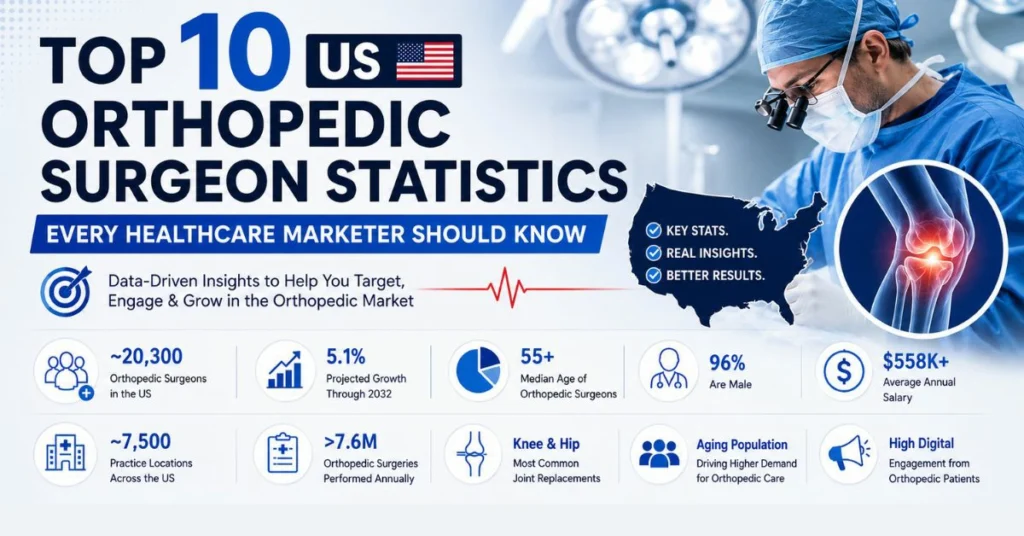
If you’re looking to connect with bone and joint specialists, having access to a reliable Orthopedic Surgeon Email List is only half the equation — you also need the numbers to back your strategy. Whether you’re pitching medical devices, surgical software, or continuing education programs, understanding the landscape of orthopedic surgery in the United States gives your outreach a sharper edge.
Healthcare marketing without data is guesswork. But when you pair smart targeting with the right statistics, your campaigns speak directly to the motivations, pressures, and professional priorities of orthopedic surgeons. Below are ten essential statistics that every healthcare marketer should know before launching their next campaign.
1. There Are Approximately 27,000 Orthopedic Surgeons Practicing in the US
Approximately 27,000 orthopedic surgeons are actively practicing across the United States, making orthopedics one of the nation’s largest surgical specialties. For marketers, this means the addressable market is significant — but also competitive. Campaigns that fail to segment by subspecialty, geography, or practice type risk getting lost in the noise. Precision targeting across this pool is essential to achieving meaningful engagement rates.
2. Orthopedic Surgery Is the Second Highest-Earning Medical Specialty
According to Medscape’s annual physician compensation surveys, orthopedic surgeons consistently rank among the top two highest-compensated physicians in the United States, with average annual earnings exceeding $570,000. For healthcare marketers, this purchasing power matters. Orthopedic surgeons are capable of making significant acquisition decisions — from surgical equipment to practice management platforms — either independently or as key influencers within hospital procurement committees.
3. Over 1 Million Joint Replacement Surgeries Are Performed Each Year
The United States performs more than 1 million hip and knee replacement procedures annually, with that number projected to grow significantly over the next decade as the Baby Boomer population ages. This volume directly shapes the demand for implants, post-operative care products, rehabilitation tools, and imaging technology. Marketers targeting companies that supply any of these categories should consider orthopedic surgeons a primary audience, not a secondary one.
4. Orthopedic Surgeons Represent About 4% of All US Physicians
While 4% may sound modest, orthopedics punches well above its weight in terms of procedure volume, revenue generated per physician, and purchasing influence within healthcare systems. For B2B healthcare marketers, this concentration means a relatively well-defined audience with high deal value potential. Reaching even a fraction of this group with the right message can deliver substantial return on investment compared to broader, less-targeted physician outreach.
5. The Average Orthopedic Surgeon Is 52 Years Old
The median age of orthopedic surgeons in the US skews older, with many practitioners in their late 40s to mid-50s. This demographic insight matters for channel strategy. While digital adoption has grown across all age groups in medicine, this cohort tends to engage heavily with peer-reviewed journals, CME (Continuing Medical Education) events, and professional associations like the American Academy of Orthopaedic Surgeons (AAOS). Multi-channel outreach that blends email, conference presence, and print still holds significant weight in reaching this audience effectively.
6. Only About 6% of Orthopedic Surgeons Are Women
Orthopedics remains one of the least gender-diverse surgical specialties in the US, with women representing approximately 6% of practicing orthopedic surgeons. While this statistic reflects a long-standing diversity gap the profession is actively working to close, it carries implications for marketers as well. Campaigns that visually and linguistically reflect diversity — including efforts to highlight women in orthopedic leadership — can resonate more authentically with surgeons who are advocates of workforce change. It also signals an evolving profession where new voices and priorities are emerging.
7. Sports Medicine Is the Fastest-Growing Orthopedic Subspecialty
Within orthopedics, sports medicine continues to expand at a pace that outstrips many other subspecialties. Driven by increased youth athletic participation, growing awareness of sports-related injuries, and the rise of minimally invasive arthroscopic procedures, sports medicine orthopedists are a particularly active market segment. Marketers selling products related to ligament repair, knee arthroscopy, biologics, or recovery technology should consider carving out dedicated campaigns targeting this high-growth niche rather than lumping them in with general orthopedics.
8. Musculoskeletal Conditions Affect Over 126 Million Americans
More than 126 million Americans — roughly one in three — live with some form of musculoskeletal condition, including arthritis, back pain, fractures, and degenerative joint disease. This staggering prevalence underpins the enormous demand for orthopedic care and signals that the specialty is unlikely to contract in the foreseeable future. For healthcare marketers, it’s a reminder that orthopedic surgeons operate in a high-demand environment and are often pressed for time — making it even more important that marketing touchpoints are concise, value-driven, and relevant.
9. Orthopedic Procedures Account for Nearly $60 Billion in Annual US Healthcare Spending
Orthopedic surgery generates close to $60 billion in annual spending across the US healthcare system, encompassing inpatient procedures, outpatient surgeries, devices, and post-acute care. This positions orthopedics as a major economic engine within healthcare — and a prime target for vendors, solution providers, and service companies. Understanding where this spending flows (hospitals versus ambulatory surgery centers, for example) helps marketers identify the right institutional contexts in which to position their products.
10. Ambulatory Surgery Centers (ASCs) Are Handling a Growing Share of Orthopedic Cases
One of the most significant structural shifts in orthopedic surgery over the past decade is the migration of procedures from hospital operating rooms to ambulatory surgery centers. ASCs now handle a substantial and growing share of total joint replacements, spine procedures, and sports medicine surgeries. For marketers, this means that decision-making authority is decentralizing. Orthopedic surgeons practicing in ASC environments often have more direct purchasing influence than they would in a large hospital system — making them especially valuable contacts for product and service outreach.
Comparison Table: Key Orthopedic Marketing Segments
| Segment | Estimated Size | Primary Buying Interest | Best Outreach Channel |
| General Orthopedic Surgeons | ~15,000 | Implants, instruments, EHR | Email, Conferences |
| Sports Medicine Specialists | ~4,500 | Biologics, arthroscopy tools | Email, Social (LinkedIn) |
| Spine Surgeons | ~3,500 | Navigation systems, implants | Direct mail, Webinars |
| Joint Replacement Surgeons | ~2,500 | Robotics, implants, PT referrals | Email, Peer events |
| Pediatric Orthopedists | ~1,000 | Pediatric implants, casting tools | Journals, Conferences |
| ASC-Based Surgeons | ~5,000+ | Cost-efficient devices, billing | Email, Direct outreach |
How These Statistics Should Shape Your Marketing Strategy
Understanding these numbers in isolation is useful. Applying them strategically is where real marketing gains are made.
Segment before you send. With 27,000 orthopedic surgeons spread across a range of subspecialties, practice settings, and career stages, a one-size-fits-all campaign will underperform. Use subspecialty filters, geographic targeting, and practice-type segmentation to tighten your audience before launch.
Speak to time scarcity. With high patient volumes and administrative burdens, orthopedic surgeons are time-constrained. Your messaging should lead with value immediately — within the first sentence of a subject line or the opening of a landing page. Long-form educational content works, but it should be gated behind a clear value proposition.
Respect the purchasing ecosystem. Not all orthopedic surgeons make purchasing decisions alone. In hospital settings, procurement committees and supply chain administrators often play a role. In ASC environments, the surgeon may have far more autonomy. Tailor your messaging to the decision-making context, not just the individual.
Align with professional calendars. The AAOS Annual Meeting, regional orthopedic conferences, and CME cycles represent predictable moments of high engagement. Campaigns that coordinate with these events — either by supporting them or by running adjacent digital outreach — often see meaningfully higher open and response rates.
Lead with outcomes, not features. Orthopedic surgeons are scientists and clinicians first. They respond to clinical evidence, patient outcome data, and peer-validated insights far more reliably than to product-first messaging. If your product improves surgical precision, reduces revision rates, or shortens recovery time, those are the claims your campaigns should center on.
Conclusion
The US orthopedic surgery landscape is large, economically significant, and evolving rapidly — shaped by aging demographics, shifting care settings, subspecialty growth, and a renewed focus on efficiency. For healthcare marketers, these ten statistics are not just numbers. They are a roadmap for smarter segmentation, more relevant messaging, and better-timed outreach.
Whether you’re just entering the orthopedic market or looking to deepen an existing go-to-market strategy, success starts with understanding your audience. A high-quality, verified Orthopedic Surgeon Mailing List — segmented by subspecialty, geography, and practice type — is the foundation on which every effective campaign in this space should be built. Pair that with the data-backed insights above, and your outreach will speak the language orthopedic surgeons actually respond to.