Skip to main content
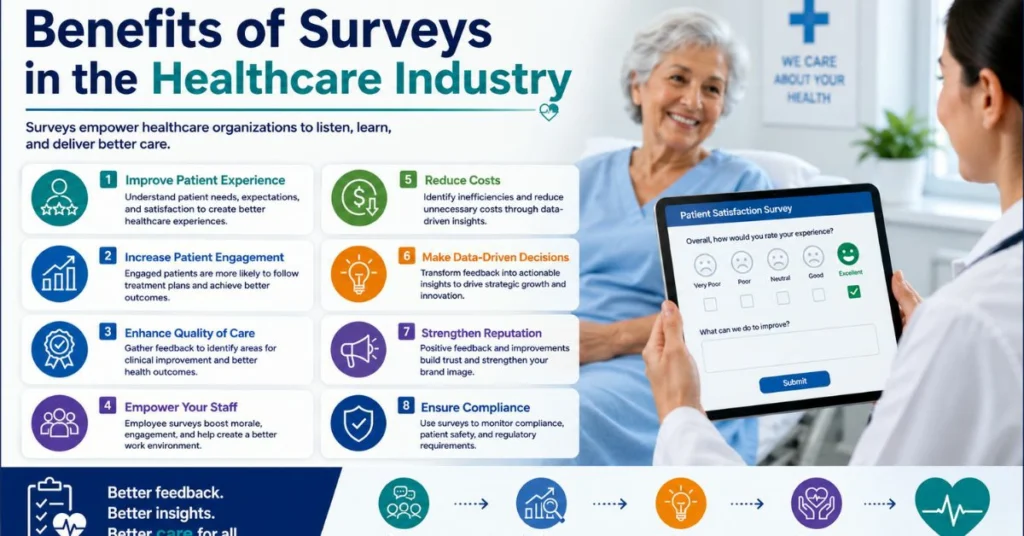
Benefits of Surveys in the Healthcare Industry extend beyond collecting opinions, helping healthcare organizations improve patient experiences, streamline operations, and make informed decisions based on real-world feedback. Surveys provide valuable insights from patients, healthcare professionals, and staff, enabling organizations to identify service gaps, enhance care quality, and strengthen overall performance. As data-driven decision-making becomes increasingly important, healthcare providers rely on surveys to measure satisfaction, outcomes, and organizational effectiveness.
Physicians Email Lists also support healthcare marketers by connecting them with physicians and key decision-makers for targeted communication and engagement. This article explores the importance of healthcare surveys, the different types organizations use, and how survey insights drive better patient care, operational efficiency, and long-term success.
Why Surveys Have Become Essential in Healthcare
A generation ago, healthcare quality was measured mostly through clinical outcomes: recovery rates, readmission numbers, mortality statistics. These numbers still matter enormously, but they only tell part of the story. They don’t explain why a patient felt confused during discharge, why a caregiver didn’t follow up on a prescribed treatment plan, or why staff turnover is climbing at a particular clinic.
Surveys fill that gap. They give a voice to the people experiencing the healthcare system firsthand, and they do it in a structured, measurable way. Instead of relying on anecdotes or assumptions, healthcare leaders can point to real data showing exactly where the experience is falling short — and where it’s succeeding.
This shift toward experience-driven measurement has been accelerated by value-based care models, where reimbursement is increasingly tied to patient satisfaction scores and quality metrics. Surveys are no longer a “nice to have” add-on; they are often a contractual and financial necessity.
The Core Benefits of Surveys in Healthcare
1. Improved Patient Satisfaction and Experience
Patient satisfaction surveys, such as those modeled on the CAHPS (Consumer Assessment of Healthcare Providers and Systems) framework, help organizations understand how patients perceive their care. Did they feel heard during their appointment? Was wait time reasonable? Did staff communicate clearly about next steps?
These questions might seem simple, but the answers drive real change. A hospital that discovers patients consistently rate “communication about medications” poorly can retrain staff on discharge counseling. A clinic that sees low scores around appointment scheduling can invest in better booking software. Without the survey, these problems often stay invisible until they show up as complaints, poor reviews, or patients switching providers altogether.
2. Better Clinical and Operational Decision-Making
Surveys don’t just measure feelings — they generate data that can be tracked over time, compared across departments, and benchmarked against industry standards. This turns subjective experience into an objective, trackable metric.
For example, a hospital system running quarterly employee engagement surveys might notice a steady decline in morale within its emergency department. That data can trigger a deeper investigation into staffing levels, shift patterns, or resource shortages — issues that might otherwise go unaddressed until burnout leads to costly turnover.
3. Early Identification of Gaps in Care
Surveys are also a tool for catching problems before they escalate. A post-discharge survey that reveals a high number of patients don’t understand their medication instructions is an early warning sign for potential readmissions. A chronic disease management survey that shows patients skipping follow-up appointments points to barriers — transportation, cost, or scheduling — that can be addressed proactively.
This kind of early detection is far cheaper, both financially and in terms of patient outcomes, than dealing with the downstream consequences of a missed problem.
4. Supporting Research and Public Health Initiatives
Beyond individual hospitals and clinics, surveys play a foundational role in public health research. Large-scale health surveys — from national nutrition and lifestyle studies to regional disease-prevalence tracking — help researchers and policymakers understand population health trends. This data informs everything from vaccination campaigns to chronic disease prevention programs.
At a smaller scale, healthcare marketers and researchers often use targeted outreach, including curated Physicians Email Lists, to distribute clinical surveys to relevant specialists. This kind of targeted distribution ensures that survey responses come from qualified professionals whose input carries genuine clinical weight, rather than a general population that may not have relevant expertise.
5. Strengthening Communication Between Patients and Providers
Surveys create a structured feedback loop that might not otherwise exist. Many patients are hesitant to voice concerns directly to their doctor, either out of politeness, uncertainty, or simply not wanting to take up appointment time. A well-designed survey gives them a low-pressure channel to share honest feedback.
When healthcare organizations act visibly on that feedback — updating a website, adjusting appointment reminders, revising consent forms for clarity — it builds trust. Patients start to realize that their suggestions do, in fact, result in change, which motivates them to participate more truthfully in subsequent surveys.
6. Reducing Costs Through Preventive Insights
It’s often cheaper to prevent a problem than to fix one after the fact. Surveys that identify dissatisfaction, confusion, or unmet needs early allow healthcare organizations to intervene before those issues turn into formal complaints, malpractice claims, or patient attrition.
For instance, a survey revealing that patients frequently misunderstand billing statements can lead to a simple redesign of the billing document — a low-cost fix that prevents a much larger volume of confused phone calls, disputes, and delayed payments.
7. Enhancing Employee Engagement and Retention
Healthcare staff burnout has become one of the industry’s most pressing challenges. Regular staff surveys — covering workload, management support, safety concerns, and job satisfaction — give administrators a real-time pulse on workforce wellbeing. Addressing concerns identified through these surveys can directly reduce turnover, which is notoriously expensive to manage in clinical settings due to recruitment, onboarding, and training costs.
Types of Healthcare Surveys and What They Measure
Different survey types serve different purposes, and choosing the right one depends on what an organization is trying to learn. The table below compares some of the most common survey types used across the healthcare industry.
| Survey Type | Primary Audience | What It Measures | Typical Frequency |
| Patient Satisfaction Survey | Patients post-visit | Experience, communication, wait times | After each visit or quarterly |
| Employee Engagement Survey | Clinical & administrative staff | Morale, workload, job satisfaction | Quarterly or annually |
| Clinical Research Survey | Physicians & specialists | Treatment outcomes, professional opinions | Study-dependent |
| Public Health Survey | General population | Lifestyle, disease prevalence, health behaviors | Annually or per-study |
| Post-Discharge Survey | Recently discharged patients | Recovery, medication understanding, follow-up care | Within 1–2 weeks post-discharge |
| Health Plan / Payer Survey | Insured members | Coverage satisfaction, claims experience | Annually |
Each of these formats requires a different distribution strategy, question design, and analysis approach — which is why many healthcare organizations rely on segmented contact data to reach the right respondents efficiently.
Best Practices for Designing Effective Healthcare Surveys
Not all surveys generate useful data. Poorly designed ones can produce misleading results or suffer from low response rates. A few best practices consistently separate effective healthcare surveys from ineffective ones:
Keep it short. Surveys longer than 10–15 questions see response rates drop sharply, especially among busy clinicians and patients managing health concerns.
Use plain, neutral language. Leading or emotionally charged questions bias results. Neutral phrasing produces more reliable, actionable data.
Mix question types. Combining rating scales with a few open-ended questions captures both measurable trends and qualitative context that numbers alone can’t explain.
Time distribution carefully. A patient satisfaction survey sent immediately after discharge captures fresher impressions than one sent weeks later.
Segment your audience. Sending a clinical research survey to the general public produces noise, not insight. Reaching qualified professionals — using verified contact channels — ensures responses are meaningful.
Close the loop. Sharing survey results and resulting changes with respondents, whether patients or staff, significantly improves future participation rates.
Common Challenges in Healthcare Surveying
Despite their value, healthcare surveys come with real challenges. Response fatigue is common, particularly among patients who receive multiple surveys after every visit, procedure, or interaction. Low response rates can skew results toward only the most satisfied or most frustrated respondents, missing the broader middle ground.
There are also privacy considerations. Healthcare surveys often touch on sensitive personal information, so organizations must ensure compliance with regulations like HIPAA when collecting, storing, and analyzing responses. Anonymizing data where possible and being transparent about how information will be used helps maintain trust and improves honest participation.
Finally, reaching the right respondents can itself be a logistical hurdle. General population surveys are relatively easy to distribute, but studies aimed at specific medical specialists or subgroups require more precise targeting to avoid wasted outreach and low-quality responses.
Another underappreciated challenge is survey design bias. Even well-intentioned teams can accidentally write questions that nudge respondents toward a particular answer, or structure rating scales in ways that make results difficult to compare over time. Periodically reviewing survey instruments with a fresh set of eyes — or piloting them with a small group before full distribution — helps catch these issues before they affect an entire dataset.
Data fragmentation is a further obstacle. Many healthcare organizations run patient satisfaction surveys through one platform, employee engagement surveys through another, and clinical research surveys through a third, with little integration between them. This makes it harder to spot connections — for example, a correlation between staff burnout scores and declining patient satisfaction in the same department. Centralizing survey data, even at a basic reporting level, often uncovers insights that siloed systems miss entirely.
How Survey Data Translates Into Real-World Improvements
It’s worth pausing on what actually happens after a survey closes, because this is where much of the value either gets realized or lost. Collecting responses is only the first step; the organizations that benefit most are the ones with a clear process for turning results into action.
This typically involves a few consistent steps: aggregating results into digestible reports, identifying the two or three highest-impact issues rather than trying to fix everything at once, assigning clear ownership for follow-up actions, and setting a timeline to re-survey and measure whether the change actually worked. Without this loop, survey programs tend to stall — teams collect data quarter after quarter without meaningfully acting on it, which eventually erodes participation as patients and staff sense their feedback isn’t leading anywhere.
Some of the most effective healthcare organizations also share high-level survey results publicly or with their care teams. A clinic that posts “you told us wait times were too long — we’ve added two additional appointment slots per day” demonstrates that feedback has real consequences. This transparency tends to have a compounding effect: response rates improve, feedback becomes more candid, and trust between patients and providers strengthens over time.
The Growing Role of Digital and Targeted Survey Distribution
As healthcare shifts increasingly toward digital communication, survey distribution methods have evolved too. Paper surveys handed out in waiting rooms have largely given way to email, text-based, and app-based surveys that are faster to distribute and easier to analyze.
For research-focused surveys aimed at clinicians, digital distribution through verified professional contact databases has become the standard. Reaching a defined, accurate set of specialists — rather than a broad, unfiltered audience — improves both response quality and statistical reliability. This is particularly relevant for pharmaceutical research, medical device feedback studies, and continuing education needs assessments, where responses from unqualified participants would undermine the study’s validity.
Looking Ahead: Surveys as a Continuous Feedback System
The healthcare organizations getting the most value from surveys aren’t treating them as occasional check-ins. They’re building continuous feedback loops — short, frequent surveys tied to specific touchpoints (after a visit, after a billing interaction, after a telehealth call) rather than long annual questionnaires. This “always-on” approach produces a steadier stream of actionable data and helps organizations spot emerging issues faster.
Artificial intelligence and natural language processing are also starting to play a role, particularly in analyzing open-ended responses at scale. Instead of manually reading thousands of comment fields, healthcare analytics teams can now surface themes and sentiment trends automatically, making it easier to act on qualitative feedback that used to be too time-consuming to review thoroughly.
Conclusion
Surveys have quietly become one of the most practical tools in modern healthcare — helping organizations understand patient experience, catch problems early, support clinical research, and keep staff engaged. Their value comes not from complexity, but from consistency: asking the right questions, to the right people, at the right time, and actually acting on what the answers reveal.
For healthcare organizations conducting clinician-focused research or professional outreach, the accuracy of who receives a survey matters just as much as the questions themselves. A well-maintained Physician Mailing List helps ensure that clinical surveys reach genuinely relevant professionals, producing cleaner data and more meaningful results. As healthcare continues to lean on data-driven decision-making, surveys — paired with accurate, targeted outreach — will remain a foundational part of how the industry listens, learns, and improves.