Skip to main content

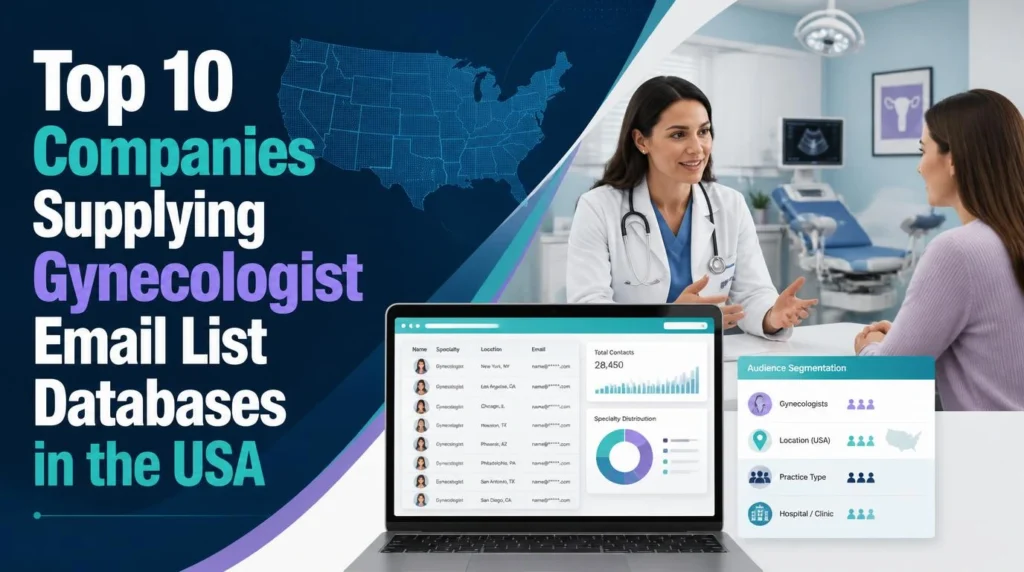
A reliable Gynecologists Email List can help healthcare marketers, medical recruiters, pharmaceutical companies, medical device manufacturers, and healthcare technology providers connect with relevant professionals across the United States. However, choosing a supplier requires more than comparing database sizes or prices. Buyers should evaluate contact accuracy, specialty coverage, targeting options, privacy practices, and data-refresh policies.
Gynecologists are important audiences for organizations promoting women’s healthcare products, clinical technologies, medical education, practice-management solutions, and professional services. A well-targeted contact database can support business-to-business outreach when campaigns are relevant, transparent, and compliant with applicable regulations.
This guide reviews 10 companies and platforms worth considering when researching gynecologist email databases in the USA. The list is a starting point for vendor evaluation, not a verified ranking of database quality. Product availability, specialty coverage, and verification methods should be confirmed directly with each provider before purchasing.
Why Businesses Use Gynecologist Email Databases
Gynecologists and obstetrician-gynecologists (OB-GYNs) work in private practices, hospitals, medical groups, academic institutions, and women’s healthcare centers. Organizations serving these professionals may need to reach specific audiences instead of sending broad campaigns to unrelated healthcare contacts.
Common business applications include:
- Pharmaceutical marketing: Sharing relevant product information and professional educational resources.
- Medical device promotion: Introducing diagnostic equipment, clinical tools, and women’s health technologies.
- Healthcare recruitment: Connecting qualified professionals with suitable career opportunities.
- Medical software sales: Promoting electronic health records, scheduling systems, billing solutions, and practice-management tools.
- Continuing medical education: Informing professionals about relevant conferences, webinars, and educational programs.
- Healthcare market research: Recruiting appropriate participants for legitimate professional surveys and research invitations.
A purchased database does not automatically guarantee engagement, deliverability, or commercial results. Campaign performance depends on data quality, audience relevance, messaging, and compliance.
Top 10 Companies Supplying Gynecologist Email List Databases in the USA
The following companies offer business contact data, healthcare professional databases, prospecting tools, or specialized mailing-list services that may be useful for reaching gynecologists. Their capabilities differ, so buyers should confirm whether each provider can supply the required US gynecologist or OB-GYN segment.
1. Medstream Data
Medstream Data focuses on healthcare professional contact databases, including specialty-oriented audiences for business-to-business marketing. Its healthcare list offerings make it a potential starting point for organizations seeking targeted professional contacts.
Businesses considering Medstream Data can inquire about a gynecologist-specific segment, the distinction between gynecologists and broader physician records, and the availability of business email addresses.
Potential use cases:
- Women’s healthcare product marketing
- Medical technology prospecting
- Healthcare recruitment campaigns
- Outreach to relevant medical practices and professionals
What to verify: Ask for the available number of US gynecologist records, sample fields, validation procedures, last verification date, geographic coverage, and options for requesting a sample. Confirm pricing and delivery formats before placing an order.
2. Definitive Healthcare
Definitive Healthcare provides healthcare commercial intelligence and data solutions used by organizations that need to understand healthcare providers, organizations, and markets. Its offerings are relevant to companies researching physician populations and planning healthcare sales strategies.
For businesses targeting gynecology practices, the platform may be useful for identifying relevant providers and understanding the healthcare organizations with which they are associated. Buyers should distinguish between provider intelligence and a purchasable list of verified email addresses.
Potential use cases:
- Healthcare territory planning
- Provider and organization research
- Medical sales prospecting
- Market segmentation
What to verify: Confirm whether the specific subscription or data service includes exportable business email addresses for US gynecologists, what usage restrictions apply, and whether the solution fits the intended campaign.
3. IQVIA
IQVIA provides healthcare data, analytics, technology, and research services. Pharmaceutical, biotechnology, and medical technology companies may consider its solutions when they need healthcare professional intelligence to support commercial planning and related business activities.
IQVIA is particularly relevant to organizations with specialized healthcare data requirements. However, not every healthcare data product is designed to provide a conventional email mailing list.
Potential use cases:
- Pharmaceutical commercial planning
- Healthcare market analysis
- Professional audience segmentation
- Data-supported sales strategy
What to verify: Ask whether an appropriate US gynecologist contact-data solution is available, whether email fields are included, and what permissions govern marketing use.
4. Doximity
Doximity is a professional network and digital platform for medical professionals. It can be relevant to organizations exploring physician-focused professional engagement and healthcare advertising opportunities.
Its role differs from that of a conventional email database vendor. Businesses should investigate its available advertising and professional engagement options rather than assume that individual physician email records are available for bulk purchase.
Potential use cases:
- Physician-focused advertising
- Professional healthcare engagement
- Specialty-oriented campaign planning
- Medical audience development
What to verify: Review the available advertising formats, targeting capabilities, campaign requirements, and whether the platform supports the intended commercial objective.
5. WebMD
WebMD operates healthcare information and professional-oriented digital properties. Depending on the product and audience, its business solutions may be relevant to organizations seeking to reach medical professionals through healthcare-focused media.
For a company marketing women’s healthcare products or services, a professional media campaign may provide an alternative to purchasing contact records.
Potential use cases:
- Healthcare professional advertising
- Medical product awareness
- Professional education campaigns
- Specialty-relevant content promotion
What to verify: Determine whether current offerings include physician-targeted advertising suitable for gynecologists, what audience targeting is available, and how campaign performance is measured.
6. Sermo
Sermo is a physician-focused online community and healthcare insights platform. It may be useful to organizations that need to understand physician perspectives or engage medical professionals through structured research and professional channels.
Its research-oriented services should not be confused with a standard downloadable gynecologist email list. Companies should assess whether a research, survey, or engagement solution better matches their goals.
Potential use cases:
- Physician surveys
- Healthcare market research
- Professional insights
- Medical product research
What to verify: Ask about gynecology-specific audience availability, research eligibility, recruitment methods, and permitted uses of any resulting contact information.
7. IQVIA OneKey
OneKey is associated with IQVIA’s healthcare professional and organization reference-data capabilities. It may be worth investigating for companies seeking structured healthcare professional records and information that supports customer relationship management or commercial operations.
Because product names, availability, and licensing arrangements can change, prospective buyers should confirm the current OneKey offering with IQVIA.
Potential use cases:
- Healthcare professional identification
- CRM data enrichment
- Medical sales operations
- Healthcare organization mapping
What to verify: Confirm US coverage, gynecologist specialty classification, email-field availability, data licensing, and whether the intended use is supported by the applicable contract.
8. ZoomInfo
ZoomInfo offers B2B business intelligence and sales prospecting solutions. Its platform is commonly associated with company, professional, and business contact research.
For medical industry sales teams, it may help identify relevant business contacts at healthcare organizations. However, individual physician coverage can differ from coverage of administrators, procurement teams, practice managers, and other business professionals.
Potential use cases:
- Prospecting healthcare organizations
- Finding practice administrators and decision-makers
- Sales intelligence
- CRM enrichment
What to verify: Check the actual number of relevant gynecologist contacts, the proportion with usable business emails, specialty filters, export permissions, and applicable outreach restrictions.
9. Apollo.io
Apollo.io is a B2B prospecting and sales engagement platform offering contact discovery and outreach-related capabilities. It can be considered by smaller teams that want to research prospects and manage business development activities in one environment.
Its usefulness for gynecologist targeting depends on the depth and accuracy of its healthcare professional coverage. A general contact database should not automatically be treated as a specialist medical directory.
Potential use cases:
- B2B prospect discovery
- Sales pipeline development
- Contact research
- Outreach workflow management
What to verify: Test the platform’s specialty and industry filters, validate sample records, and determine whether the available contacts are appropriate for the intended US physician campaign.
10. Data Axle
Data Axle provides business data, audience information, and marketing solutions. Organizations seeking business contact research and targeted prospecting may consider its services as part of a broader data acquisition strategy.
For gynecologist campaigns, the key question is whether the specific product provides reliable physician-level professional contact information rather than only practice-level or general business records.
Potential use cases:
- Business audience research
- Market segmentation
- Business contact discovery
- Targeted marketing planning
What to verify: Ask about healthcare professional coverage, specialty-level selection, professional email availability, record freshness, and permitted marketing uses.
Comparison Table: Gynecologist Email List Providers
The table below summarizes each provider’s general positioning. It does not imply that every company sells downloadable gynecologist email databases.
| Company | Primary focus | Best-fit evaluation |
| Medstream Data | Healthcare professional contact lists | Specialty-specific email list requests |
| Definitive Healthcare | Healthcare commercial intelligence | Provider and organization research |
| IQVIA | Healthcare data and analytics | Enterprise healthcare data requirements |
| Doximity | Physician network and digital engagement | Physician-focused advertising |
| WebMD | Healthcare media and professional engagement | Medical audience campaigns |
| Sermo | Physician community and insights | Surveys and professional research |
| IQVIA OneKey | Healthcare professional reference data | Structured provider records |
| ZoomInfo | B2B contact intelligence | Healthcare company prospecting |
| Apollo.io | B2B prospecting and sales engagement | Contact discovery and workflows |
| Data Axle | Business data and marketing solutions | Business audience research |
Important: These are differences in general product focus, not independently verified rankings of gynecologist email-list quality. Confirm current offerings and pricing with the relevant provider.
How to Choose the Right Gynecologist Email List Provider
Comparing vendors becomes easier when businesses establish clear selection criteria before requesting a quote. The most suitable provider depends on the campaign’s objective, the number of contacts required, and the type of healthcare professional being targeted.
1. Confirm Specialty-Level Coverage
A gynecologist database should distinguish between general physicians, obstetricians, gynecologists, and OB-GYNs where those classifications are available. These categories overlap in practice, but they are not interchangeable for every campaign.
Ask vendors whether they can segment records by:
- Medical specialty and subspecialty
- State, city, or ZIP code
- Hospital, clinic, or private practice
- Professional role and practice type
- Relevant healthcare organization
For example, a medical device company launching a women’s health product may need OB-GYNs working in particular clinical settings rather than a general physician audience.
2. Evaluate Email Accuracy and Data Freshness
Outdated addresses, duplicate records, and incorrect professional classifications can reduce campaign efficiency. Request a sample containing representative records and ask the supplier to explain its validation process.
Useful questions include:
- When were the records last updated?
- Are emails checked using technical validation or other verification methods?
- Are professional and personal email addresses distinguished?
- Does the provider report invalid or undeliverable addresses?
- Is there a replacement or credit policy for inaccurate records?
Avoid relying on a vendor’s headline accuracy percentage without understanding its definition, testing method, and measurement date.
3. Review the Available Data Fields
The number of contacts alone does not determine the value of a database. Additional fields can help sales and marketing teams segment prospects and personalize relevant communications.
Potential fields include professional name, specialty, practice name, business email, office location, professional identifiers, and institutional affiliation. Not every provider offers every field, and some information may be subject to licensing restrictions.
4. Compare Pricing and Licensing
Database costs may depend on contact volume, selected specialties, geographic coverage, data fields, access duration, or integration requirements. Some services charge for individual data exports, while others offer subscriptions, APIs, or customized datasets.
Request an itemized quote and clarify whether the license allows CRM imports, repeated campaigns, use by multiple team members, and data sharing with contractors. A lower initial price may not represent the best value if the records require extensive cleaning or cannot be used for the intended purpose.
5. Check Customer Support and Sample Availability
A supplier that answers technical questions clearly can make evaluation easier. Ask whether it offers a sample, documentation explaining its fields, guidance on segmentation, and assistance with data integration.
Samples should be representative of the proposed delivery, rather than a specially selected set that may not reflect the full database. Compare a sample against independent, legitimate business records where possible.
Gynecologist Email Lists vs. Physician Advertising Platforms
A contact database is not the only way to reach medical professionals. Depending on the campaign, a professional advertising platform or research service may be more suitable.
For example, IQVIA offers healthcare professional and organization reference-data solutions, including specialty information and provider records. WebMD and Medscape offer professional advertising opportunities, while Sermo provides physician insights and research services.
These solutions serve different purposes. Buyers should establish whether they need contact records for an authorized outreach program, advertising exposure within a professional network, or participation in market research.
A prospecting platform such as Apollo.io may also be worth testing for B2B contact discovery, but its healthcare specialty coverage should be validated before it is selected for a gynecologist-specific campaign.
Compliance Considerations for Healthcare Email Marketing
Purchasing a contact database does not automatically authorize every form of email marketing. Businesses should review applicable laws, platform policies, contractual restrictions, and the recipient’s location before launching campaigns.
In the United States, the CAN-SPAM Act establishes requirements for commercial email, including accurate header information, non-deceptive subject lines, identification of advertising where required, a valid physical postal address, and a functioning opt-out mechanism. Opt-out requests must be honored within the statutory timeframe.
Healthcare-related marketing also requires careful handling of sensitive information. A professional contact database should not be treated as permission to collect, infer, or distribute patient health information. Organizations should follow applicable privacy and security requirements and avoid placing sensitive medical details into marketing lists.
Before sending a campaign, businesses should:
- Document the source of the contact records and the applicable license.
- Confirm that the intended use is permitted by the provider’s terms.
- Use accurate sender information and relevant subject lines.
- Provide a clear, working unsubscribe option.
- Maintain suppression lists and honor opt-out requests.
- Review applicable federal and state requirements with qualified counsel when necessary.
For further guidance, consult the US Federal Trade Commission’s official CAN-SPAM resources.
Frequently Asked Questions About Gynecologist Email Databases
1. What Is a Gynecologist Email List?
A gynecologist email list is a collection of professional contact records associated with gynecologists and, depending on the provider, obstetrician-gynecologists. Records may include business email addresses, names, practice details, specialties, and geographic information. The exact fields, coverage, and permitted uses vary by supplier.
2. Who Benefits From Purchasing a Gynecologist Database?
Pharmaceutical companies, medical device manufacturers, healthcare software providers, medical recruiters, and professional education organizations may benefit from relevant physician contact data. The database should match the intended audience and support a lawful, clearly defined outreach purpose.
3. Can I Request a Sample Before Buying?
Some vendors provide sample records or product demonstrations, while others require a consultation or subscription. Ask for a representative sample, the available data fields, and the method used to validate email addresses before making a purchasing decision.
4. How Often Should a Gynecologist Database Be Updated?
There is no single update schedule suitable for every database. Contact information can change when physicians move practices, change affiliations, or update their professional details. Ask the provider how frequently records are reviewed and how it handles outdated or undeliverable addresses.
5. What Is the Difference Between a Gynecologist List and an OB-GYN List?
The terms are closely related, but specialty classifications may differ among data providers. Some records identify gynecologists specifically, while others combine obstetrics and gynecology into an OB-GYN category. Confirm the classification rules when the distinction matters to your campaign.
6. How Much Does a Gynecologist Email Database Cost?
Pricing depends on record volume, geographic targeting, included fields, validation services, licensing, and delivery format. Request quotes from several suppliers and compare the total cost of usable records rather than the advertised database size alone.
7. Are Free Gynecologist Email Lists Reliable?
Free lists may contain incomplete, outdated, or poorly classified records. They may also have restrictions on reuse. Evaluate the source, verify contact information appropriately, and confirm that your intended use is permitted before importing records into a marketing system.
8. Can I Use These Lists for Pharmaceutical Marketing?
Potentially, provided the data license and applicable laws permit the intended activity. Pharmaceutical marketing also requires appropriate review of product claims, audience suitability, and relevant industry requirements. Buying a list does not replace these obligations.
9. Should I Choose a Contact Database or an Advertising Platform?
Choose a contact database when you need authorized access to professional records for a suitable outreach workflow. Consider advertising platforms when your goal is to reach a medical audience through an established professional channel. Compare audience targeting, cost, measurement, and permitted uses before deciding.
10. What Should I Check Before Placing an Order?
Confirm specialty coverage, sample quality, email validation, data freshness, pricing, licensing, delivery format, privacy practices, and customer support. Also ask about duplicate records, replacement policies, and whether the supplier can meet your geographic and professional targeting requirements.
Conclusion
Selecting a suitable gynecologist contact database requires careful evaluation of data quality, specialty coverage, pricing, and permitted marketing uses. Medstream Data, IQVIA, and other healthcare data or professional engagement providers offer different approaches to reaching medical audiences. The best option depends on whether your organization needs downloadable business contacts, healthcare reference data, advertising opportunities, or physician research services.
Before committing to a supplier, request a sample, compare relevant records, and confirm the provider’s current capabilities and licensing terms. A smaller, well-matched audience can be more useful than a large database with limited specialty relevance or outdated information.
For organizations evaluating a Gynecologists mailing List, the priority should be reliable professional data, appropriate audience segmentation, responsible outreach, and measurable campaign objectives. These factors provide a more practical basis for choosing a vendor than database size or promotional claims alone.