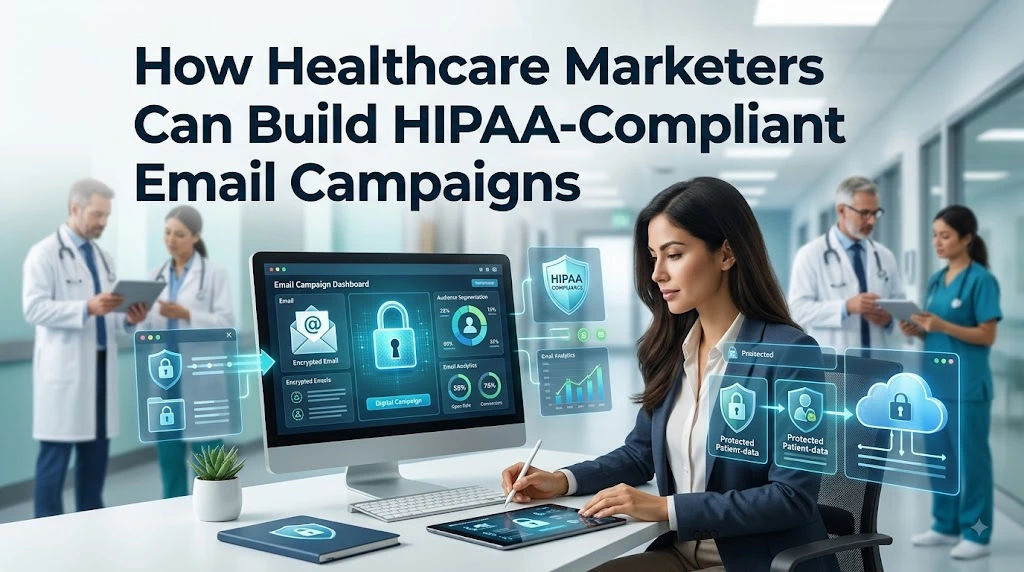
HIPAA-Compliant email marketing is essential for healthcare organizations that use email to communicate with patients, share educational resources, announce services, or maintain professional relationships. Because healthcare communications can involve sensitive information, marketers need to consider privacy requirements before launching campaigns and ensure that messages are handled through appropriate processes and systems.
A Medical and Healthcare Facilities Email List can help healthcare marketers identify relevant organizations and verified professional contacts for targeted business communication. This guide explains the key HIPAA considerations surrounding email marketing, highlights common compliance risks, and outlines practical approaches for creating campaigns that balance audience engagement, data privacy, and regulatory requirements.
Why HIPAA Matters for Email Marketing
The Health Insurance Portability and Accountability Act (HIPAA) exists to protect patients’ health information, and it applies to “covered entities” — healthcare providers, health plans, and healthcare clearinghouses — as well as their “business associates,” which includes many marketing vendors and platforms that touch patient data on a covered entity’s behalf.
Most day-to-day marketing emails, like a general wellness newsletter sent to a broad subscriber list, don’t automatically fall under HIPAA’s strictest rules. But the moment a message uses or references Protected Health Information (PHI) — a patient’s diagnosis, treatment, appointment details, or any information tied to their identity and their care — different rules kick in. Promotional messages intended to persuade individuals to buy or use a product or service typically require the patient’s prior written authorization, although limited exceptions may apply to treatment communications, specific health plan activities, and low-value promotional items.
This distinction is the foundation of every HIPAA-compliant email strategy: understand whether your message touches PHI, and treat it accordingly.
It’s also worth noting that most marketing teams themselves are not “covered entities” under HIPAA. Instead, they typically act as business associates, or they work through vendors who take on that role. That distinction matters because it shapes who is legally responsible for what. A marketing agency handling a healthcare client’s patient list, for example, is generally expected to sign a Business Associate Agreement with that client, formally accepting responsibility for protecting any PHI it touches. Skipping that step doesn’t remove the risk — it just leaves both parties more exposed if something goes wrong.
Understanding PHI in Healthcare Marketing Emails
Protected Health Information isn’t limited to obvious things like lab results or diagnosis codes. In a marketing context, PHI can include:
- A patient’s name combined with any reference to a specific condition, treatment, or provider visit
- Appointment reminders that name a specific service line (for example, an oncology or behavioral health appointment)
- Prescription refill reminders tied to a specific medication
- Any list segment built around a health condition, such as “patients with diabetes” or “patients who had a recent procedure”
- Billing or insurance details connected to an individual’s care
By contrast, a general newsletter about seasonal flu shot availability sent to a broad, non-segmented list typically doesn’t require the same level of protection, because it isn’t tied to any specific individual’s health status. The safest approach is to assume that anything referencing a specific person’s health condition, treatment, or provider relationship is PHI until proven otherwise.
The Core Requirements for HIPAA-Compliant Email
There isn’t a single certification that makes an email platform “HIPAA compliant” — compliance is really a combination of technical safeguards, contractual agreements, and organizational practices working together. The key requirements can typically be grouped into several main categories.
1. A Signed Business Associate Agreement (BAA)
If any third-party platform — an email service provider, marketing automation tool, or CRM — will handle PHI on your behalf, that vendor must sign a Business Associate Agreement. A BAA is the legal document that puts the vendor on the hook for the same safeguards a covered entity is required to follow. Without a signed BAA, using a platform to send PHI-containing emails is a compliance violation regardless of how secure the underlying technology claims to be. Many widely used consumer-focused email marketing platforms do not provide Business Associate Agreements (BAAs), making them unsuitable for campaigns that involve protected health information (PHI).
2. Encryption in Transit and at Rest
PHI sent by email needs to be encrypted both while it’s traveling across the internet and while it’s stored on servers. Standard email is not encrypted by default in a way that meets HIPAA’s Security Rule, which is why healthcare-specific platforms build in features like inbox-level encryption, secure portals, or policy-based encryption triggers that automatically encrypt a message when it’s detected to contain sensitive content.
3. Role-Based Access Controls (RBAC)
Not everyone on a marketing team needs access to every patient record or list segment. Role-based access controls limit who inside an organization can view, edit, or export data that includes PHI, following what’s often called the “minimum necessary” standard — only give people access only to the information necessary to perform their specific job responsibilities.
4. Audit Logging
HIPAA-compliant systems need to track who accessed what data and when. Audit logs create a record that can be reviewed if there’s ever a question about how PHI was handled, and they’re often one of the first things investigators look for if a complaint is filed.
5. Data Loss Prevention (DLP) and Content Scanning
More advanced healthcare email platforms include tools that automatically scan outgoing messages for PHI and either block the send, flag it for review, or trigger encryption automatically. This adds a safety net for situations where a staff member accidentally includes sensitive information in a message that wasn’t meant to carry it.
6. Patient Authorization
For marketing messages that promote a product or service and reference PHI, a signed patient authorization is generally required before that information can be used. This is separate from a general consent to receive email communications — it specifically covers the use of health information for marketing purposes. Keeping clear records of when and how authorization was obtained protects the organization if a campaign is ever questioned.
Consent, Opt-In, and the CAN-SPAM Act
HIPAA isn’t the only regulation healthcare marketers need to think about. The CAN-SPAM Act, a federal law governing commercial email, applies on top of HIPAA and requires:
- A clear and accurate sender identity — no misleading “From” names or subject lines
- A functioning, easy-to-find unsubscribe link in every commercial email
- Honoring opt-out requests within 10 business days
- A valid physical postal address included in the email
Combining CAN-SPAM compliance with HIPAA’s PHI protections means healthcare marketers are effectively managing two overlapping sets of rules at once. A useful mental model: CAN-SPAM governs how you’re allowed to email people in general, while HIPAA governs what you’re allowed to say about their health once you do.
There’s also an important nuance around patient-initiated contact. If a patient reaches out to a provider by email first, HHS guidance generally allows the provider to assume that email is an acceptable communication channel for that patient, unless the patient says otherwise. That said, best practice is still to obtain clear, written consent before sending anything that references PHI, since assumptions can create disputes later.
Building a HIPAA-Compliant Email Campaign, Step by Step
Step 1: Classify Your Campaign
Before building anything, decide whether the campaign will touch PHI. A campaign promoting a new urgent care location to the general public is very different from a reminder email to patients who are due for a specific screening. Campaigns that fall into the second category need the full set of safeguards described above; general awareness campaigns may not.
Step 2: Choose the Right Platform
Select an email platform that offers a BAA and has clearly documented HIPAA safeguards — not just a vague claim of being “secure.” Ask vendors directly about encryption methods, access controls, audit logging, and how they handle Sensitive Data Functionality. If a platform can’t produce a BAA or clear documentation, it isn’t a safe choice for PHI-containing campaigns, regardless of its marketing features.
Step 3: Segment Lists Carefully
List segmentation is where a lot of unintentional HIPAA exposure happens. A list segmented by health condition (for example, “patients with a recent cardiology visit”) is itself a form of PHI, because it reveals something about each person’s health status just by their inclusion on the list. Store and manage these segments inside HIPAA-compliant systems, not in spreadsheets or general-purpose marketing tools that lack the required safeguards.
Step 4: Obtain and Document Authorization
For any campaign that will use PHI for marketing purposes, collect a signed authorization before the campaign runs. Keep records of when authorization was given, what it covers, and how a patient can revoke it. This documentation becomes essential if a compliance question ever comes up.
Step 5: Write with Privacy in Mind
Even with the right technical safeguards in place, message content matters. Avoid restating sensitive details unnecessarily in a subject line or preview text, where they might be visible on a lock screen or in a shared inbox. A subject line like “Your upcoming appointment” is safer than one that names a specific condition or procedure.
Step 6: Test Encryption and Delivery
Before sending a live campaign, test how the email actually arrives. Some encryption methods require the recipient to log into a secure portal to read the message, while others deliver an encrypted message directly to the inbox. Understand which method your platform uses and make sure the experience is not so cumbersome that patients ignore or distrust the email.
Step 7: Monitor, Audit, and Update
HIPAA compliance isn’t a one-time setup. Review audit logs periodically, keep BAAs current as vendors update their services, and retrain staff regularly on what does and doesn’t count as PHI in a marketing context. Regulatory guidance and platform capabilities both evolve, so a campaign process that was compliant a year ago may need adjustments today.
It also helps to build a simple internal checklist that any new campaign has to pass before it launches: confirm whether PHI is involved, confirm the platform has a valid BAA, confirm encryption is active, confirm authorization is documented if required, and confirm the unsubscribe and sender information meet CAN-SPAM requirements. A short checklist like this turns a fairly complex set of legal requirements into a repeatable process that any marketing team member can follow, rather than something only a compliance specialist can evaluate.
Tracking, Analytics, and Privacy
Email marketing usually relies on tracking — open rates, click-throughs, conversion data — to measure performance and improve future campaigns. In a healthcare context, this data needs the same careful handling as the email content itself, because tracking behavior can reveal PHI just as easily as the message can.
Consider a campaign email that links to a page about a specific treatment option. If click data is tied to an identifiable patient, that combination (this person clicked this treatment-specific link) can itself become PHI, even if the original email didn’t reference the person’s actual diagnosis. A few practices help keep analytics useful without creating new privacy risk:
- Use aggregated reporting wherever possible. Look at overall open and click rates across a segment rather than tracking individual-level engagement tied to sensitive content.
- Route PHI-related actions to compliant systems. If a click leads to a form that could collect health information, send that traffic to a HIPAA-compliant landing page or patient portal rather than a general marketing analytics tool.
- Disable or redact sensitive tracking parameters. Some platforms allow individual identifiers to be stripped from URLs used in sensitive campaigns, reducing the chance that click data can be traced back to a specific patient outside a secure system.
- Separate marketing analytics tools from PHI-adjacent campaigns. General-purpose analytics platforms are usually not covered by a BAA, so any campaign that could generate PHI-linked engagement data should avoid piping that data into a non-compliant tool.
None of this means healthcare marketers have to fly blind. It simply means that measurement strategy needs to be designed with the same care as message content, particularly for any campaign tied to a specific health condition or treatment pathway.
Training Your Team
Technology and contracts only solve part of the compliance picture. Human error remains one of the most common causes of email-related privacy incidents, whether that’s an email sent to the wrong recipient, a list segment shared outside its intended system, or a well-meaning staff member including more detail in a message than the campaign actually required.
A practical training approach for marketing teams typically covers:
- What counts as PHI in a marketing context, using concrete, campaign-specific examples rather than abstract definitions
- How to recognize when a campaign needs elevated safeguards, such as encryption or patient authorization, before it goes out
- What to do if a mistake happens, including who to notify and how quickly, since fast internal reporting can significantly reduce the impact of an accidental disclosure
- How list segmentation and access controls actually work inside the tools the team uses, so staff aren’t relying on guesswork about what’s safe to export or share
Refresher training on a regular cadence — not just during onboarding — helps keep these practices current as platforms, regulations, and campaign types change over time.
Common Mistakes Healthcare Marketers Make
Using a general-purpose email platform for PHI-containing campaigns
Many popular marketing tools are excellent at automation and design but simply don’t offer the BAA and safeguards required for PHI. Teams sometimes discover this gap only after a campaign has already gone out, which is far riskier than checking a vendor’s compliance documentation up front.
Assuming a newsletter is automatically exempt
Broad wellness content is usually low-risk, but the moment a message is personalized around a specific diagnosis or treatment, it likely requires the full set of protections. Personalization features that feel harmless from a marketing standpoint, like inserting a patient’s most recent visit type, can quietly turn a low-risk newsletter into a PHI-containing message.
Skipping documentation of patient authorization
Verbal or implied consent isn’t a substitute for a documented authorization when PHI is used for marketing purposes. If a patient later disputes receiving a promotional message, a clear authorization record is often the only reliable evidence that consent was properly obtained.
Overlooking who inside the organization has list access
Without role-based access controls, too many people may be able to view sensitive segments, increasing the risk of an accidental disclosure. This is especially common in smaller organizations where marketing, front-desk, and administrative staff often share broad system access out of convenience.
Treating encryption as optional
Standard, unencrypted email is not sufficient for messages containing PHI, no matter how routine the message feels. A short appointment reminder can carry just as much exposure as a longer clinical message if it names a specific service or provider.
Forgetting CAN-SPAM basics
Even fully HIPAA-compliant campaigns can run into legal trouble if they’re missing a working unsubscribe link or accurate sender information. Compliance with one regulation doesn’t automatically cover the other, so both need to be checked independently before a campaign launches.
How This Fits into a Broader Healthcare Marketing Strategy
HIPAA compliance shouldn’t be treated as a separate checklist bolted onto marketing after the fact — it works best when it’s built into how a campaign is planned from the beginning. That starts with where contact data comes from. Reaching out to hospitals, clinics, and other provider organizations for business-to-business marketing is a different exercise than emailing individual patients, and it calls for its own accurate, well-maintained records. Many healthcare marketers rely on a properly vetted Medical and Healthcare Facilities Mailing List to reach administrators, decision-makers, and procurement contacts at provider organizations, separate from any patient-facing communications that require the PHI protections described above.
Keeping these two types of outreach clearly separated — patient communications governed by HIPAA, and business-to-business outreach to healthcare facilities — reduces confusion internally and lowers the chance that PHI safeguards get applied inconsistently or, worse, skipped where they’re actually needed.
Frequently Asked Questions
Does every healthcare email need to be HIPAA compliant?
No. General communications that don’t reference an individual’s specific health condition, treatment, or provider relationship typically fall outside HIPAA’s strictest requirements. The safeguards apply specifically when a message uses or discloses PHI.
Can I use a standard email marketing platform if I don’t include PHI?
In many cases, yes, for broad campaigns like general newsletters or service announcements. However, healthcare organizations often prefer to standardize on a single HIPAA-compliant platform to reduce the risk of PHI accidentally ending up in a non-compliant system.
What happens if a HIPAA-compliant email campaign is done incorrectly?
Violations can result in financial penalties, mandatory corrective action plans, and reputational damage. The severity typically depends on factors like whether the violation was willful, how quickly it was corrected, and how many individuals were affected.
Is patient consent the same as HIPAA authorization?
Not exactly. General consent to receive email communications is different from the specific authorization required to use PHI for marketing purposes. Healthcare organizations should track both separately.
Do marketing vendors need to be HIPAA certified?
There’s no single official “HIPAA certification,” but a vendor should be willing to sign a Business Associate Agreement and provide clear documentation of the security safeguards they have in place.
Can email tracking data itself violate HIPAA?
It can, if click or open data is tied to an identifiable patient in a way that reveals something about their health condition or treatment. This is why sensitive campaigns often need aggregated, rather than individual-level, analytics.
Is it safe to reuse a patient email list across multiple types of campaigns?
Only if every campaign using that list meets the same compliance standard as the most sensitive message it might contain. It’s often simpler and safer to keep PHI-related lists separate from general marketing lists so the two don’t get mixed by accident.
A Note on Legal Guidance
This article is intended as a general, practical overview and not as legal advice. HIPAA requirements can vary by situation, state law, and the specific type of covered entity or business associate involved. Healthcare marketing teams should work with qualified legal or compliance counsel before finalizing policies for handling PHI in email campaigns, particularly as regulatory guidance and platform capabilities continue to evolve.
Conclusion
HIPAA-Compliant email marketing comes down to a few consistent principles: know when a message touches PHI, use a platform willing to sign a Business Associate Agreement, apply encryption and access controls consistently, and document patient authorization before using health information for promotional purposes. None of this has to slow a marketing team down.
Organizations that get the most value from healthcare email marketing treat compliance as part of the strategy, not an obstacle to it, and build campaigns on accurate, properly sourced data from the start, whether that means patient records under strict PHI safeguards or a trustworthy Medical and Healthcare Facilities Mailing List used for outreach to provider organizations.